New Domain vs Aged Domain Placements: Does Site Age Matter
Aged domains usually carry more accumulated trust, but a genuinely active new site with real traffic can still be a smart placement.
Site age is one of those metrics buyers fixate on without always understanding why it matters. An aged domain has had more time to accumulate links, indexed content and search engine trust, but age alone does not guarantee quality, and a well-run new site can still be a perfectly good placement.
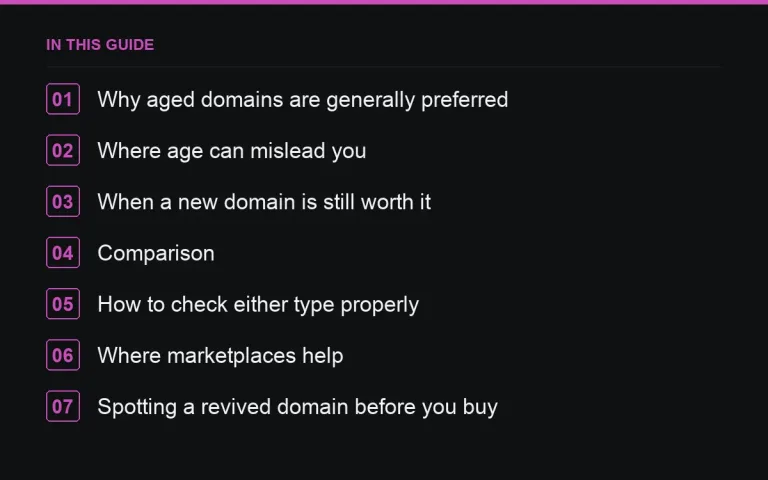
Why aged domains are generally preferred
A domain that has existed and been actively publishing for several years has had time to build a track record: consistent indexing, a stable backlink profile, and enough history for a search engine to have formed a confident view of its trustworthiness. All else equal, this makes an aged domain a safer bet, since there is more evidence to evaluate before you commit budget.
Where age can mislead you
Some genuinely aged domains sat dormant or nearly inactive for years before being revived purely to sell links, which is a pattern worth checking for specifically — a long registration history with a sudden, recent spike in publishing activity and outbound link volume is a warning sign, not a reassurance. Domain age by itself, without checking actual publishing history and traffic trend, tells you less than it appears to.
When a new domain is still worth it
A new site run by an experienced publisher, with real editorial standards, genuine traffic building month over month, and topical focus, can be a good placement even without years of history. Search engines evaluate a lot more than age: content quality, backlink profile, and user engagement all matter, and a new site doing everything right will often outperform an old site that has been coasting.
Comparison
| Factor | Aged domain | New domain |
|---|---|---|
| Track record | Established | Limited or none |
| Risk of revival-for-links pattern | Present, needs checking | Lower, but unproven |
| Typical price | Higher | Often lower |
| Best for | Lower-risk, established placements | Early support of promising publishers, lower cost |
How to check either type properly
- Look at publishing frequency over time, not just the total number of posts.
- Check whether traffic has grown steadily or spiked suddenly and inexplicably.
- Read a handful of recent articles for genuine editorial quality, not just word count.
- Check the site’s outbound link pattern for evidence it exists mainly to sell placements.
https://successtoroad.com/bulk-check/ and https://successtoroad.com/compare/ both help you run this kind of due diligence quickly across a shortlist rather than manually visiting each site.
Where marketplaces help
A marketplace that filters by traffic trend and publish history in addition to raw domain age, like https://successtoroad.com/marketplace/, reduces the chance you get fooled by a technically old but practically dormant-then-revived domain. Filter by niche, such as https://successtoroad.com/niche/technology/ or https://successtoroad.com/niche/startups/, and sort by these signals together rather than age alone.
Spotting a revived domain before you buy
The clearest tell of a domain that sat dormant before being repurposed for link sales is a long gap in its publishing history followed by a sudden burst of new content and outbound links. https://successtoroad.com/blog/what-is-an-expired-domain/ explains this specific pattern in more detail, including why some buyers deliberately seek out expired domains for reasons that have nothing to do with genuine publishing.
Checking link velocity as a secondary signal
A domain that suddenly starts adding outbound links at a much faster rate than its publishing history would suggest is worth extra scrutiny. https://successtoroad.com/blog/link-velocity/ covers how to think about pace both for your own site and, just as usefully, when judging whether a prospective publisher’s own link-selling activity looks sustainable or opportunistic.
A reasonable default for most buyers
If you have no strong reason to prefer one type over the other for a specific placement, favour genuinely active, real-traffic sites over raw domain age as the deciding factor. Age is a useful secondary signal once you have already confirmed the site is genuinely active and relevant, but it should rarely be the first filter you apply.
Ultimately, neither age nor youth is a shortcut that replaces genuine due diligence. Treat every prospective placement, regardless of how old or new the domain is, with the same basic checklist of traffic, content quality and publishing consistency, and you will avoid most of the mistakes that come from over-indexing on a single, easily gamed metric like registration date.
How pricing typically reflects this trade-off
In general, expect aged, well-established domains to command a premium over comparable new sites, since buyers are effectively paying for the reduced due-diligence burden as much as for any inherent ranking advantage. If a new site is priced only marginally lower despite lacking a track record, that is worth questioning, since the discount should meaningfully reflect the added uncertainty you are taking on.
Keeping this expectation in mind before you negotiate price will save you from either overpaying for age alone or underpaying for a new site that genuinely deserves a fair rate.
Where to go next
For a related risk-focused comparison, read https://successtoroad.com/blog/pbn-vs-real-sites/, and for how domain choice interacts with link concentration strategy, revisit https://successtoroad.com/blog/one-strong-link-vs-many-weak-links/.
Frequently asked questions
Is an older domain always more trustworthy?
No. A domain's age matters less than its consistent publishing history and real traffic. A dormant domain revived purely to sell links can be riskier than a genuinely active newer site.
How can I check if a domain was recently revived?
Look at historical publishing activity and traffic trends over time. A long gap followed by a sudden burst of new content and outbound links is a common sign of a domain being repurposed for link sales.
Are new domains cheaper to place links on?
Often yes, since they have not yet built the reputation or traffic that commands a premium price, though this varies by how quickly the site is growing and how relevant it is to your niche.
Should I completely avoid new sites for backlinks?
No, a genuinely well-run new site with real editorial standards and growing traffic can be a good placement, especially at a lower price point than established domains in the same niche.
Put it into practice
Filter 54,483 websites by DR, traffic, niche and price, and order with escrow — you pay only after the link is live.
Browse the marketplace