Checking Metrics for Non-English Sites: What Changes
The same tools work worldwide, but their coverage is not even, and non-English sites often need a different read.
Most major SEO metric providers built their keyword and link databases with heaviest coverage in English-language, US and UK-centric search results first. Coverage for other languages and markets has improved over time but often remains thinner, which means the same DR, DA, traffic and spam score numbers can be less reliable, in either direction, for non-English sites.
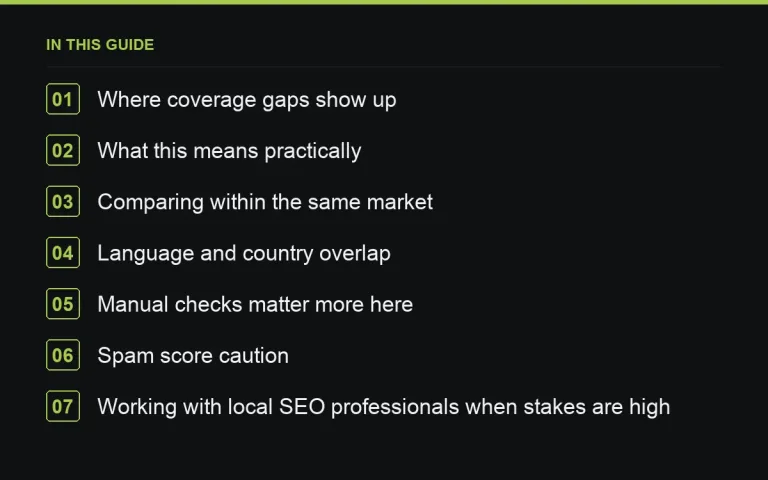
Where coverage gaps show up
- Traffic estimates — keyword databases for smaller-language markets are often less complete, which can understate a site’s real traffic even when it genuinely performs well in its local search results.
- Referring domain discovery — link crawlers may index a smaller share of the non-English web, understating true referring domain counts for sites in those markets.
- Spam score reliability — models trained mostly on English-language patterns can misclassify legitimate local practices as suspicious, or miss local manipulation patterns that do not resemble the training data.
What this means practically
A non-English site showing a modest traffic estimate or thin keyword count is not automatically weaker than it appears — the underlying tool may simply have less complete data for that market. Do not apply the same absolute thresholds you would use for an English-language site without adjusting for this; a lower bar, informed by comparing several sites within the same language market rather than against a global default, is usually more sensible.
Comparing within the same market
| Approach | Why it works better |
|---|---|
| Compare non-English sites against each other, same tool | Removes the absolute coverage gap, keeps relative comparison useful |
| Avoid comparing raw numbers across languages directly | A German site’s traffic estimate and an English site’s are not on equal footing |
| Weight manual review more heavily | Automated scores are less reliable, so direct inspection matters more |
Language and country overlap
Non-English sites are not automatically foreign to your target market — a site publishing in a given language can still draw meaningful traffic from a country relevant to your buyer, or the reverse. Check https://successtoroad.com/blog/traffic-by-country-for-placements/ alongside language, and use the marketplace’s language filters, such as https://successtoroad.com/language/german/ or https://successtoroad.com/language/french/, to build a shortlist within the right linguistic market before comparing metrics.
Manual checks matter more here
Because automated scores carry more uncertainty for these sites, the manual checks covered in https://successtoroad.com/blog/how-to-read-a-link-profile/ and https://successtoroad.com/blog/content-freshness-as-a-signal/ deserve relatively more weight in your overall assessment. Reading a sample of the actual content, even through translation if needed, tells you more about genuine quality than a metric built on incomplete underlying data.
Spam score caution
Be especially cautious about rejecting a non-English site purely on an elevated spam score without further review, since the model behind it may not distinguish well between genuine local publishing patterns and actual manipulation. Cross-check with the manual profile review in https://successtoroad.com/blog/how-to-read-a-link-profile/ before deciding, rather than trusting the automated flag alone.
Working with local SEO professionals when stakes are high
For a significant campaign specifically targeting a non-English market, it can be worth consulting someone with direct, native familiarity with that market’s search landscape rather than relying purely on English-language tool defaults. A local professional can often tell you quickly whether a given traffic or authority figure looks plausible for a site of that type in that specific market, filling in exactly the context that a global tool’s coverage gaps leave missing.
Translation as part of due diligence
Reading a sample of a non-English site’s actual content, even through machine translation, remains one of the more reliable checks available, since content quality, editorial standards, and genuine topical depth are usually still discernible even through an imperfect translation. This manual step deserves at least as much weight here as it does for English-language sites, arguably more, given the additional uncertainty around the automated metrics themselves.
Checking search engine market share by country
In some markets, a search engine other than the one most major SEO tools are optimised around holds a meaningfully larger share of search traffic. A site’s real visibility and traffic in such a market can be understated by tools built primarily around a single dominant search engine’s data, which is a further reason to weight manual, market-specific judgment more heavily for sites operating in these regions.
Building a trusted shortlist over time
Given the extra uncertainty involved, it can be worth building and maintaining your own trusted shortlist of non-English publishers you have personally vetted and worked with successfully, rather than re-evaluating an entirely fresh, unfamiliar list for every new campaign in that market. Over time, this personal track record becomes a more reliable guide than any single tool’s metrics for that specific language or region.
A final practical rule of thumb
When in doubt on a non-English prospect, lean toward the more conservative interpretation of an ambiguous metric rather than the more generous one, since the direction of most tool coverage gaps tends to understate rather than overstate a legitimate site’s true standing. This means a borderline non-English prospect deserves the benefit of manual review before rejection, more so than an equally borderline English-language site where the underlying data is generally more complete and trustworthy on its own.
Where to go next
This connects to the closely related case of https://successtoroad.com/blog/metrics-for-local-sites/, where geography rather than language is the main factor to adjust for. For the full metrics picture, see https://successtoroad.com/blog/seo-metrics-explained/. Browse relevant markets directly using the language filters in https://successtoroad.com/marketplace/.
Frequently asked questions
Should I use lower traffic thresholds for non-English sites?
It's often reasonable to adjust thresholds relative to other sites in the same language market rather than applying a single global standard, since underlying data coverage varies by market.
Is spam score less reliable for non-English sites?
It can be, since these models are often trained mostly on English-language patterns. Treat an elevated spam score on a non-English site as a prompt for manual review rather than an automatic rejection.
How do I compare two sites in different languages fairly?
Generally, avoid comparing raw metric numbers directly across languages; instead compare each site against others within its own language market, and rely more on manual quality checks across the board.
Does DR or DA account for language coverage gaps?
Not explicitly — both are built from whatever the provider's crawler has indexed, so thinner coverage in a given language market can understate a domain's true authority.
What is the most reliable check for a non-English site?
Manual review of actual content quality and recent publishing activity tends to be more reliable than automated scores alone, given the coverage gaps described above.
Put it into practice
Filter 54,483 websites by DR, traffic, niche and price, and order with escrow — you pay only after the link is live.
Browse the marketplace