Using Order Messaging to Talk Directly to Publishers
A short guide to using order messaging well, from pre-order questions to post-delivery clarifications.
Not every question needs to go through a formal revision request or wait for a status change. Order messaging lets you talk to the publisher directly, and using it at the right moments can prevent a misunderstanding from turning into a slower, more formal process later.
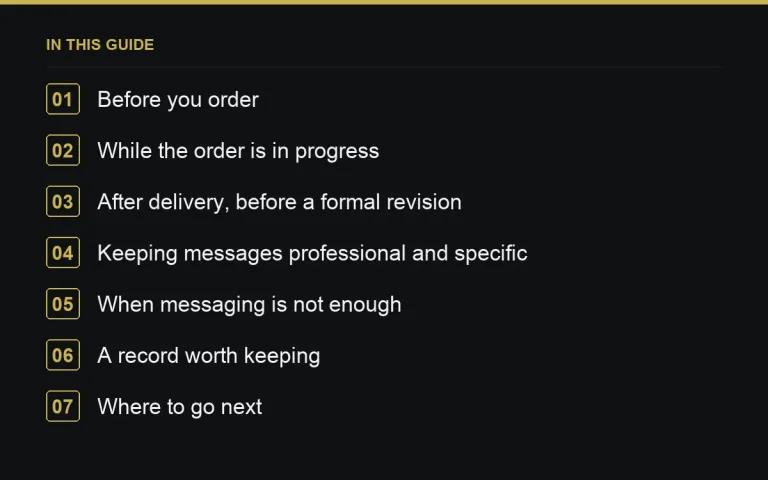
Before you order
If a listing page leaves something unclear — an ambiguous note on accepted topics, an uncertain turnaround estimate, or a question about whether a specific format is possible — message the publisher before placing the order rather than guessing. This is a normal use of messaging and generally the fastest way to avoid ordering something that will not fit.
While the order is in progress
Once an order is accepted, a short message is the right way to flag something you forgot in the brief, confirm a detail, or check progress if the order is sitting close to the stated turnaround without an update. Keep these messages specific and low-friction — a quick clarifying question, not a demand.
After delivery, before a formal revision
For something small enough that a formal revision request feels like overkill — a quick clarifying question about why something was worded a certain way, for instance — messaging can resolve it faster than the structured revision flow. Reserve the formal revision request, covered in https://successtoroad.com/blog/requesting-a-revision/, for anything that actually needs a change to the delivered content.
Good uses for messaging
- Clarifying a listing detail before ordering.
- Checking on progress near the stated turnaround.
- Flagging a small detail you forgot to include in the brief.
- Asking a quick question about a delivered draft before deciding whether to request a formal revision.
Keeping messages professional and specific
Publishers are managing multiple orders at once, so a message that states exactly what you need gets a faster, better response than a vague one. Treat it the same way you would treat the brief itself — specific and to the point.
When messaging is not enough
If a genuine issue is not being addressed through messages — the publisher goes quiet, or repeatedly does not act on a clear request — that is the point to move to a formal revision request or, if that also stalls, a dispute. See https://successtoroad.com/blog/requesting-a-revision/ and https://successtoroad.com/blog/opening-a-dispute/ for those next steps.
A record worth keeping
Messages tied to an order form a useful record if an issue does escalate later — a dispute reviewer benefits from seeing that you raised concerns clearly and gave the publisher a fair chance to respond before escalating.
Where to go next
For the full status lifecycle messaging supports, see https://successtoroad.com/blog/order-statuses-explained/, and for the complete process from filter to live link, read https://successtoroad.com/blog/how-to-use-digital-pr-marketplace/.
An example exchange worth having
A buyer unsure whether a https://successtoroad.com/niche/technology/ listing accepts comparison-style articles sends a short message asking directly before ordering, rather than guessing from a vague accepted-topics note. The publisher confirms it is fine, and the order proceeds with confidence instead of a nagging doubt about whether the brief will be rejected. This kind of quick check works the same way for any listing found through https://successtoroad.com/marketplace/.
A short, specific question nearly always gets a faster and more useful answer than a longer one covering several topics at once, so keep messages narrow when you can.
Setting reasonable expectations for response time
Publishers are typically managing several orders across different buyers at once, so a same-day response is a bonus rather than a guarantee. A day or two is a reasonable window before following up, and following up with a brief, polite nudge is entirely normal rather than something to feel awkward about.
If a publisher consistently responds slowly across more than one order, that is useful information worth factoring into whether you continue ordering from them, and it is fair to mention in a review afterward.
Building an ongoing relationship through messaging
Buyers who order repeatedly from the same handful of strong publishers often find that a bit of relationship-building through messaging, beyond the bare minimum needed to place an order, pays off over time in faster turnaround and more flexibility on brief adjustments. This is not necessary for a one-off order, but worth investing in for a publisher you expect to use regularly.
A short note of thanks after a particularly well-handled order costs nothing and tends to make future interactions with that same publisher smoother.
A final note on clarity
Whatever the message is about, stating the specific action you want the publisher to take, rather than only describing the problem, tends to get the fastest and clearest response.
None of this requires elaborate wording; a plain, courteous message stating exactly what you need almost always outperforms a longer, more hedged one, both in speed and clarity of response.
Over a long enough history with the platform, the buyers who message well and message often, without being excessive, tend to build the smoothest working relationships with the publishers they use repeatedly.
Frequently asked questions
Can I message a publisher before placing an order?
Yes, this is a normal use of messaging, particularly to clarify an ambiguous listing detail or confirm turnaround before you commit funds to an order.
Is messaging a substitute for a formal revision request?
For small clarifications, yes. For anything that actually requires a change to delivered content, use the formal revision request instead, since it is tracked as part of the order status.
What should I do if a publisher stops responding to messages?
Move to a formal revision request if one has not already been made, and if that also goes unanswered, consider opening a dispute rather than waiting indefinitely.
Are order messages kept as part of the order record?
Yes, and they can be useful if an issue later needs to be escalated, since they show what was raised and when a response was or was not given.
Put it into practice
Filter 54,483 websites by DR, traffic, niche and price, and order with escrow — you pay only after the link is live.
Browse the marketplace