A Monthly Workflow for an Agency Using the Marketplace
A repeatable monthly cycle covering prospecting, ordering, review and reporting for agency link-building work.

Ad hoc ordering works for a single campaign, but an agency running link-building for several clients month after month benefits from a repeatable cycle. This post lays out a practical monthly workflow that covers prospecting, ordering, monitoring and reporting.
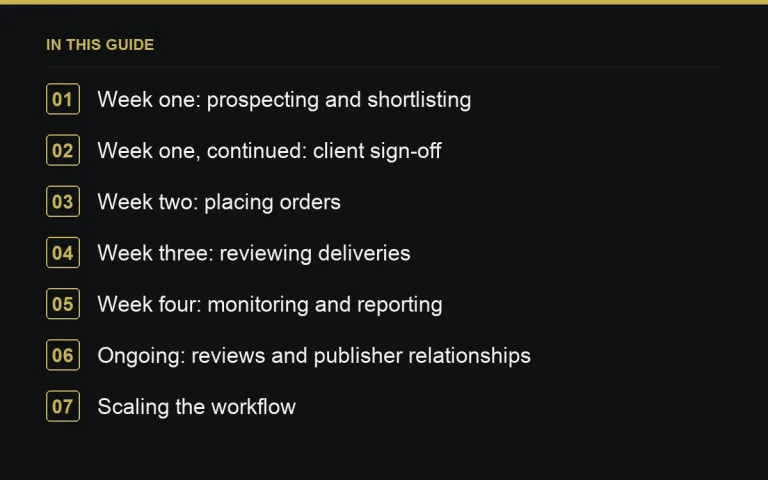
Week one: prospecting and shortlisting
Start the month by refreshing shortlists for each active client. Run saved searches for new inventory matching each client’s niche and budget — see https://successtoroad.com/blog/saved-searches-and-alerts/ — and, where you have an existing prospect list from outreach or competitor research, run it through https://successtoroad.com/bulk-check/ as covered in https://successtoroad.com/blog/bulk-domain-check-marketplace-guide/. Export the combined shortlist per client with https://successtoroad.com/blog/exporting-to-csv/.
Week one, continued: client sign-off
Share the exported shortlist with each client for approval before committing budget. This keeps clients in the loop on what specific sites their money is going toward and avoids surprises later.
Week two: placing orders
Once shortlists are approved, place orders with properly written briefs — see https://successtoroad.com/blog/writing-a-brief-in-the-order-form/ and https://successtoroad.com/blog/anchor-text-and-target-url-fields/ — using your client-specific brief templates. Decide per listing whether to supply your own content or let the publisher write it, following https://successtoroad.com/blog/content-you-write-vs-publisher-writes/.
A simple monthly cadence
| Week | Focus |
|---|---|
| 1 | Refresh shortlists, run bulk checks, get client sign-off |
| 2 | Place orders with client-specific briefs |
| 3 | Review deliveries, request revisions, approve completed orders |
| 4 | Check the link monitor, review reports, plan next month’s budget |
Week three: reviewing deliveries
As orders move through pending, accepted and delivered, check each one properly before approving — see https://successtoroad.com/blog/order-statuses-explained/. Use the revision process where a draft misses the brief rather than approving something that does not fit, following https://successtoroad.com/blog/requesting-a-revision/.
Week four: monitoring and reporting
Check the weekly link monitor for anything flagged on previously completed orders — see https://successtoroad.com/blog/weekly-link-monitor-and-lost-links/ — and address any lost links before they slip through the cracks. Compile a simple report per client covering what was ordered, what is live, and what is pending for the next cycle.
Ongoing: reviews and publisher relationships
Throughout the month, leave reviews on completed orders and note any publisher you would specifically use again or avoid — see https://successtoroad.com/blog/reviews-and-ratings/. Over several months this builds an internal shortlist of reliable publishers per niche that speeds up future prospecting.
Scaling the workflow
Once this cycle is running smoothly across a handful of clients, consider moving repetitive parts of it to the API — see https://successtoroad.com/blog/the-api-for-agencies/ — and keep budgets and history organised per client as covered in https://successtoroad.com/blog/managing-orders-for-multiple-clients/.
Where to go next
For the fundamentals this workflow is built on, read https://successtoroad.com/blog/how-to-use-digital-pr-marketplace/, and for the wallet planning that supports a monthly ordering cadence, see https://successtoroad.com/blog/the-wallet-and-adding-funds/.
An example month in practice
In week one, an agency refreshes shortlists for four clients spanning https://successtoroad.com/niche/startups/, https://successtoroad.com/niche/real-estate/ and two others, using saved searches and a bulk check against each client’s own prospect list. By week two, orders are placed against approved shortlists from https://successtoroad.com/marketplace/ with client-specific briefs. Week three brings two revision requests, both resolved within days, and week four’s monitor check turns up one lost link from a site redesign, fixed with a single message.
Running this same cycle for a few consecutive months is what turns a list of one-off orders into a genuine, repeatable process the whole team can rely on without reinventing it each time.
Adjusting the cycle for smaller teams
A solo consultant managing two or three clients does not need the full four-week structure described here; the same principles can be compressed into a shorter cycle, with prospecting, ordering and monitoring happening in quicker succession rather than dedicated separate weeks. The value of the workflow is in the sequence and discipline, not the specific calendar length.
As client count grows, the full monthly structure becomes more useful precisely because it prevents the kind of ad hoc, reactive ordering that gets harder to manage cleanly once several accounts are running at once.
A note on documenting the workflow itself
Write the cycle down somewhere the whole team can reference, so it survives a change in who is running client campaigns day to day rather than living only in one person’s head.
Reviewing the workflow itself each quarter
Beyond running the monthly cycle, set aside time each quarter to review whether the cycle itself still fits how the agency operates. Client count, niche mix and team size all change over time, and a workflow that fit well a year ago may need adjusting rather than being followed unchanged indefinitely.
A final word on consistency
The specific cycle matters less than running some version of it consistently; an imperfect process followed every month beats a perfect one that only gets applied occasionally.
Even a lightweight version of this cycle, tracked in a simple shared document, tends to outperform no structure at all, and it can always be refined further as the team and client roster grow.
Whatever shape the cycle takes for your own team, writing it down and revisiting it periodically is what turns good intentions into an actual, dependable process.
Frequently asked questions
Why structure this as a monthly cycle rather than ad hoc ordering?
A repeatable cycle keeps prospecting, client approval, ordering and reporting consistent across clients, and makes it easier to spot what worked or did not from one month to the next.
When should client sign-off happen in the cycle?
Early, right after shortlisting and before placing orders, so budget is only committed to sites the client has actually approved rather than after the fact.
What is the purpose of the week-four monitoring step?
It catches any links flagged by the weekly link monitor as lost or changed before they go unnoticed for another full month, and it feeds directly into client reporting.
At what point should an agency consider moving to the API?
Once the monthly cycle is running smoothly across enough clients that the manual, repetitive parts of it become a real time cost worth automating.
Put it into practice
Filter 54,483 websites by DR, traffic, niche and price, and order with escrow — you pay only after the link is live.
Browse the marketplace