Marketplace vs Freelancer: Buying Links Directly vs Hiring Help
A freelancer brings personal outreach skill and flexibility; a marketplace brings speed, transparency and no dependency on one person.
Between a full agency and doing everything yourself sits a middle option: hiring an individual freelancer to handle link building, versus buying placements directly through a marketplace. Both can be cost-effective. The right choice depends on whether you value a skilled outreach specialist’s judgment, or the speed and transparency of shopping directly from listed inventory.
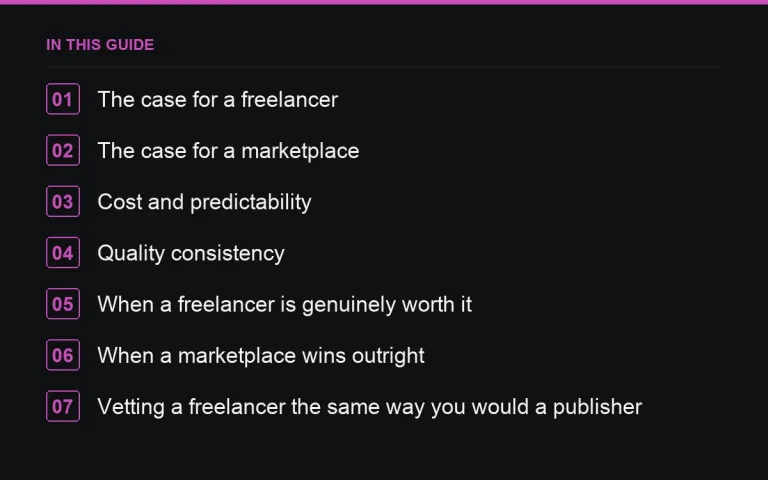
The case for a freelancer
A good freelance link builder brings relationships, writing skill, and the patience for cold outreach that produces links a marketplace will never list, because the publisher does not sell placements openly. Freelancers are usually cheaper than agencies and can be more flexible about scope, taking on a single small project or a long engagement. The risk is dependency on one person’s availability, and quality varies enormously between freelancers since there is no shared vetting standard.
The case for a marketplace
A marketplace removes the variability of an individual’s skill and relationships. Every listed site on https://successtoroad.com/marketplace/ shows its own metrics, so you are evaluating the publisher directly rather than trusting a middleman’s claims about who they know. You can also buy at whatever pace suits you, scale up in a busy month, and pause without needing to manage a freelancer’s workload or notice period.
Cost and predictability
Freelancer pricing is often negotiated per project or per hour, which can be cheaper for small, well-defined jobs but harder to budget for ongoing programs. Marketplace pricing is fixed per site and visible before you commit, making monthly budgeting far simpler, especially if you are reporting spend to a client or a finance team.
Quality consistency
| Factor | Freelancer | Marketplace |
|---|---|---|
| Pricing transparency | Negotiated, variable | Fixed, visible upfront |
| Dependency risk | Tied to one person | None, self-serve |
| Access to exclusive placements | Sometimes, via relationships | Limited to listed inventory |
| Best for | Bespoke outreach campaigns | Predictable, scalable buying |
When a freelancer is genuinely worth it
If your niche is narrow and the handful of relevant publishers do not sell placements openly, a skilled freelancer who already has those relationships can get you links no marketplace will ever offer. This is common in tightly-knit industries like https://successtoroad.com/niche/law/ or specialised https://successtoroad.com/niche/finance/ publications, where trust is built over years rather than transactions.
When a marketplace wins outright
If you need to place links across a broad range of general or moderately competitive niches, a marketplace almost always wins on speed and transparency. There is no waiting on a freelancer’s queue, no risk of losing momentum if they take on other clients, and no ambiguity about what a link actually cost.
Vetting a freelancer the same way you would a publisher
Treat hiring a freelancer with the same rigour you would apply to buying a placement directly. Ask what https://successtoroad.com/blog/how-to-evaluate-a-guest-post-site/ calls out as red flags, and require them to disclose which specific sites they plan to use before paying for a larger batch of work. https://successtoroad.com/blog/link-building-for-seo-freelancers/ is written from the freelancer’s side of this relationship and is a useful read for understanding how the best ones actually operate and price their time.
Setting expectations on turnaround
A freelancer’s delivery speed depends heavily on their existing relationships and current workload, which varies far more than a marketplace’s listed turnaround estimates. Agree on a specific delivery window in writing before the engagement starts, and check in partway through a longer project rather than waiting until the deadline to find out progress has stalled.
Keeping a simple record of what you have tried
Whichever model you choose, keep a running record of who you worked with, what was delivered, and what it cost. Over a year, this record becomes genuinely useful: it shows you which relationships are worth deepening and which are not worth repeating, rather than relying on memory or scattered email threads to make that call each time.
It also helps to set a trial period explicitly, even with a freelancer you feel confident about. Agree upfront that the first month or project is a test of fit on both sides, with a clear checkpoint to decide whether to continue. This removes the awkwardness of ending a working relationship that is not delivering, since both parties understood from the outset that the arrangement was provisional until proven out.
What happens when volume grows past one person
A single freelancer, however good, has a ceiling on how many placements they can realistically deliver in a month without quality slipping. If your program’s needs grow past that ceiling, you either need to bring on a second freelancer, which reintroduces the consistency problem this comparison started with, or shift a growing share of volume to a marketplace that scales without that constraint. Planning for this transition before you hit the ceiling avoids a scramble later.
Where to go next
For the DIY-without-any-help option, see https://successtoroad.com/blog/marketplace-vs-diy-outreach/, and if you are weighing this decision against a full agency, https://successtoroad.com/blog/marketplace-vs-agency/ covers that comparison. The https://successtoroad.com/blog/link-building-options-compared/ pillar ties all these routes together.
Frequently asked questions
Are freelancers cheaper than marketplaces per link?
It varies. A freelancer may charge less for a single relationship-based placement, but once you factor in their sourcing time and inconsistent output, marketplace pricing is often more predictable per link delivered.
How do I vet a freelancer before hiring them?
Ask for examples of past placements with live URLs, check those sites' real traffic and relevance yourself, and start with a small paid test project before committing to a larger engagement.
Can I combine a freelancer with marketplace purchases?
Yes, and many teams do exactly this: a freelancer for niche relationship-based placements, a marketplace for everything else where transparent, scalable buying makes more sense.
What happens if my freelancer becomes unavailable?
This is the main risk of the model. Keep records of what has been delivered, diversify across more than one freelancer for anything business-critical, or fall back to a marketplace to keep momentum going.
Put it into practice
Filter 54,483 websites by DR, traffic, niche and price, and order with escrow — you pay only after the link is live.
Browse the marketplace