Building Local Landing Pages That Are Worth Linking To
A thin, templated location page wastes every local link that points to it.
Local link building efforts often focus entirely on where a link comes from and overlook where it lands. A link from a well-regarded regional publication pointing to a thin, templated location page with a stock photo and a paragraph of generic text wastes most of the value that link could have carried. The landing page itself is half the strategy.
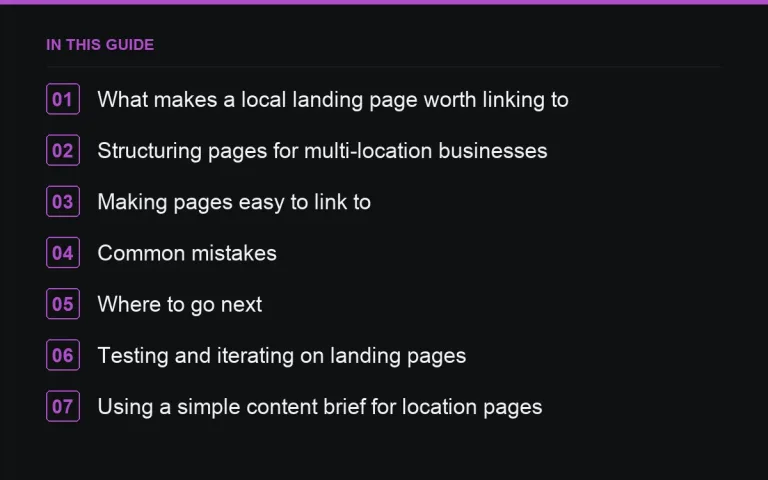
What makes a local landing page worth linking to
A genuinely useful local page answers the specific questions someone in that area would have: which services are available there, what makes the local team or location different, and practical details like service hours or areas covered. It should read as if it was written by someone who knows the area, not as a template with the city name swapped in.
Elements worth including
- Specific, accurate address and service area detail, matching your citations exactly (see https://successtoroad.com/blog/citations-vs-links/).
- Local team or staff information where relevant, especially for professional services.
- Genuinely local content — a note about neighbourhoods served, local landmarks, or region-specific considerations for your service.
- Reviews or testimonials specific to that location, not a generic company-wide block (see https://successtoroad.com/blog/reviews-and-links/).
- A clear call to action and contact method for that specific location.
Structuring pages for multi-location businesses
For businesses with several locations (see https://successtoroad.com/blog/multi-location-link-building/) or service areas (see https://successtoroad.com/blog/service-area-business-links/), each page needs enough unique content to stand on its own. Avoid a template that only changes the city name in an otherwise identical block of text, since this reads as thin to both users and search engines.
Making pages easy to link to
When you pitch a local journalist, chamber, or blog for coverage, point them to the most specific relevant page rather than your homepage by default. If a page doesn’t exist yet for the topic or location being covered, it is often worth creating one before the outreach goes out, so the resulting link lands somewhere that actually reinforces local relevance.
Common mistakes
| Mistake | Why it hurts |
|---|---|
| Duplicate content across location pages | Reads as low effort, weakens relevance signals for every page |
| No unique local details | Nothing distinguishes the page from a generic company page |
| Burying the location page deep in site navigation | Makes it harder for both users and search engines to find and value |
| Pointing all local links at the homepage instead | Wastes the specific relevance the link was earned for |
Where to go next
Once your landing pages are solid, revisit outreach tactics like https://successtoroad.com/blog/local-guest-posting/ and https://successtoroad.com/blog/sponsorship-link-building/ with a clear destination in mind for each link, and consider https://successtoroad.com/marketplace/ for additional relevant coverage once your own pages are ready to receive it.
Testing and iterating on landing pages
Treat local landing pages as living pages rather than a one-time setup task. Revisit them after a few months to update seasonal information, add new reviews or project photos specific to that location, and check that contact details remain accurate. A page that was strong when first built can quietly go stale, undermining the value of any links pointing to it.
It’s also worth checking analytics for these pages periodically — if a page that has earned several local links is getting little engagement or a high bounce rate, that’s a signal the content may need a rework, independent of whether the links themselves are strong.
Using a simple content brief for location pages
Before writing a batch of location pages, sketch a brief outlining exactly what unique detail exists for each one — genuinely distinct information, not just a city name swap. If the brief comes up mostly empty for a given location, that’s a sign the page needs more research (talking to local staff, reviewing completed jobs there) before it’s worth publishing.
Getting internal buy-in for better landing pages
If someone else on your team is sceptical about investing time in detailed location pages, framing the request around the specific links and press opportunities that depend on having somewhere credible to send them can help make the case more concretely than a general appeal to “better SEO.”
Using customer stories with permission
A specific, well-told customer story tied to a particular location, published with the customer’s permission, often makes for more compelling landing page content than generic service descriptions, and gives local press a concrete, human angle to reference if you later pitch it as a story.
Refreshing photos regularly
Stock photography undermines the genuine, local feel that makes a landing page worth linking to. Where possible, use real photos of your team, premises, or completed local work, refreshed periodically so the page doesn’t look frozen in time several years after it was first built.
Getting a second opinion on your own pages
It’s easy to lose objectivity about your own landing pages after staring at them for months. Ask a colleague, or even a friend unfamiliar with the business, to read a page cold and say what stands out or feels generic. This kind of outside read often catches thin or repetitive content faster than another internal review.
Where to go next
This post is one piece of a broader local link building approach. For the full framework, see https://successtoroad.com/blog/local-link-building-guide/.
Frequently asked questions
How much unique content does a local landing page need?
Enough that it clearly could not be mistaken for another location's page with the city name swapped. Specific local detail, not a word count target, is what matters.
Should every location page target the same keywords?
Each should target its own local variant naturally, but forcing an identical keyword pattern across every page often produces the same thin, templated feel that weakens the whole set.
What if I only have one location?
The same principles apply — make sure your single location page has genuine local detail rather than generic company copy, since it is still the destination for most of your local links.
Can a blog post work as a local landing page target instead?
Sometimes, especially for content-driven links like guest posts or press coverage tied to a specific local topic rather than a service page.
Put it into practice
Filter 54,483 websites by DR, traffic, niche and price, and order with escrow — you pay only after the link is live.
Browse the marketplace