Link Rot and Why a Weekly Link Monitor Matters
Waiting for a quarterly audit to catch link rot means losing links you could have saved weeks earlier.
Link rot is the gradual decay of a backlink profile as linking pages disappear, get restructured, or drop the link during routine edits. It’s a slow, constant background process rather than a single event, which is exactly why it’s easy to underestimate — nothing dramatic happens, links just quietly stop existing a few at a time.
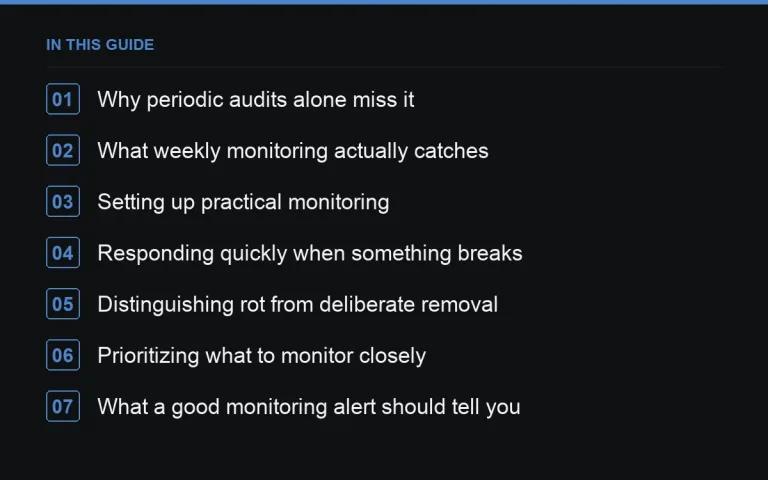
Why periodic audits alone miss it
A quarterly https://successtoroad.com/blog/backlink-audit-guide/ pass will eventually catch link rot, but by the time it does, the window for successful outreach to reclaim a link has often closed — the page has been further updated, the editor has moved on, or the content that prompted the link originally is no longer relevant. Monitoring closer to real time preserves more of the reclaim opportunity.
What weekly monitoring actually catches
- A link that disappeared from a still-live page during a content refresh
- A page that went from 200 to 404 or was removed entirely
- A domain that stopped resolving altogether
- A link that changed from a normal link to nofollow or was altered in some other way
Setting up practical monitoring
| Approach | Best for |
|---|---|
| Automated weekly link monitor tied to specific orders or high-value placements | Paid or actively managed placements where you want confirmation the link stays live |
| Weekly or biweekly spot-check of your highest-value referring domains | Smaller sites without automated monitoring tools |
| Alert-based monitoring on your most important individual placements | Cases where a single link matters enough to justify close tracking |
For links acquired through a marketplace with escrow and monitoring built in, this is largely handled for you — a weekly link monitor on completed orders confirms placements stay live without manual checking on your end.
Responding quickly when something breaks
Speed matters more here than in a routine audit. Reach out or investigate within days rather than weeks, since the editorial team is more likely to still recall the context and be willing to help. Follow the same https://successtoroad.com/blog/lost-links-and-reclaiming-them/ process, just on a faster timeline.
Distinguishing rot from deliberate removal
Not every disappearance is rot — some are deliberate, for example a publisher removing a paid link after a dispute or a change in policy. If you suspect the latter, that’s a different conversation; see https://successtoroad.com/blog/when-a-publisher-removes-your-link/ for how to handle it.
Prioritizing what to monitor closely
You don’t need to watch every link with equal attention. Prioritize placements with real traffic and authority, and anything you paid for directly, since those represent the clearest loss if they disappear. Lower-value or incidental links can stay on the standard quarterly audit cycle.
What a good monitoring alert should tell you
A useful alert does more than say “something changed” — it should tell you whether the page returned an error, whether it’s still live but the link itself was removed, or whether the link is still present but its attributes changed, such as switching from a normal link to nofollow. Each of those calls for a different response, and a vague alert just shifts the investigation work back onto you rather than saving time.
Balancing monitoring against noise
Monitoring too many links too closely can generate more alerts than anyone actually reviews, at which point the system stops being useful and starts being ignored entirely. Keep the watch list focused on placements that would genuinely be worth acting on quickly if something changed, and let lower-priority links surface through your regular audit cadence instead of adding everything to a weekly check by default.
The compounding value of catching things early
The real benefit of weekly monitoring isn’t any single catch — it’s the compounding effect over a year of catching issues while they’re still fixable rather than letting them accumulate into a larger cleanup project during the next full audit. A site that monitors closely tends to have a noticeably higher reclaim success rate over time than one that only discovers link rot every few months, simply because the window for a successful response hasn’t yet closed.
Deciding what counts as “high-value” for monitoring purposes
Rather than a purely subjective judgment call, use a short, consistent set of criteria to decide what earns a spot on your weekly watch list: real organic traffic to the linking page, strong topical relevance, and either a direct cost paid or a meaningful relationship behind the placement. Links that meet at least two of these three criteria are reasonable candidates for close monitoring; everything else can safely wait for the next scheduled audit.
Reviewing the watch list itself periodically
A watch list built a year ago may no longer reflect what’s actually valuable today — some placements will have grown in importance, others may no longer matter as much as priorities shift. Revisit the list itself roughly annually rather than letting it silently drift out of date while continuing to monitor items that no longer deserve the attention.
Where to go next
Placements bought through https://successtoroad.com/marketplace/ come with weekly link monitoring on completed orders as a standard feature, which removes most of the manual tracking burden for links acquired that way.
Frequently asked questions
How is link rot different from a lost link I find in an audit?
They're the same underlying phenomenon — link rot is the ongoing process, and a 'lost link' found in an audit is a snapshot discovery of it. Monitoring weekly just catches it closer to when it happens, preserving more reclaim opportunity.
Do I need to monitor every single backlink weekly?
No, that's rarely practical or necessary. Focus close monitoring on your highest-value and paid placements, and let lower-priority links surface through your regular quarterly audit instead.
Why does responding quickly matter for reclaiming a rotted link?
Editorial teams are more likely to remember the context and act on a request within days of a change than months later, when the page may have been further updated or the original writer has moved on.
Can automated monitoring replace manual audits entirely?
No, they serve different purposes. Monitoring catches individual link breakage quickly; a full audit still catches broader pattern issues like anchor text drift or network links that monitoring alone wouldn't surface.
Put it into practice
Filter 54,483 websites by DR, traffic, niche and price, and order with escrow — you pay only after the link is live.
Browse the marketplace