Link Building vs Paid Ads: Where Should the Next Budget Dollar Go
Paid ads deliver traffic the moment you spend and stop the moment you don't; link building compounds slowly but keeps paying off.
Marketing budgets are finite, and the choice between putting the next dollar into link building or into paid advertising comes up constantly, especially for growing businesses without unlimited resources. The two are not really substitutes for each other, since they behave completely differently over time, but understanding that difference helps you allocate sensibly rather than just following whichever channel is currently fashionable.
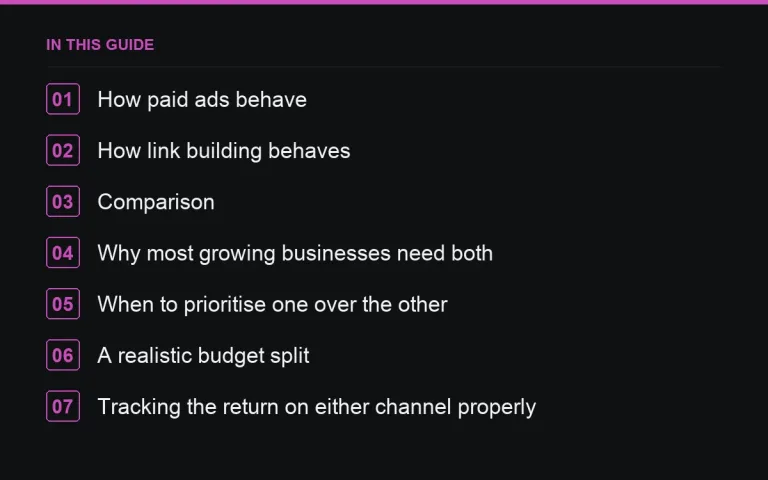
How paid ads behave
Paid advertising produces traffic almost immediately once a campaign launches, and that traffic stops almost immediately once you stop paying. The relationship between spend and result is direct and largely linear: more budget generally means more clicks, within the limits of your targeting and market size, but there is no residual value once the budget runs out.
How link building behaves
Link building takes longer to show results, since search engines need time to crawl, evaluate and factor new links into rankings, and improved rankings then take further time to translate into meaningful organic traffic. But once a page ranks well on the back of a strong link profile, that traffic largely continues without ongoing spend, aside from maintaining the profile against natural link decay over time.
Comparison
| Factor | Paid ads | Link building |
|---|---|---|
| Time to results | Immediate | Weeks to months |
| Durability without ongoing spend | None, stops when spend stops | Largely retained, needs light maintenance |
| Cost predictability | Very predictable per click | Predictable per link, less so for ranking outcome |
| Best for | Immediate demand, testing, promotions | Long-term organic growth |
Why most growing businesses need both
Paid ads fill the gap while organic rankings are still building, giving you traffic and revenue during the months when a link building campaign has not yet fully paid off. Once organic rankings mature, the reliance on paid spend for the same queries can often be reduced, freeing budget for either new keyword targets or a lighter, maintenance-level link building program.
When to prioritise one over the other
- Prioritise paid ads if you need revenue now and cannot wait months for organic results to build.
- Prioritise link building if you are optimising for long-term cost efficiency and are not under immediate revenue pressure.
- Run both in parallel if budget allows, treating paid ads as the bridge while organic authority compounds in the background.
A realistic budget split
There is no universal ratio, but many growing businesses allocate the larger share to paid ads early on, shifting more toward organic and link building investment as the site’s authority and rankings mature and the marginal cost of paid clicks in a competitive space rises. Sourcing consistent link volume from https://successtoroad.com/marketplace/ keeps this shift manageable rather than requiring a sudden, large reallocation.
Tracking the return on either channel properly
Comparing paid ads and link building fairly requires tracking both consistently over the same time period, using the same conversion definitions. https://successtoroad.com/blog/link-building-kpis/ covers what to track on the organic side so a genuine like-for-like comparison against ad spend is possible rather than an apples-to-oranges guess.
How topical relevance affects the organic side of this comparison
The organic traffic link building eventually produces depends heavily on how relevant your acquired links are to your actual topic, not just their raw authority. https://successtoroad.com/blog/topical-relevance/ explains why a smaller, more relevant site can outperform a larger generalist one, which changes how you should think about the long-term payoff of an organic investment relative to a paid ads budget.
Reviewing spend allocation on a regular cycle
Revisit your split between paid ads and link building at least once a quarter, using actual performance data from both channels rather than a fixed assumption set at the start of the year. As organic rankings mature, the marginal value of an additional dollar in each channel shifts, and your allocation should shift with it.
It is also worth stress-testing your assumptions occasionally by briefly reducing paid ad spend on a well-ranked query to see how much organic traffic alone actually delivers, which gives you real data on how much your organic investment has paid off rather than relying on a theoretical estimate.
A common mistake worth avoiding
A common mistake is cutting link building spend the moment paid ads deliver strong short-term results, only to find organic rankings stagnate or decline months later once that link building investment dries up. Treat organic and paid investment as running on different timelines, and avoid judging the health of one channel using the other’s short feedback loop.
This kind of small, deliberate experiment gives you a genuine, first-party data point rather than relying entirely on general industry assumptions about channel value.
Document the result of this experiment clearly so it becomes a lasting reference point for future budget conversations rather than a one-off exercise nobody remembers a year later.
Where to go next
Read https://successtoroad.com/blog/link-building-vs-technical-seo-first/ for the related question of sequencing within organic SEO itself, and https://successtoroad.com/blog/short-term-burst-vs-steady-velocity/ for how to pace link building once you commit to it.
Frequently asked questions
Should a new business start with paid ads or link building?
Most new businesses benefit from starting with paid ads for immediate traffic and validation, while building link equity in parallel, since organic rankings typically take months to mature regardless of budget.
Does link building ever fully replace the need for paid ads?
For some businesses in less competitive niches, strong organic rankings can significantly reduce reliance on paid ads for the same queries, though most still keep some paid presence for testing and peak demand periods.
Which channel has a better long-term return?
Link building generally has a better long-term cost efficiency once rankings mature, since the traffic continues without ongoing per-click spend, but it requires patience and upfront investment that paid ads do not.
Can I run both channels on a small budget?
Yes, many small businesses run a modest paid ad budget for immediate demand alongside a slower, steady link building program, adjusting the split as they see which channel delivers stronger returns for their specific niche.
Put it into practice
Filter 54,483 websites by DR, traffic, niche and price, and order with escrow — you pay only after the link is live.
Browse the marketplace