Link Building Across South-East Asia
A regional guide to link building across South-East Asia, a market defined by real linguistic and economic variety.
South-East Asia isn’t one market so much as a cluster of quite different ones sharing a region: Indonesia’s enormous Bahasa Indonesia-speaking population, Vietnam and Thailand’s own distinct languages and media cultures, the Philippines’ English-heavy publishing landscape, and Singapore and Malaysia’s multilingual mix all sit under the same regional label but require different plans.
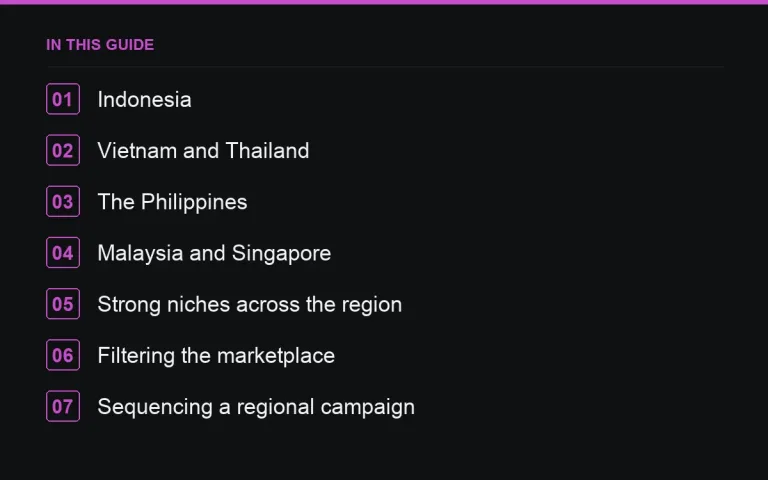
Indonesia
The largest population in the region by far, with an active Bahasa Indonesia-language publisher base spanning national media, technology and e-commerce blogs (Indonesia has one of the fastest-growing e-commerce markets globally), and lifestyle content. English-language business publishing exists but Bahasa Indonesia reaches a far larger share of the population for general content.
Vietnam and Thailand
Both have their own national languages and well-developed domestic media, generally requiring native-language content for real engagement outside a narrow English-reading business segment. Vietnam’s technology and e-commerce blogging scene is particularly active given the country’s fast-growing digital economy; Thailand has strong tourism, lifestyle and food content given its large domestic and international tourism industry.
The Philippines
Uniquely English-heavy for the region — English is an official language and widely used in media, business and everyday online content alongside Filipino. This makes the Philippines one of the more accessible South-East Asian markets for English-language campaigns without needing translation, though Filipino-language content still reaches a broader domestic audience for general-interest topics.
Malaysia and Singapore
Both are genuinely multilingual, with English, Malay and Chinese-language publishing operating alongside each other (and Tamil in Malaysia and Singapore too). See our dedicated Singapore guide for hub-market specifics; Malaysia has a similarly layered structure but a larger domestic-focused publisher base outside the financial-hub role Singapore plays.
Strong niches across the region
- E-commerce and fintech, among the fastest-growing content categories region-wide.
- Travel and tourism, especially in Thailand and the Philippines.
- Technology and startups, particularly in Vietnam, Indonesia and Singapore.
- Food and lifestyle, with strong local identity content in every market.
Filtering the marketplace
Use https://successtoroad.com/language/indonesian/ for Indonesia specifically, and filter by country for Vietnam, Thailand, the Philippines and Malaysia rather than searching the region as one block. The https://successtoroad.com/niche/e-commerce/ filter is well represented region-wide, and https://successtoroad.com/compare/ is useful for weighing the very different pricing norms across these markets on one shortlist.
Sequencing a regional campaign
Most brands new to the region get the best early return from Singapore and the Philippines given their English-language accessibility, then expand into Indonesia, Vietnam and Thailand as budget and local-language content capacity grow.
A note on mobile-first content consumption
Across nearly all of these markets, a large share of readers access content on mobile devices, and while this doesn’t change the guest post itself, it’s worth keeping content well-structured with short paragraphs and clear headings, since this is how the majority of the eventual readership will actually encounter it.
Avoiding a one-size-fits-all regional brief
A single content brief translated across Indonesian, Vietnamese, Thai and Filipino rarely performs as well as briefs adapted per country, even when the underlying topic is genuinely relevant everywhere. Local examples, currency references and cultural context need country-specific attention rather than a single regional template applied uniformly.
Where budget is limited, prioritising the two or three countries most relevant to your actual customer base, rather than spreading thin across all six markets discussed here, tends to produce better overall results.
A note on budget efficiency
Given the wide pricing range across this region, comparing cost-per-placement across countries periodically helps identify where a given budget is currently stretching furthest, since relative value between markets can shift as publisher landscapes mature at different rates.
Working with regional logistics and supply chain coverage
Given the region’s role in global manufacturing and trade, logistics, shipping and supply chain content has an active trade press across Vietnam, Indonesia and Singapore specifically. This is a valuable niche for B2B brands in trade, manufacturing or logistics, and one that benefits from content addressing genuinely regional, cross-border themes rather than single-country framing alone.
Working with Vietnam’s fast-growing independent blogging scene
Vietnam’s technology and lifestyle blogging community has grown quickly alongside the country’s digital economy, supporting a genuinely active independent publisher tier distinct from state-affiliated national media. This tier is often more accessible for international brands new to the market and worth prioritising in early outreach.
Given how differently each of these markets is likely to perform, review results country by country rather than as one blended regional average, and let early performance data guide where to expand investment first.
Ultimately, the brands that do well across this region are the ones willing to invest properly in a smaller number of priority countries rather than spreading a fixed budget too thinly across all six markets at once.
Where to go next
Read https://successtoroad.com/blog/link-building-singapore/ for the region’s financial hub market in more depth, and our existing Indonesian-language guest posting guide for placement mechanics there. Our https://successtoroad.com/blog/multilingual-site-link-strategy/ guide is directly relevant given how many languages sit within this one region, and https://successtoroad.com/blog/international-link-building/ covers running South-East Asia within a wider global campaign.
Frequently asked questions
Is South-East Asia one market or several for link building purposes?
Effectively several. Indonesia, Vietnam, Thailand, the Philippines, Malaysia and Singapore each have distinct languages, publisher landscapes and pricing, and treating them as one block undersells the differences.
Which country is most accessible for English-only campaigns?
The Philippines, where English is an official language widely used in media and business, though Filipino-language content still reaches a broader domestic audience for general-interest topics.
What is Indonesia's publisher landscape like?
Large and active, primarily in Bahasa Indonesia, spanning national media, a fast-growing e-commerce and technology blogging scene, and lifestyle content.
What niches perform consistently well across the region?
E-commerce and fintech, travel and tourism, and technology and startup content all have strong, active publisher coverage across most South-East Asian markets.
Put it into practice
Filter 54,483 websites by DR, traffic, niche and price, and order with escrow — you pay only after the link is live.
Browse the marketplace