Link Building for the Singapore Market
A guide to link building in Singapore, a small but influential regional hub with a distinct multilingual publisher mix.
Singapore punches well above its physical size as a publishing market, largely because it functions as a regional business and finance hub whose media is read well beyond its own borders across Southeast Asia. English is the dominant language of business publishing, but a real multilingual layer sits underneath it that’s easy to overlook if you only search in English.
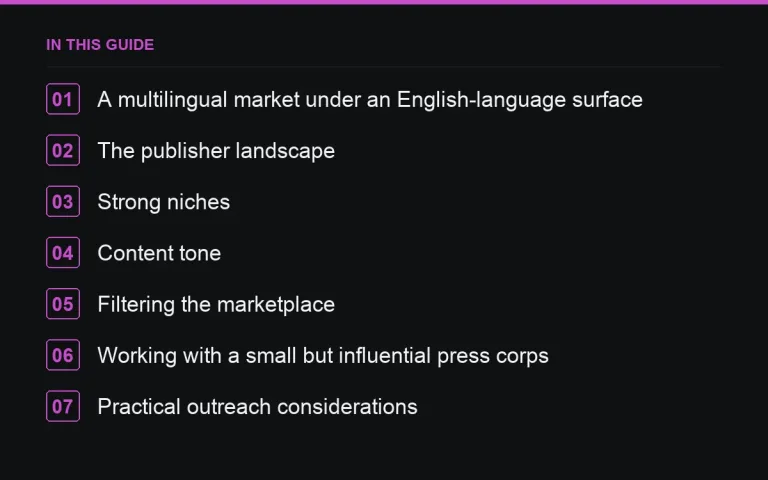
A multilingual market under an English-language surface
Alongside English-language national media and business publications, Singapore has active Chinese-language (see our note on script and audience differences), Malay and Tamil-language publishing, each serving distinct communities within the country. A campaign that only ever touches the English-language layer is missing real segments of the local audience, even though English gets you the most reach for regional B2B content.
The publisher landscape
Expect polished, professional business and finance media, a strong technology and startup blogging scene (Singapore is a regional startup hub), and lifestyle and food content with a genuinely engaged local following. Editorial standards are generally high and closer to Western business publishing norms than some neighbouring Southeast Asian markets, reflecting the country’s role as a financial centre.
Strong niches
- Finance, fintech and business services, given Singapore’s role as a regional financial hub.
- Technology and startups.
- Travel and hospitality, both inbound tourism and outbound regional travel content.
- Food and lifestyle, with a strong, opinionated local food blogging culture.
Content tone
Business content should be direct, well-referenced and free of exaggerated claims — Singaporean business readers are generally sophisticated and international in outlook, and will quickly discount content that feels like generic marketing copy. Lifestyle and food content can be more casual, but still expects a clear point of view rather than filler.
Filtering the marketplace
Use a country filter for Singapore alongside https://successtoroad.com/language/english/ for the bulk of business content, and check https://successtoroad.com/language/chinese/ separately if you’re also targeting the Chinese-reading segment. The https://successtoroad.com/niche/finance/ and https://successtoroad.com/niche/startups/ filters are both well represented here, and the https://successtoroad.com/compare/ tool is useful for weighing Singapore against other Southeast Asian hubs on the same shortlist.
Working with a small but influential press corps
Singapore’s media, while covering a small physical population, is read well beyond its borders by regional business audiences, so a placement here can carry more reach than its domestic traffic figures alone suggest. This regional influence is part of what justifies pricing at the higher end of the Southeast Asian range.
Practical outreach considerations
English-language business editors in Singapore generally respond quickly and professionally, closer in pace to Western European markets than to some neighbouring Southeast Asian outlets, which makes it a relatively efficient market to work in once you’ve built an accurate shortlist.
Balancing reach against local specificity
Because Singapore’s media is read regionally, it’s tempting to write content that speaks broadly to all of Southeast Asia rather than to Singapore specifically. Resist this where you can — content with genuine local specificity generally gets a warmer reception from Singaporean editors than a piece that reads as aimed at “the region” in general.
Where a campaign genuinely does want regional reach, it’s usually more effective to produce separate, locally specific pieces for each priority country rather than one generic regional piece run everywhere.
A note on regional spillover value
A strong Singapore placement often gets noticed by readers and editors elsewhere in the region given the country’s hub status, so it’s reasonable to view Singapore placements as carrying some regional value beyond their direct domestic reach when evaluating overall campaign return.
Working with government-linked and institutional publishers
Singapore has a number of government-linked and institutional publications covering business, trade and policy that carry particular weight for B2B and finance content, distinct from independent commercial media. These outlets often have more formal submission processes and longer review timelines than commercial blogs, so plan for a longer lead time if pursuing this specific tier of publisher.
Working with Singapore’s startup ecosystem media specifically
Beyond general business press, Singapore has a dedicated tier of startup and venture-focused media covering the region’s tech ecosystem specifically, often read by founders and investors across Southeast Asia rather than a purely domestic audience. This is a valuable, fairly accessible niche for technology and fintech brands with a regional growth story to tell.
As with other hub markets, it’s worth periodically reassessing whether your Singapore placements are genuinely reaching a Singapore-specific audience or functioning more as regional exposure — both have value, but they justify different content approaches and different success metrics.
Over a longer campaign, the brands that do best in Singapore tend to be the ones that invest in a small set of ongoing publisher relationships rather than constantly sourcing new contacts, given how tightly connected the country’s business and media community actually is.
Where to go next
Read https://successtoroad.com/blog/link-building-southeast-asia/ for how Singapore fits into the broader region, and https://successtoroad.com/blog/guest-posting-chinese-sites/ for the Chinese-language layer specifically. Our https://successtoroad.com/blog/multilingual-site-link-strategy/ guide covers running several language tracks in one market, and https://successtoroad.com/blog/international-link-building/ and https://successtoroad.com/blog/currency-invoicing-payment-markets/ cover the operational side of a hub market like this.
Frequently asked questions
Is English enough to reach Singapore's whole audience?
It covers most business and general content, but Chinese, Malay and Tamil-language publishing each reach distinct local communities that an English-only campaign would miss.
How does Singapore compare to other Southeast Asian markets editorially?
Standards are generally closer to Western business publishing norms, reflecting the country's role as a financial hub, so content needs to be well-referenced and free of exaggerated claims.
What niches are strongest in Singapore?
Finance and fintech, technology and startups, and travel and food content all have well-developed, engaged publisher communities.
Should I run Singapore as part of a Southeast Asia campaign or separately?
Either can work, but treat it as distinct enough to warrant its own shortlist given its different editorial standards and hub role, even if you're comparing pricing across the wider region.
Put it into practice
Filter 54,483 websites by DR, traffic, niche and price, and order with escrow — you pay only after the link is live.
Browse the marketplace