Link Building for the New Zealand Market
A guide to link building in New Zealand, a small English-language market often run alongside Australian campaigns.

New Zealand is frequently bundled into Australian campaigns given the shared language and geographic proximity, and while there’s overlap in tone and approach, treating it as identical misses real differences in publisher scale and local reader interest. This is a small, close-knit media market where relationships and local relevance carry real weight.
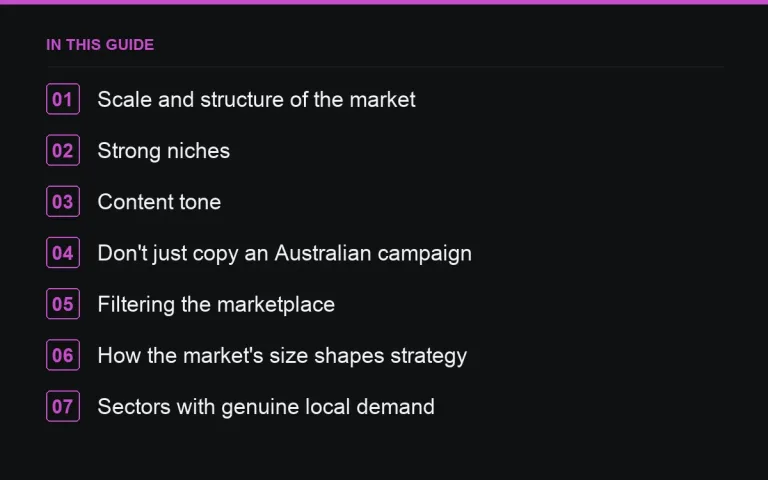
Scale and structure of the market
Expect a smaller total pool of publishers than Australia, concentrated in Auckland- and Wellington-based national outlets alongside regional sites and a genuinely active niche blogging community in outdoor lifestyle, food and travel. Because the market is small, individual publishers tend to have closer relationships with their readers, and content that feels locally specific — not just “adapted from an Australian pitch” — performs noticeably better.
Strong niches
- Outdoor lifestyle, adventure tourism and sustainability, reflecting the country’s strong outdoor culture.
- Agriculture and farming, a genuinely major part of the domestic economy with dedicated trade publications.
- Food and wine, particularly around New Zealand’s wine regions.
- Technology and remote work, a growing category among smaller, distributed businesses.
Content tone
New Zealand readers generally respond to a modest, understated tone rather than aggressive sales language — closer to the reserved end of the English-language spectrum than to more brash American content marketing styles. Local spelling and vocabulary conventions closely follow British/Commonwealth English rather than American English; a piece full of American spellings and phrasing reads as obviously non-local.
Don’t just copy an Australian campaign
It’s tempting to reuse Australian content and pitch it to New Zealand publishers with minor edits, but editors notice this, and it undersells the market. Genuine local references — place names, local events, New Zealand-specific regulatory or market context — go a long way in a market this size, where publishers can tell the difference between a locally minded pitch and a repurposed one.
Filtering the marketplace
Filter by country for New Zealand specifically rather than relying on a broader “Australia/NZ” grouping if the marketplace offers that distinction, and pair with https://successtoroad.com/niche/agriculture/ or https://successtoroad.com/niche/travelling/ depending on sector. Given the smaller total site count, it’s worth reviewing the full shortlist manually rather than filtering too aggressively, and using https://successtoroad.com/compare/ to weigh options side by side.
How the market’s size shapes strategy
With a total online population smaller than many single cities elsewhere, New Zealand rewards a quality-over-quantity approach more than almost any other English-language market. A handful of well-placed, genuinely locally relevant pieces on respected outlets will do more for a brand here than a larger volume of generic placements.
Sectors with genuine local demand
Beyond the niches already covered, education and skilled migration content has real demand given New Zealand’s active immigration and international education sectors, and environmental and conservation topics resonate strongly given a national identity closely tied to the country’s natural landscape.
Working with a tightly connected media community
New Zealand’s small size means editors and writers across different outlets often know each other personally, so a poor outreach experience with one publisher can realistically affect your reputation with others in the same community. Treat every interaction here as part of a longer-term relationship rather than an isolated transaction.
This also cuts the other way — a well-handled placement can lead to warm introductions to other publishers faster than in larger, more anonymous markets.
A note on realistic campaign sizing
Set placement volume expectations for New Zealand well below what a similarly budgeted UK or US campaign might achieve, given the smaller total publisher pool, and communicate this to stakeholders early so a smaller absolute number of placements isn’t mistaken for underperformance.
Working with New Zealand’s agricultural and export sectors
Beyond the consumer-facing niches already discussed, New Zealand’s substantial agricultural export economy supports a real trade and business press covering dairy, wine and other export industries. This is a smaller but genuinely valuable niche for B2B brands with any connection to agriculture, food production or export logistics, and one that’s easy to overlook if a campaign focuses only on consumer lifestyle content.
Working with Wellington’s government and policy-adjacent media
As the capital, Wellington supports a policy and government-adjacent media layer distinct from Auckland’s more commercially focused press. For brands in sectors touching public policy, education or regulated industries, this is a worthwhile niche to include alongside the more commonly targeted lifestyle and business outlets based in Auckland.
Ultimately, success in this market comes down to genuine local relevance more than any other single factor. A smaller, carefully tailored campaign will consistently outperform a larger but generic one in a media environment this size and this closely connected.
Where to go next
Read our existing guide on https://successtoroad.com/blog/link-building-australia/ for the closest regional comparison, and https://successtoroad.com/blog/link-building-uk-market/ for how Commonwealth English markets differ from the US. Our https://successtoroad.com/blog/international-link-building/ guide and https://successtoroad.com/blog/cultural-norms-publisher-negotiations/ post both help with tailoring pitches to smaller, tightly connected markets like this one, and https://successtoroad.com/blog/local-language-vs-english-placements/ is relevant if you’re weighing how much localisation effort a market this size actually needs.
Frequently asked questions
Can I reuse an Australian campaign for New Zealand?
Not directly. Editors notice repurposed content, and genuinely local references perform much better in a market this size. Adapt pitches with real New Zealand-specific context rather than lightly editing Australian content.
Is New Zealand's publisher market as large as Australia's?
No, it's meaningfully smaller given the population difference, so plan for a shorter shortlist and judge success by relevance and engagement rather than sheer volume.
Should content use British or American spelling?
British/Commonwealth spelling and phrasing conventions are standard. American spelling and idiom stand out as clearly non-local to New Zealand readers.
What industries have strong publisher coverage?
Outdoor lifestyle and adventure tourism, agriculture and farming trade publications, and food and wine content all have genuine, active local audiences.
Put it into practice
Filter 54,483 websites by DR, traffic, niche and price, and order with escrow — you pay only after the link is live.
Browse the marketplace