Link Building in the Middle East and Gulf
A guide to the Middle East and Gulf as a link building market, covering the region's dual Arabic/English publishing landscape.
The Gulf and wider Middle East run on a genuinely dual publishing landscape: Arabic-language media reaching the broad regional population, and a large, well-developed English-language business and lifestyle press serving the UAE, Qatar and Saudi Arabia’s international business communities and expatriate populations. A campaign here usually needs to plan for both rather than picking just one.
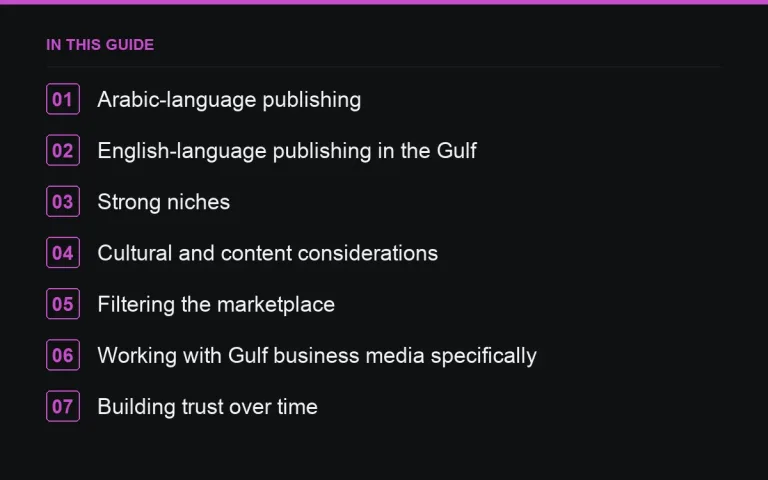
Arabic-language publishing
Arabic media spans the region from Egypt and the Levant through the Gulf states, and while Modern Standard Arabic is broadly understood everywhere, everyday spoken dialects differ significantly by country — Gulf Arabic, Egyptian Arabic and Levantine Arabic are distinct enough that a piece aimed at one sub-region can feel slightly foreign in another. Written content generally uses Modern Standard Arabic regardless, which keeps this less of an issue for guest posts than it would be for spoken content, but tone and cultural references still benefit from sub-regional awareness.
English-language publishing in the Gulf
Dubai, Abu Dhabi, Doha and Riyadh all have substantial English-language business, technology and lifestyle media aimed at the large expatriate and international business population living and working in the region. These publications are often a more accessible entry point for international brands than Arabic-language media, and editorial standards are generally comparable to Western business publishing.
Strong niches
- Finance, fintech and business services, reflecting the Gulf’s role as a growing regional financial centre.
- Real estate and property investment, an intensely active topic given large-scale regional development.
- Travel, tourism and hospitality, both inbound and luxury travel content.
- Technology, including e-commerce and logistics given the region’s trade hub role.
Cultural and content considerations
Content should be reviewed for cultural appropriateness before submission — imagery, phrasing and topics considered unremarkable elsewhere can be inappropriate here, and this matters more for guest posting than in most markets given religious and cultural norms across the region. Avoid political commentary and keep content focused on the practical topic at hand rather than broader social themes.
Filtering the marketplace
Use https://successtoroad.com/language/arabic/ for the Arabic-language layer, and filter by country for UAE, Qatar or Saudi Arabia to reach the English-language business press specifically. The https://successtoroad.com/niche/real-estate/ and https://successtoroad.com/niche/finance/ filters are both well represented, and https://successtoroad.com/compare/ helps weigh Arabic and English options against each other on price and reach.
Working with Gulf business media specifically
English-language Gulf business press is generally comfortable with international brands and international case framing, more so than general consumer Arabic media, making it a reasonably efficient entry point for brands new to the region before expanding into Arabic-language placements.
Building trust over time
As with several other relationship-driven markets, an initial placement that performs well often leads to easier follow-up opportunities with the same publisher or its sister publications, since Gulf media groups frequently operate several titles under one umbrella.
Sequencing an entry into this region
Most brands new to the Gulf get the most straightforward early results from English-language UAE and Qatar business media, given its comparatively international, business-first editorial culture, before expanding into Arabic-language placements once the team has more region-specific experience and native-language content capacity in place.
Saudi Arabia’s market, while large and growing quickly, often benefits from a slightly more cautious, well-researched approach given its distinct regulatory and cultural context relative to the UAE and Qatar.
A note on long-term regional presence
Given how much Gulf media groups operate across multiple titles, a good relationship with one publication within a group can open doors to its sister publications over time, making an initial well-handled placement worth more than its immediate reach alone suggests.
Working with construction and infrastructure trade media
Given the scale of ongoing regional development, construction, infrastructure and urban planning form a substantial and active trade press category across the Gulf states, distinct from general real estate consumer content. This niche typically has a more technical, B2B-oriented readership and correspondingly different content expectations than lifestyle-oriented property coverage.
Working with Qatar’s media separately from the UAE
Qatar’s business and lifestyle press has its own distinct outlets and editorial character, shaped partly by the country’s own major events and development priorities, and shouldn’t be assumed to behave identically to UAE media simply because both are English-heavy Gulf markets. Treating Qatar as its own line item in a shortlist, rather than a UAE afterthought, tends to produce better-targeted placements.
Given how relationship-driven this region can be, particularly within media groups spanning several titles, it’s worth treating an early successful placement as the start of an ongoing relationship rather than a single closed transaction.
Over time, brands that treat each Gulf market as distinct, while still building relationships across media groups where they exist, tend to get more sustainable value from this region than those applying one uniform approach across every country.
Where to go next
Read https://successtoroad.com/blog/link-building-southeast-asia/ for a useful contrast in how English- and local-language publishing split in a different region, and our existing Arabic-language guest posting guide for placement-level detail. Our https://successtoroad.com/blog/cultural-norms-publisher-negotiations/ guide expands on the cultural review point above, and https://successtoroad.com/blog/multilingual-site-link-strategy/ covers running Arabic and English tracks together in one plan.
Frequently asked questions
Should I focus on Arabic or English content in the Gulf?
Most campaigns benefit from both: Arabic reaches the broad regional population, while English-language Gulf business and lifestyle media reaches the large expatriate and international business audience.
Does Modern Standard Arabic work across the whole region?
For written content generally yes, since it's used broadly regardless of spoken dialect differences between Gulf, Egyptian and Levantine Arabic, though tone and references still benefit from sub-regional awareness.
What cultural checks should content go through before submission?
Review imagery, phrasing and topic choice for cultural and religious appropriateness specific to the region, and avoid political commentary, which matters more here than in most other markets.
Which niches have the strongest publisher coverage?
Finance and fintech, real estate and property, travel and hospitality, and technology and logistics content all have well-developed publisher landscapes across the Gulf.
Put it into practice
Filter 54,483 websites by DR, traffic, niche and price, and order with escrow — you pay only after the link is live.
Browse the marketplace