Indexing Checks: Confirming a Site (and Your Page) Is Actually in Google
A link that never gets indexed carries no SEO value at all, no matter how good the metrics look.
Every metric discussed elsewhere on this site — DR, DA, traffic, spam score — assumes the pages carrying them are actually indexed by search engines. A link placed on a page that Google has not indexed, or has since removed from its index, carries essentially no SEO value, regardless of how strong the domain’s other numbers look. Indexing checks are a simple, often-skipped step that catches this.
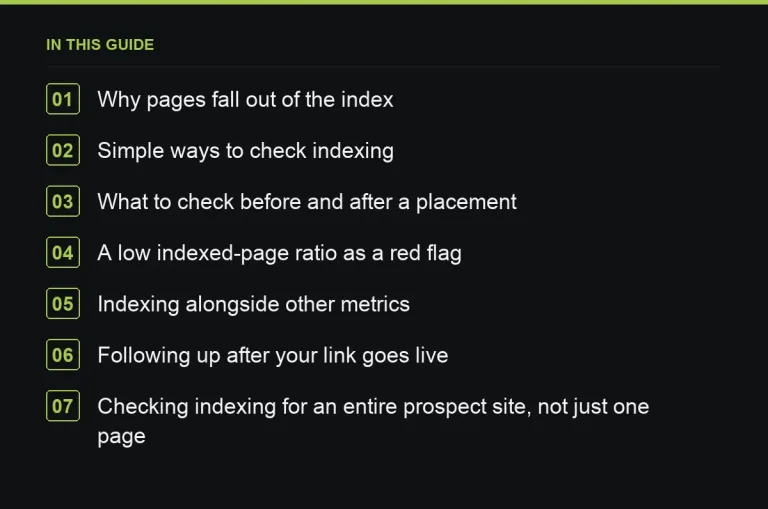
Why pages fall out of the index
- A site can be manually or algorithmically penalised, leading to broad de-indexing.
- Technical issues — a misconfigured robots.txt, an accidental noindex tag, or crawl errors — can quietly block indexing without any visible sign on the page itself.
- Thin or duplicate content across many pages on the same site can lead search engines to selectively exclude weaker pages while keeping others indexed.
- A site that has gone largely inactive may see older or lower-priority pages gradually dropped from the index over time.
Simple ways to check indexing
A quick site-search query restricted to the domain in a search engine shows a rough count of indexed pages and lets you spot-check whether specific URLs appear. For your own specific target page — an existing article where a link insertion will go, or a domain’s homepage — searching for a distinctive, unique phrase from that exact page is a fast way to confirm it is both indexed and not merely duplicated or overshadowed by another version of the same content elsewhere.
What to check before and after a placement
| Timing | What to confirm |
|---|---|
| Before committing | The domain shows a reasonable share of its pages indexed; the specific target page or section is indexed |
| Shortly after publishing | Your new guest post has been indexed, not just published |
| Periodically afterward | The page remains indexed over time, especially on sites you use repeatedly |
A low indexed-page ratio as a red flag
If a domain shows a large discrepancy between its total published pages and its indexed page count, that is worth investigating before committing to a placement there. It can indicate a recent penalty, a technical problem affecting the whole site, or in some cases a very young site still waiting to be fully crawled — see https://successtoroad.com/blog/metrics-for-new-domains/ for how to tell the difference in that last case.
Indexing alongside other metrics
Indexing checks work best as a complement to, not a replacement for, the authority and traffic checks covered in https://successtoroad.com/blog/domain-rating-explained/ and https://successtoroad.com/blog/organic-traffic-estimates-why-tools-disagree/. A site can have a strong historical authority score while currently facing an indexing problem that a lagging score has not yet reflected — another instance of the update-lag issue discussed in https://successtoroad.com/blog/how-often-metrics-update/.
Following up after your link goes live
Confirming your own placement’s page is indexed shortly after publication is worth doing routinely, especially for higher-value orders. If a page has not indexed within a reasonable window, it’s worth raising directly with the publisher, since the fix — often a simple technical correction — is usually straightforward once flagged.
Checking indexing for an entire prospect site, not just one page
Beyond confirming a single target page is indexed, it is worth getting a rough sense of how much of a prospective publisher’s overall site is indexed relative to its apparent total content volume. A site that has published thousands of articles but shows only a small fraction indexed may be dealing with a broader technical or quality issue affecting the whole domain, which is a more serious concern than an isolated indexing gap on one older page.
What to do if your own placement fails to index
If a page fails to index within a reasonable window after publication, start with the simplest explanations: check whether the page is genuinely reachable from the site’s internal navigation, whether it appears in the site’s sitemap, and whether it carries any accidental noindex directive. Most indexing failures on an otherwise healthy site trace back to one of these straightforward technical issues rather than anything more serious, and a publisher with a functioning technical setup can usually resolve it quickly once it is flagged directly.
Indexing checks as part of ongoing monitoring
For placements you intend to keep for the long term, an occasional recheck of indexing status, alongside the other periodic reviews covered elsewhere in this series, catches the case where a previously indexed page later drops out due to a site-wide technical change or a broader issue affecting the publisher’s domain, well after your original placement decision was made.
Indexing checks for sites using non-standard platforms
Sites built on less common publishing platforms, or those with heavily customised technical setups, are occasionally more prone to subtle indexing issues than sites on well-supported, standard platforms. This is worth a slightly closer look specifically when a prospective publisher’s site feels unusual or non-standard in its technical presentation, even if nothing else about the site raises immediate concern.
Where to go next
Indexing checks pair naturally with a broader vetting pass — see https://successtoroad.com/blog/how-to-read-a-link-profile/ and the compressed version in https://successtoroad.com/blog/vet-a-site-in-ten-minutes/. For the complete metrics picture this fits into, read https://successtoroad.com/blog/seo-metrics-explained/, and find vetted, active publishers in https://successtoroad.com/marketplace/.
Frequently asked questions
How do I quickly check if a specific page is indexed?
Search for a distinctive, unique phrase pulled directly from that page in a search engine, ideally restricted to the domain, and see whether the exact URL appears in the results.
What does it mean if a domain has very few indexed pages relative to its total content?
It can indicate a technical indexing issue, a recent penalty, or simply a very new site still being crawled. Investigate further before assuming the worst, especially for younger domains.
How soon after publishing should a guest post be indexed?
This varies by site, but checking within a couple of weeks is reasonable. If it hasn't indexed by then, raise it with the publisher rather than assuming it never will.
Can a page lose its indexed status after being placed?
Yes, pages can be de-indexed later due to site-wide penalties, technical changes, or content quality issues unrelated to your specific link, which is why periodic spot checks are worthwhile on sites you use repeatedly.
Does indexing status affect a site's DR or DA score?
Not directly or immediately — those scores are calculated from the link graph on their own cycle and can lag behind a fresh indexing problem, so check indexing separately rather than assuming a strong score rules it out.
Put it into practice
Filter 54,483 websites by DR, traffic, niche and price, and order with escrow — you pay only after the link is live.
Browse the marketplace