In-House vs Outsourced Link Building: Building the Right Team
In-house teams build lasting expertise and control; outsourcing gets you moving faster without a long hiring and ramp-up process.
As link building becomes a recurring line item rather than a one-off project, businesses eventually face a staffing decision: build the capability internally, or continue outsourcing to agencies, freelancers, or direct marketplace buying managed by an existing marketing team member. Neither is universally right, and the answer usually shifts as a company grows.
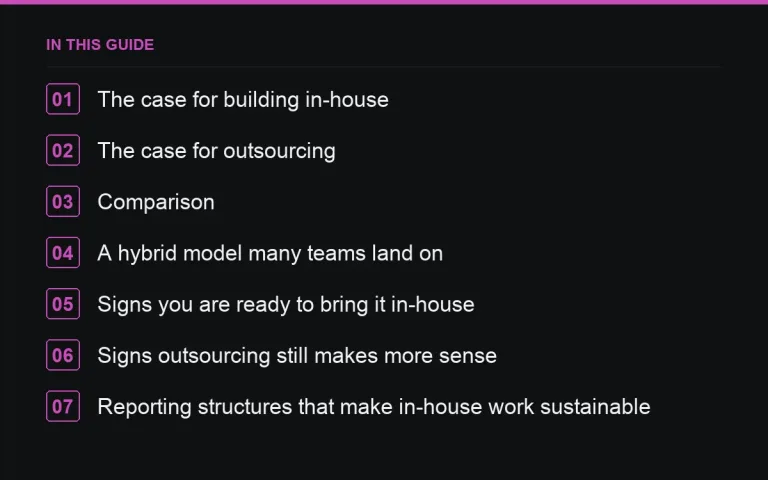
The case for building in-house
An internal link builder develops deep knowledge of your specific product, audience and competitive landscape over time, which outside vendors have to rebuild with every new engagement or client relationship. In-house work also keeps institutional knowledge inside the company rather than walking out the door if you switch agencies, and can be cheaper at real scale once you are buying enough volume that a dedicated headcount pays for itself against agency management fees.
The case for outsourcing
Outsourcing gets you moving immediately, without a hiring process, onboarding time, or the risk of hiring the wrong person for a specialised skill set. Agencies and experienced freelancers bring existing relationships and templates from working across many clients, which a first internal hire simply will not have on day one. For smaller or seasonal needs, outsourcing avoids paying a full-time salary for work that does not fill a full-time role.
Comparison
| Factor | In-house | Outsourced |
|---|---|---|
| Ramp-up time | Slower, includes hiring | Fast, immediate start |
| Cost at low volume | Inefficient, salary regardless of output | Efficient, pay per link or project |
| Cost at high, sustained volume | Can be more efficient | Ongoing management fees add up |
| Institutional knowledge | Retained internally | Held by the vendor |
A hybrid model many teams land on
A common middle ground is hiring one internal person to own strategy, reporting and quality control, who then buys placements directly through https://successtoroad.com/marketplace/ rather than outsourcing the entire function to an agency. This keeps strategic knowledge internal while avoiding the cost and complexity of building a full outreach team from scratch. See https://successtoroad.com/blog/marketplace-vs-agency/ for how this compares to a fully outsourced model.
Signs you are ready to bring it in-house
- You are spending enough on outsourced link building that a dedicated hire’s salary would be comparable or lower.
- Your niche is specialised enough that an outside vendor consistently struggles to source relevant, high-quality placements.
- You want tighter, faster control over strategy and messaging than a vendor relationship easily allows.
Signs outsourcing still makes more sense
If your link building need is modest, seasonal, or you simply do not yet have the internal expertise to manage quality control, outsourcing remains the more efficient path, at least until volume or complexity justifies a dedicated hire.
Reporting structures that make in-house work sustainable
An internal link builder still benefits from the same reporting discipline an agency would provide to a client, if only to demonstrate value to the rest of the business. https://successtoroad.com/blog/link-building-reporting-for-clients/ applies internally just as well, even though the language assumes an agency-client relationship.
Onboarding a new hire into an existing program
Bringing link building in-house usually means training someone who may not have deep SEO background from day one. https://successtoroad.com/blog/seo-client-onboarding/, though written from an agency’s perspective, covers much of the same groundwork worth walking a new internal hire through: understanding site history, prior campaigns, and existing link profile health.
Budgeting for the transition period
Moving from outsourced to in-house link building rarely happens overnight, and budgeting for an overlap period, where both the new hire is ramping up and some outsourced work continues, avoids a gap in link velocity while the transition settles. Treat the first quarter of an in-house hire as a ramp-up period rather than expecting full output immediately.
Whichever direction you move, communicate the change clearly to the rest of your marketing team, since link building rarely happens in isolation from content, PR and broader campaign planning, and a staffing transition that surprises adjacent teams tends to create avoidable friction and duplicated effort.
Signs the decision needs revisiting
Revisit this decision whenever your overall marketing budget changes significantly, your niche’s competitiveness shifts, or your existing arrangement’s output quality noticeably declines. Treating this as a fixed, one-time decision rather than one to periodically re-examine is a common reason businesses stay in a suboptimal arrangement far longer than they should.
Treat this as a standing item on your quarterly marketing review agenda rather than a decision you only revisit when something has already gone visibly wrong.
Treating this as a recurring, scheduled review rather than a reactive decision keeps your staffing model aligned with your actual current needs rather than a choice made once and never revisited.
Put a specific date on the calendar for this review rather than leaving it as a vague future intention that easily gets crowded out by more urgent tasks.
Whichever way the decision goes, write down the reasoning at the time, since it makes the next review far faster and more objective than trying to reconstruct the original thinking from memory months later.
Where to go next
Read https://successtoroad.com/blog/marketplace-vs-freelancer/ for a lighter-weight outsourcing option, and https://successtoroad.com/blog/monthly-retainer-vs-project-pricing/ for how to structure payment either way.
Frequently asked questions
At what point does it make sense to hire in-house?
Generally once your outsourced spend approaches or exceeds what a dedicated hire's salary would cost, or when your niche is specialised enough that outside vendors consistently underperform.
Can one in-house person handle link building alone?
Often yes for small to mid-sized programs, especially if they buy placements directly through a marketplace rather than managing cold outreach entirely from scratch, which is far more time-intensive.
Is outsourcing less effective than an in-house team?
Not inherently. Experienced agencies and freelancers bring relationships and efficiency an in-house beginner will not have immediately, though a well-trained internal team eventually builds equivalent or better product-specific knowledge.
What is the biggest risk of going fully in-house too early?
Paying a full-time salary for a function that does not yet have enough volume or complexity to justify it, when outsourcing on a per-project basis would have been more cost-efficient at that stage.
Put it into practice
Filter 54,483 websites by DR, traffic, niche and price, and order with escrow — you pay only after the link is live.
Browse the marketplace