Hosting Local Events as a Link Building Strategy
An event you organise yourself gives you more control over the story than waiting for press to notice you.
Sponsoring someone else’s event is a passive tactic; hosting your own event flips that around. When you organise something — a workshop, a small local conference, a charity drive, a customer appreciation day open to the public — you control the story, the timing, and who gets invited, which creates more predictable opportunities for coverage and links than waiting to be noticed.
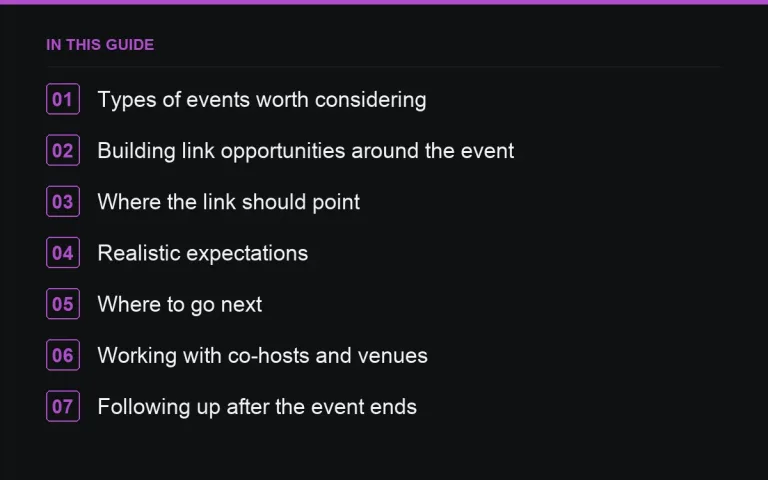
Types of events worth considering
- An educational workshop relevant to your industry (a financial planner hosting a budgeting session, a contractor hosting a home maintenance clinic).
- A community fundraiser or charity drive tied to a cause with local relevance.
- A customer appreciation event that’s genuinely open to the wider community, not just existing customers.
- A co-hosted event with a complementary local business, doubling the promotional reach.
Building link opportunities around the event
Before the event, pitch it to local press and community calendars as a listing (see https://successtoroad.com/blog/local-news-press-links/) — many regional outlets maintain event calendars that link back to organiser websites. During and after, document it well enough that a follow-up recap is worth publishing, either on your own site or pitched as a short story to the same outlets.
A basic event link checklist
- Submit the event to local community calendars and chamber of commerce event listings (see https://successtoroad.com/blog/chamber-of-commerce-links/).
- Invite a local reporter or blogger directly, not just through a general press release.
- Ask any co-hosting partner to link to the event page from their own site.
- Publish a recap afterward with photos, and pitch a short follow-up story if turnout or impact was notable.
Where the link should point
Have a dedicated event page ready before you start outreach, rather than sending people to a generic homepage. This page can later be repurposed or linked from a relevant local landing page (see https://successtoroad.com/blog/local-landing-pages-links/) once the event itself has passed, keeping some of the link value active longer term.
Realistic expectations
A single event typically produces a modest handful of links — a calendar listing or two, a partner mention, maybe a recap article if the story was strong enough. Treat it as one input into a broader local presence rather than a single tactic capable of transforming your link profile on its own.
Where to go next
Pair event hosting with the sponsorship tactics in https://successtoroad.com/blog/sponsorship-link-building/ and the press relationship building in https://successtoroad.com/blog/local-news-press-links/, and use https://successtoroad.com/marketplace/ to maintain a steady link cadence in the months between events.
Working with co-hosts and venues
Sharing an event with a complementary local business or hosting at a well-known venue can extend your reach and split the promotional workload. Agree upfront on how each party will promote the event, including who is responsible for submitting it to which calendars, to avoid duplicated effort or, conversely, gaps where nobody follows through. A clear written understanding, even informal, avoids confusion after the event about who was meant to link to what.
If a venue has its own established audience or mailing list, hosting there rather than at your own premises can also introduce your business to a new segment of the local community that a purely self-hosted event might not reach.
Following up after the event ends
Send a short, genuine thank-you to anyone who helped promote or attend the event, including any local press or bloggers who covered it. This isn’t purely a courtesy — it keeps the relationship warm for your next event or pitch, and occasionally prompts an additional follow-up mention if the event turned out to be more successful than expected.
Setting a realistic RSVP expectation
When submitting an event to community calendars or pitching it to press, provide a realistic expected turnout rather than an inflated guess. Reporters and calendar editors sometimes follow up after the fact, and a significant mismatch between expectation and reality can affect how your future submissions are received.
Insuring an event appropriately
Public-facing events, even modest ones, may need specific liability coverage beyond your standard business insurance. Confirm this with your insurer well before the event, since an uninsured incident could cause far more damage to your local reputation than any link building benefit could offset.
Choosing a date that doesn’t compete with bigger local events
Check your area’s existing event calendar before finalising a date, since competing with a much larger local event for the same weekend can significantly reduce both attendance and press attention, even if your event is otherwise well planned.
Recording lessons for the next event
After each event, jot down a short, honest note on what worked, what didn’t, and what you’d change next time, covering everything from date selection to promotion channels. This turns each event into a genuine learning cycle rather than repeating the same planning process from scratch every time.
Where to go next
This post is one piece of a broader local link building approach. For the full framework, see https://successtoroad.com/blog/local-link-building-guide/.
Frequently asked questions
What kind of event generates the most links?
Events with a clear community benefit or educational angle tend to attract more calendar listings and press interest than purely promotional events.
Do event calendar listings actually count as useful links?
Yes, particularly from chambers of commerce and regional outlets with real local audiences, even though the link is typically a directory-style listing rather than editorial coverage.
Should I host events regularly or occasionally?
Occasional, well-organised events tend to work better than frequent smaller ones that struggle to draw attention each time, unless you have the resources to sustain a regular series.
What if my event has low turnout?
It can still generate a calendar listing and modest coverage; treat turnout as separate from the link building value, and use the experience to refine the next event's timing or format.
Put it into practice
Filter 54,483 websites by DR, traffic, niche and price, and order with escrow — you pay only after the link is live.
Browse the marketplace