Guest Posting on Ukrainian Websites
A practical look at guest posting on Ukrainian sites, from language filtering to publisher etiquette.
Ukrainian publishers sit in an unusual spot: a domestic-language audience, a large diaspora reading Ukrainian abroad, and a media landscape that has consolidated hard around a handful of well-run outlets since 2022. If you’re planning a campaign here, the biggest adjustment for outreach teams used to Western Europe is patience with infrastructure — email response times can be slower, and some publishers run on volunteer or skeleton editorial teams. That doesn’t mean the sites are low quality; many are rebuilding traffic and welcome sponsored content that funds real journalism.
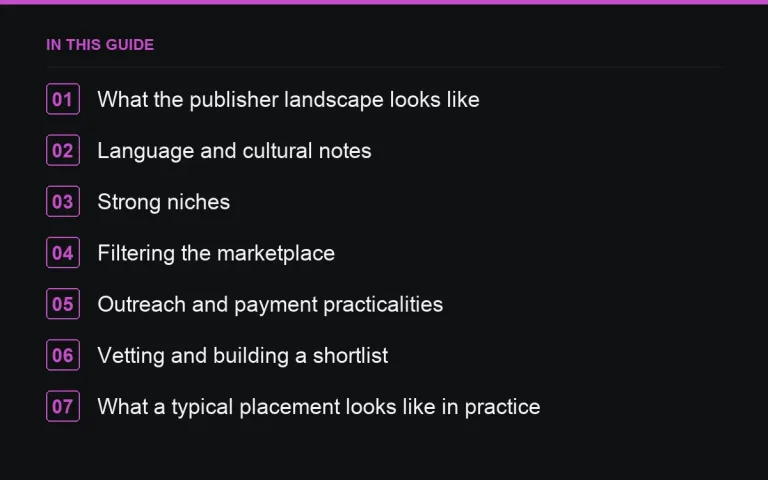
What the publisher landscape looks like
Expect a mix of national news portals, regional city sites, and a growing number of niche blogs in technology, business and lifestyle. Some publishers operate bilingual sites with Ukrainian and Russian versions, though the Russian version is often being phased out or clearly separated — worth checking before you pitch, since editorial policy on this varies by outlet and matters for brand safety. Traffic is concentrated in Kyiv-based media, but don’t ignore regional outlets in Lviv, Kharkiv or Odesa; they carry real local authority for location-specific campaigns.
Language and cultural notes
Write pitches in Ukrainian if you can, or clearly state that translation is available — a generic English template pitching a Ukrainian editor is an easy way to get ignored. Content tone tends to be direct and information-dense rather than heavily narrative; long personal anecdotes translate less well than clear, structured advice. Avoid any messaging that could read as minimising the current situation in the country; editors are understandably sensitive to tone-deaf international brands parachuting in for a backlink.
Strong niches
- Technology and IT services — Ukraine has a large outsourced dev sector, so tech blogs are active and used to working with international clients.
- Business and finance, particularly around reconstruction, logistics and cross-border trade.
- Education, including English-language learning and study-abroad content.
- Lifestyle and travel, aimed at both domestic readers and the diaspora.
Filtering the marketplace
Use https://successtoroad.com/language/ukrainian/ to pull every Ukrainian-language site in one view, then layer in country and niche filters to narrow down to your sector. If you’re running a broader Eastern European campaign, it’s worth comparing metrics side by side rather than buying on domain authority alone — check the https://successtoroad.com/compare/ tool for that. Traffic figures on smaller regional outlets can look thin compared to Western European counterparts of similar authority, which is normal for the market rather than a red flag.
Outreach and payment practicalities
Confirm currency and invoicing terms up front — some publishers prefer payment in USD or EUR rather than local currency, and escrow protects both sides while the piece goes live. Build in extra lead time versus a Western European placement; a two-to-three week turnaround is common and shouldn’t be read as disinterest. If a publisher goes quiet, a single polite follow-up after ten days is normal practice rather than pushy.
Vetting and building a shortlist
Because the publisher landscape is still stabilising, treat traffic figures on smaller outlets as a starting point rather than a guarantee, and check for recent publication activity — a site that hasn’t posted in months is a weak bet regardless of its historical authority. Regional outlets outside Kyiv can be excellent for location-specific campaigns (property, local business services, tourism) precisely because they carry real trust with a readership that national portals don’t reach as deeply.
What a typical placement looks like in practice
Most successful campaigns in this market start with a shortlist of five to ten publishers across national and regional tiers, a Ukrainian-language pitch (or a clear note that translation is available), and a realistic three-week window per placement. Content that offers genuinely useful information — a how-to guide, a comparison, a practical explainer — gets accepted more readily than anything that reads as pure promotion, which holds true here as much as anywhere but matters more given how selective smaller editorial teams need to be about what they publish.
Measuring results honestly
Track placements by publisher tier and region rather than lumping every Ukrainian link into one bucket, since a national portal and a regional city site serve very different purposes in a campaign. Over several months, this breakdown makes it easier to see which tier is actually driving referral traffic and which is contributing mainly to broader authority.
It also helps to revisit your shortlist every quarter. Given how quickly some smaller outlets change ownership, staffing or editorial focus, a publisher that was a strong fit six months ago may no longer be the right match, and a fresh review keeps the campaign from drifting on outdated assumptions.
Where to go next
For the wider region, read our https://successtoroad.com/blog/eastern-europe-link-building-overview/ and our notes on https://successtoroad.com/blog/guest-posting-russian-sites/ if you’re running parallel Russian-language content with compliance in mind. If you’re deciding whether to localise at all, see https://successtoroad.com/blog/local-language-vs-english-placements/ and https://successtoroad.com/blog/translating-vs-native-content-guest-posts/. For the mechanics of running several language markets from one plan, our https://successtoroad.com/blog/multilingual-site-link-strategy/ guide and https://successtoroad.com/blog/international-link-building/ cover the operational side, and https://successtoroad.com/blog/cultural-norms-publisher-negotiations/ is useful before your first outreach email.
Frequently asked questions
Do Ukrainian publishers accept content in English?
Some do, especially technology and business outlets used to international clients, but a Ukrainian translation usually performs better with readers and is more likely to be accepted quickly by the editor.
Is it safe to buy links on bilingual Ukrainian/Russian sites?
Check the site's current editorial stance first. Many publishers have separated or dropped Russian-language sections; placing content on the Ukrainian version only is the safer default for most brands.
How long does a placement typically take?
Budget two to three weeks from pitch to published article. Smaller regional outlets and volunteer-run teams can take longer than national portals.
What niches should I avoid?
Avoid anything that reads as opportunistic commentary on the current situation in the country. Stick to genuinely useful business, technology or lifestyle content.
Put it into practice
Filter 54,483 websites by DR, traffic, niche and price, and order with escrow — you pay only after the link is live.
Browse the marketplace