Guest Posting on Russian-Language Websites
A compliance-first look at Russian-language guest posting, including sanctions screening and where publishers are actually based.
“Russian-language” and “Russia-based” are not the same thing, and that distinction should drive your whole approach to this market. Russian is a working language across a much wider region — parts of Central Asia, the Baltics, Israel, and large diaspora communities in North America and Germany all produce Russian-language content, and plenty of it sits outside any jurisdiction with sanctions exposure. Before running any campaign here, the first job isn’t finding publishers, it’s screening them.
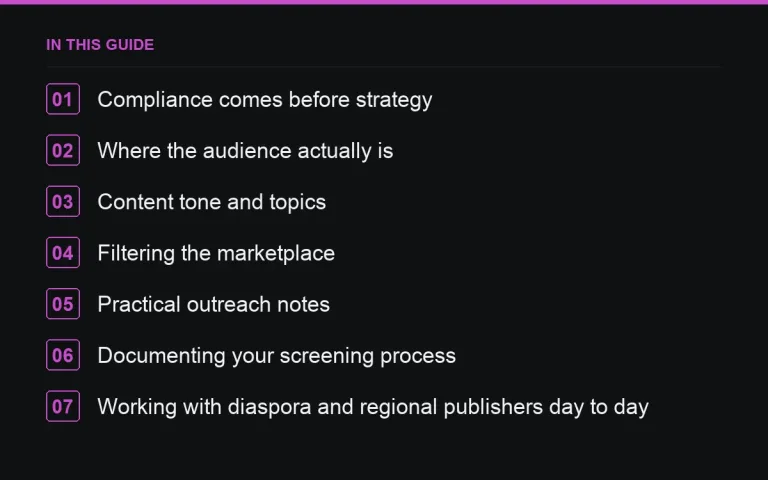
Compliance comes before strategy
Depending on your business’s home jurisdiction, there may be restrictions on paying entities registered in certain countries, transacting through certain payment rails, or working with sanctioned individuals and organisations. This isn’t legal advice, and requirements change, so route any Russian-language campaign through whoever handles compliance at your company before you spend on it. In practice this means checking a publisher’s registration location and payment details, not just its language, and keeping records of that check.
Where the audience actually is
Once you’ve screened for compliance, the Russian-language web is genuinely broad: Kazakhstan, Kyrgyzstan and other Central Asian markets run large Russian-language media alongside their own national languages; Israel has an active Russian-speaking publishing scene; and diaspora sites in Germany, the US and Canada serve emigre communities with business, immigration and lifestyle content. These are often the most straightforward Russian-language placements from a compliance standpoint, since the publisher is registered and paid in a jurisdiction with no additional restrictions.
Content tone and topics
Russian-language readers respond well to detailed, somewhat formal writing — more so than the punchy, scannable style that works in English-language content marketing. Long paragraphs with clear logical structure read as credible rather than dense. Strong topics include immigration and relocation services, personal finance, education abroad, and technology, particularly among diaspora audiences navigating a new country’s systems.
Filtering the marketplace
Use https://successtoroad.com/language/russian/ and then filter by country to separate publishers by where they’re actually registered — this is the single most useful step for keeping a campaign compliant. Cross-check any publisher that looks promising against the https://successtoroad.com/bulk-check/ tool before committing budget, and use escrow so payment only releases once you’ve confirmed the live URL and the publisher’s details match what you screened.
Practical outreach notes
Keep pitches neutral and business-focused; avoid political commentary entirely, in either direction, since it’s rarely relevant to the content you’re placing and can derail a placement. Response times vary widely by country of registration — Central Asian and Baltic-adjacent outlets often respond faster than expected, while some diaspora blogs are run part-time and take longer.
Documenting your screening process
Beyond the initial check, keep a simple record for each publisher: registration country, payment method, and the date you reviewed them. This matters less for any single placement and more as a campaign scales — if a question ever comes up internally about why a particular site was used, having that trail saved makes the conversation straightforward rather than a scramble to reconstruct reasoning after the fact.
Working with diaspora and regional publishers day to day
Once compliance screening is done, the actual placement process for Central Asian, Baltic-adjacent or diaspora Russian-language sites looks a lot like any other market: a clear pitch, a reasonable turnaround expectation, and payment through escrow until the live URL is confirmed. Diaspora sites in particular often welcome business content aimed at their readers navigating life in a new country, so pitches framed around practical, everyday value tend to do well.
Reviewing your approach periodically
Compliance requirements and publisher circumstances both change, so a screening process that was adequate a year ago may need updating. Build a recurring review into the campaign calendar rather than treating the initial screening as a one-time task, and keep whoever handles compliance at your company looped in on any changes to your publisher list, not just the initial approval.
This is also a market where it pays to be conservative rather than opportunistic. If a publisher’s registration details are unclear or hard to verify, it’s generally better to skip that placement and find an alternative than to proceed on an assumption that later turns out to be wrong.
A final note on judgment calls
Not every screening decision will be clear-cut, and there will be borderline cases where a publisher’s registration details are ambiguous. In those situations, defer to whoever owns compliance at your organisation rather than making the call yourself under time pressure — a delayed placement is a far smaller cost than a compliance mistake.
Where to go next
See https://successtoroad.com/blog/guest-posting-ukrainian-sites/ if you’re weighing a parallel Eastern European push, and https://successtoroad.com/blog/eastern-europe-link-building-overview/ for the region as a whole. For general placement mechanics, https://successtoroad.com/blog/international-link-building/ and https://successtoroad.com/blog/currency-invoicing-payment-markets/ cover invoicing differences you’ll want to plan for. If you’re unsure whether native content or translation fits better here, https://successtoroad.com/blog/translating-vs-native-content-guest-posts/ walks through the trade-offs, and https://successtoroad.com/blog/cultural-norms-publisher-negotiations/ covers negotiation tone more broadly.
Frequently asked questions
Is Russian-language guest posting compliant with sanctions rules?
It can be, but this depends on the publisher's registration location, payment method and your own jurisdiction's rules. Always route this through your compliance team before spending; this guide is not legal advice.
Are all Russian-language sites based in Russia?
No. Russian is a major language in Central Asia, the Baltics, Israel and diaspora communities worldwide, many of which carry no additional compliance restrictions.
How do I filter for publisher location, not just language?
Combine the {{lang:russian}} filter with the marketplace's country filter, and check registration details on any site before paying.
What topics work best for diaspora Russian-language readers?
Immigration, relocation, personal finance and education abroad tend to perform well, since these audiences are actively navigating a new country's systems.
Put it into practice
Filter 54,483 websites by DR, traffic, niche and price, and order with escrow — you pay only after the link is live.
Browse the marketplace