Guest Posting on Latvian Websites
A practical guide to guest posting in Latvia, covering its bilingual publisher base and where genuine audience attention sits.
Latvia is one of the smallest language markets you’re likely to run a dedicated campaign in, with a population under two million, but it’s a well-organised one. Riga-based media and a compact set of niche blogs cover most of the country’s online publishing, and EU membership means standard, predictable practices around invoicing, VAT and contracts.
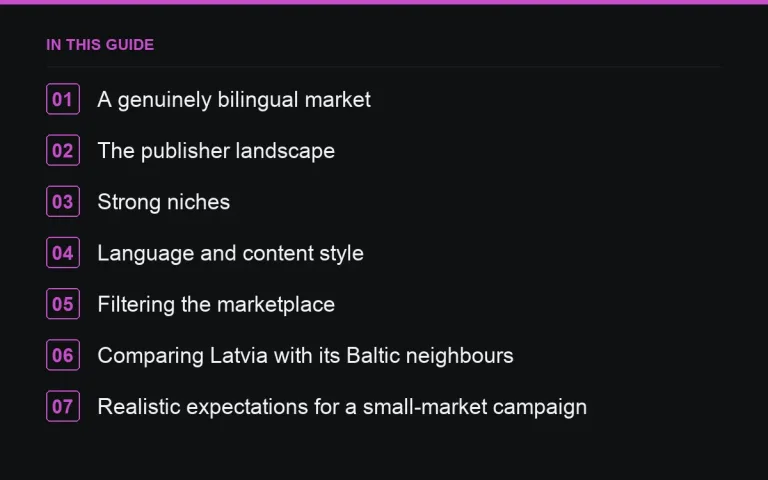
A genuinely bilingual market
Latvia has a significant Russian-speaking population, and it’s common to find publishers running content in both Latvian and Russian, sometimes on the same site with separate sections. Check which audience a specific outlet is actually reaching before choosing a language for your piece — a Latvian-only placement misses the Russian-reading segment of the audience, and vice versa, so this is worth clarifying with the publisher directly rather than assuming.
The publisher landscape
Expect a smaller total number of sites than in larger European markets, concentrated in national news, business, and a handful of active lifestyle and technology blogs. Traffic ceilings are naturally lower given the population size, so judge sites by engagement and relevance rather than expecting the volume you’d see in a market ten times the size.
Strong niches
- Real estate and property, a widely discussed topic given Latvia’s active rental and investment market.
- Technology and startups, with Riga developing a modest but real tech scene.
- Personal finance and banking.
- Travel, both inbound tourism content and Baltic regional travel guides.
Language and content style
Latvian readers generally prefer concise, practically structured content over long narrative pieces. English is reasonably well understood among younger, urban readers, but general-audience publishers still expect Latvian for best engagement. If budget allows, get any translated content reviewed by a native speaker; Latvian’s grammar is distinct enough from most Western European languages that machine translation errors are usually easy for a native reader to spot.
Filtering the marketplace
Use https://successtoroad.com/language/latvian/ to isolate the market, and given its small size, it’s often efficient to review the full list of matching sites directly rather than narrowing heavily by niche first. Pair with https://successtoroad.com/niche/real-estate/ or https://successtoroad.com/niche/finance/ depending on your sector, and use https://successtoroad.com/bulk-check/ to verify traffic claims on smaller sites before committing.
Comparing Latvia with its Baltic neighbours
Estonia and Lithuania share a broadly similar market structure — small population, EU-standard invoicing, and a compact set of national and niche publishers — but none of the three languages are mutually intelligible, so a campaign covering all three Baltic states needs three separate content tracks even though the markets are operationally similar.
Realistic expectations for a small-market campaign
Given the limited total number of sites, it’s worth allocating slightly more time per outreach email — a more personalised pitch to each of a short list of ten or fifteen relevant sites tends to outperform a templated blast, especially since editors in a market this size often know of each other and compare notes on outreach quality.
Making the most of a small but capable market
Because the total number of relevant sites is limited, it’s worth treating each successful placement as an opportunity to build an ongoing relationship rather than a one-off transaction. A publisher who has worked with your brand once and had a good experience is often willing to consider follow-up pitches more readily in a market this size, where trust and word of mouth carry real weight.
Where a Latvian campaign is part of a broader Baltic push, keep clear records of which publishers you’ve approached in each country to avoid duplicated or conflicting outreach across a small, closely connected media environment.
A note on setting expectations internally
When reporting results to stakeholders unfamiliar with small-market campaigns, set expectations upfront that raw volume and traffic figures will be modest compared to larger European markets, so success is judged by relevance and engagement rather than an unfair comparison to a market ten times the size.
Working alongside Estonian and Lithuanian campaigns
Many brands treat the three Baltic states as one operational project even though the languages are entirely distinct, sharing a single project timeline and budget review process across all three while still producing separate native content for each. This shared operational structure tends to be more efficient than running three entirely separate campaign processes for markets of comparable size and structure.
Working with Latvia’s business and startup community directly
Riga’s modest but genuine startup scene has produced a small number of active business and technology blogs run by founders and industry figures rather than traditional media companies. These can be valuable, highly relevant placements for technology and business brands, though they often require a more personal, direct approach to outreach than a formal media pitch.
Where to go next
Read https://successtoroad.com/blog/eastern-europe-link-building-overview/ for how Latvia compares with its Baltic and Eastern European neighbours, and https://successtoroad.com/blog/guest-posting-russian-sites/ given the bilingual publisher overlap noted above. Our https://successtoroad.com/blog/international-link-building/ and https://successtoroad.com/blog/currency-invoicing-payment-markets/ posts cover the practical side of running a small-market campaign, and https://successtoroad.com/blog/translating-vs-native-content-guest-posts/ is worth reading given the translation point above.
Frequently asked questions
Should I write in Latvian or Russian for this market?
It depends on the specific publisher's audience. Many Latvian sites serve a mixed readership; ask the editor directly which language section actually gets the traffic you want to reach.
Is the Latvian publisher market big enough for a large campaign?
It's a small market given the population, so judge success by engagement and relevance rather than expecting the volume of sites you'd find in a larger European country.
Do I need native-speaker review for translated content?
It's recommended. Latvian grammar differs enough from most Western European languages that translation errors are usually noticeable to native readers, so a native review pass is worth the cost.
What are the strongest content niches in Latvia?
Real estate and property, technology and startups, personal finance, and Baltic regional travel content all have active, engaged publisher audiences.
Put it into practice
Filter 54,483 websites by DR, traffic, niche and price, and order with escrow — you pay only after the link is live.
Browse the marketplace