Guest Posting on Korean Websites
A guide to Korean guest posting, a market shaped by platform blogging culture and high standards for polish and formality.
South Korea’s online publishing culture is shaped heavily by platform blogging — services with large built-in readerships that function differently from the independent WordPress-style blogs common in Western markets. Understanding this distinction matters more here than in most language markets, since it changes what “a good Korean placement” actually looks like.
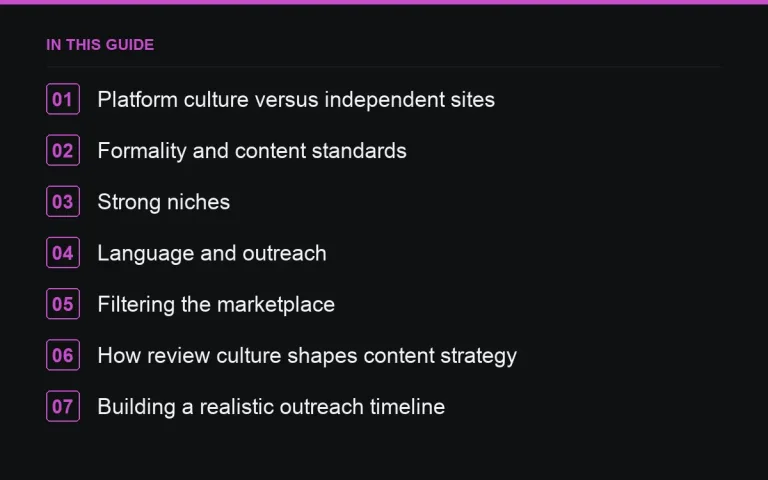
Platform culture versus independent sites
A meaningful share of Korean content lives on blogging platforms with their own search and discovery systems, alongside independent sites and major online news outlets. When evaluating a Korean-language publisher, check whether its audience comes from general web search, from within a platform’s own ecosystem, or from social sharing — this affects how much of that traffic actually translates into search-relevant backlink value versus platform-internal visibility.
Formality and content standards
Korean readers expect a high level of polish: clean structure, confident but not overly casual language, and content that demonstrates real expertise rather than surface-level advice. Beauty, technology and lifestyle content in particular face intense competition for attention, so a generic guest post is unlikely to get real engagement even if it’s technically accepted by an editor.
Strong niches
- Beauty and skincare, one of the most competitive and well-developed content categories in the world in this market.
- Technology and consumer electronics.
- Education, particularly around exam preparation and study-abroad content.
- Food and lifestyle, with strong visual and narrative content culture.
Language and outreach
Native-level Korean is close to essential — this is not a market where a competent but non-native piece will be well received, given how developed the domestic content industry already is. Outreach tone should be polite and appropriately formal; Korean business communication has clear conventions around hierarchy and respect that are worth respecting even in a brief email exchange.
Filtering the marketplace
Use https://successtoroad.com/language/korean/ to filter the marketplace, and pair with https://successtoroad.com/niche/beauty/ or https://successtoroad.com/niche/technology/ depending on sector. Given the competitive nature of Korean content, it’s worth spending more time vetting a smaller number of genuinely strong sites here than spreading budget thin across many mediocre ones — check real engagement signals via https://successtoroad.com/bulk-check/ rather than relying on headline traffic numbers alone.
How review culture shapes content strategy
Korean consumers, particularly in beauty and technology, place heavy weight on detailed, comparative reviews rather than broad brand messaging. A guest post structured as a genuine comparison or a detailed how-to, rather than a single-product pitch, tends to perform better both with editors and with the eventual readership.
Building a realistic outreach timeline
Given the competitiveness of this market, expect a lower acceptance rate per pitch than in less saturated markets, and plan outreach volume accordingly — a campaign that budgets for contacting twenty sites to land three or four strong placements is being realistic about how selective Korean editors can afford to be.
Working with influencer-adjacent publishers
A number of Korean platform blogs blur the line between traditional publishing and influencer marketing, and it’s worth clarifying upfront whether a placement functions as a standard guest post or something closer to a sponsored influencer post, since the expectations, format and pricing can differ meaningfully between the two even on the same platform.
This distinction also affects how you should evaluate results — engagement metrics on an influencer-style placement are often a better signal of value than traditional backlink authority alone.
A note on long-term brand building
Because Korean content markets are so competitive, a single placement rarely moves the needle on its own. Treat guest posting here as part of a longer, sustained presence-building effort rather than a quick win, and budget patience alongside the extra production cost this market generally requires.
Understanding platform-specific submission requirements
Different Korean platforms and independent sites can have quite different technical and formatting requirements for guest content — some expect a specific structure or length, others have stricter rules about promotional language than a typical independent blog would. Confirming these requirements before drafting, rather than adapting after a rejection, saves a meaningful amount of back-and-forth in a market where editorial standards are already demanding.
Working with English-language Korean business media
Alongside the Korean-language press, a smaller tier of English-language business and technology media covers the Korean market for an international audience, including expatriates and international investors. This can be a useful complementary placement type for brands wanting some Korea-relevant coverage without the full native-language production requirement discussed above, though it reaches a narrower domestic audience.
Given how much this market rewards patience and genuine quality, resist the temptation to judge a Korean campaign’s success after only one or two placements. A longer view, tracking engagement and relationship quality over several months, gives a much fairer picture of whether the approach is working.
Where to go next
See https://successtoroad.com/blog/guest-posting-japanese-sites/ for a useful contrast in formality and outreach style, and https://successtoroad.com/blog/link-building-southeast-asia/ for the wider East and Southeast Asian picture. Our https://successtoroad.com/blog/cultural-norms-publisher-negotiations/ guide expands on formality expectations, and https://successtoroad.com/blog/translating-vs-native-content-guest-posts/ explains why native-quality writing carries more weight in mature content markets like this one.
Frequently asked questions
Is platform blogging different from a regular website for link purposes?
Yes. Some Korean platform blogs draw traffic mainly from within the platform's own ecosystem rather than general web search, which affects how their traffic translates into standard SEO value. Check the traffic source before assuming equivalence with an independent site.
Do I need a native Korean writer?
Essentially yes. The domestic content industry, especially in beauty and lifestyle, is highly developed, and non-native writing is unlikely to get genuine engagement even where it's technically accepted.
What's the most competitive content category?
Beauty and skincare content faces some of the most intense competition for attention anywhere in the world, so this niche needs particularly strong, specific content to stand out.
Should outreach emails be very formal?
Politeness and appropriate formality matter. Korean business communication has clear conventions around respect and hierarchy that are worth reflecting even in a short outreach email.
Put it into practice
Filter 54,483 websites by DR, traffic, niche and price, and order with escrow — you pay only after the link is live.
Browse the marketplace