Guest Posting on Japanese Websites
A guide to Japanese guest posting, a relationship-driven market where cold outreach performs differently than in the West.

Japan’s publisher market rewards patience and formality in a way that catches a lot of Western outreach teams off guard. Cold pitches that would get a reasonable response rate in the US or UK often go unanswered here, not because the content is bad but because the approach doesn’t match how Japanese editors expect to be approached. Understanding that upfront saves a lot of wasted effort.
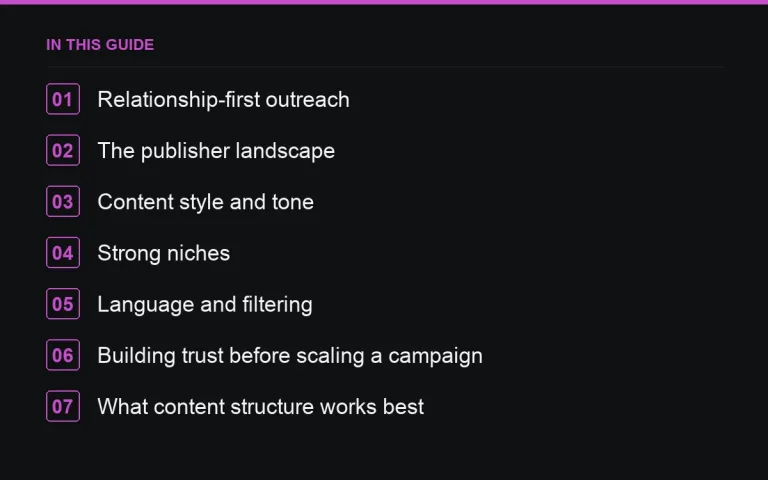
Relationship-first outreach
A warm introduction, even a light one through a mutual contact or an existing marketplace relationship, meaningfully improves response rates compared to a cold email. Where a warm intro isn’t possible, a more formal, detailed first message that clearly explains who you are, what your business does and why the content is relevant performs better than a short, casual pitch — brevity reads as low-effort rather than efficient in this context.
The publisher landscape
Japan has a large, sophisticated blog and media ecosystem, from major portal-affiliated sites to highly specific niche blogs with small but devoted readerships. Niche authority matters a great deal — a small blog with a genuinely engaged following in a specific hobby or professional area can be more valuable than a larger general-interest site, and Japanese readers tend to trust specialist voices.
Content style and tone
Overt sales language and superlative claims (“the best,” “revolutionary”) read as untrustworthy to Japanese readers, who generally prefer modest, detail-oriented writing that lets the information speak for itself. Long-form, thoroughly researched content with clear structure and visual breaks (even though images aren’t part of the placement itself, structure still matters for how the text reads) tends to be well received.
Strong niches
- Technology and consumer electronics.
- Travel, particularly regional and lesser-known destinations within Japan.
- Beauty and skincare, a large and detail-oriented content category.
- Business and productivity culture.
Language and filtering
Native-level Japanese is close to essential; machine-translated or non-native content is usually easy for an editor to spot and reflects badly on the pitch. Use https://successtoroad.com/language/japanese/ to filter the marketplace, and pair it with relevant niche filters — https://successtoroad.com/niche/technology/ and https://successtoroad.com/niche/beauty/ are both well represented. Because relationship quality matters so much here, keep a record of publishers you’ve worked with before and prioritise repeat placements over one-off cold pitches where you can.
Building trust before scaling a campaign
Rather than reaching out to a large batch of Japanese publishers at once, many successful campaigns start narrow: a small number of carefully chosen sites, a properly localised and formally written pitch, and a genuine effort to build a working relationship with each. Once a few placements land well, subsequent introductions and referrals within the same publisher community become noticeably easier to secure.
What content structure works best
Long-form pieces broken into clear sections with specific, concrete detail — rather than broad generalisations — read as more credible to Japanese audiences. Avoid claiming an idea or product is unique or first-of-its-kind unless it demonstrably is; overstated claims are one of the fastest ways to lose credibility with an editor here.
Handling rejection gracefully
A polite decline from a Japanese editor is not necessarily the end of the relationship — a respectful response acknowledging their decision, without pushing back, keeps the door open for a future, better-fitting pitch. Editors in this market tend to remember how a brand handled a no, and that memory can matter for a second approach months later.
It’s also worth asking, where appropriate, what kind of content the publication would be more interested in, rather than assuming the door is fully closed after one rejected pitch.
A note on long-term campaign value
Placements in this market tend to have a longer effective shelf life than in faster-moving content markets, since Japanese readers frequently revisit trusted, well-regarded publications for reference rather than only consuming content once. This makes the extra upfront effort in this market a reasonably durable investment.
Adapting content format to Japanese reading habits
Japanese readers are generally comfortable with longer articles than some Western markets, provided the structure is clear and the information genuinely earns the length. A well-organised, thorough piece with clear section breaks tends to be read all the way through rather than abandoned partway, which is worth keeping in mind when deciding how much detail to include in a given guest post.
Understanding the role of niche forums and communities
Beyond blogs and formal media, Japan has a strong tradition of specialist online communities and forums with real influence in specific hobby or professional areas. While these aren’t always structured for guest posting in the traditional sense, being aware of where a topic’s most engaged community actually lives helps identify which blog placements will genuinely reach an interested audience versus one that merely looks authoritative on paper.
Where to go next
See https://successtoroad.com/blog/guest-posting-korean-sites/ and https://successtoroad.com/blog/guest-posting-chinese-sites/ for how neighbouring East Asian markets compare in tone and structure. Our https://successtoroad.com/blog/cultural-norms-publisher-negotiations/ guide expands on formality expectations across regions, and https://successtoroad.com/blog/translating-vs-native-content-guest-posts/ explains why native writing matters more in some markets than others. For the operational side of running this alongside other languages, read https://successtoroad.com/blog/international-link-building/ and https://successtoroad.com/blog/multilingual-site-link-strategy/.
Frequently asked questions
Why do cold pitches perform worse in Japan than in Western markets?
Japanese business culture generally favours warmer, more formal introductions over brief cold outreach. A detailed, respectful first message tends to outperform a short, casual pitch.
Is machine-translated content acceptable?
No. It's usually easy for an editor to identify and reflects poorly on the pitch. Native-level Japanese writing is close to essential for acceptance.
Do small niche blogs matter in this market?
Yes, often more than in Western markets. A small blog with a genuinely engaged niche readership can carry real influence and trust.
What tone should the content have?
Modest and detail-oriented. Overt sales language or superlative claims tend to undermine credibility with Japanese readers rather than persuade them.
Put it into practice
Filter 54,483 websites by DR, traffic, niche and price, and order with escrow — you pay only after the link is live.
Browse the marketplace