Guest Posting on Chinese-Language Websites
A guide to Chinese-language guest posting focused on accessible publisher ecosystems in Taiwan, Hong Kong, Singapore and beyond.
“Chinese-language” guest posting means something quite different depending on where the publisher sits. Mainland China’s internet operates behind its own regulatory and technical ecosystem, with domestic platforms rather than the open web most international marketers are used to buying links on — this guide focuses instead on the large, accessible Chinese-language publisher base outside the mainland, in Taiwan, Hong Kong, Singapore, Malaysia and diaspora communities worldwide.
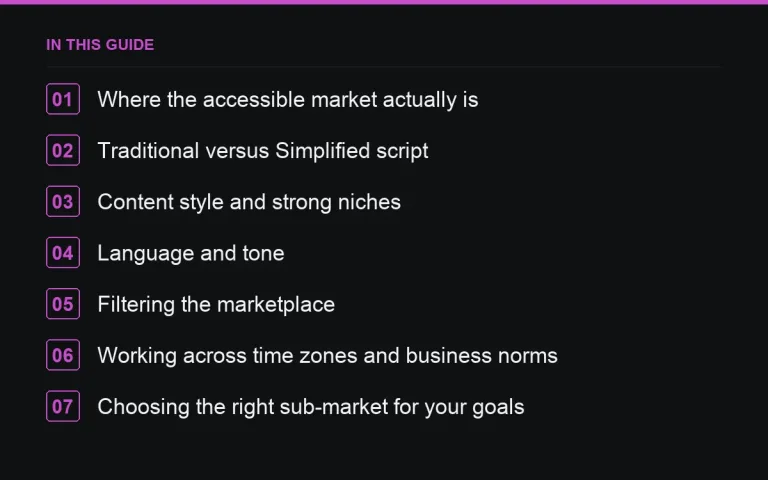
Where the accessible market actually is
Taiwan has a mature, open blog and media ecosystem writing in Traditional Chinese, with strong coverage in technology, lifestyle and business. Hong Kong mixes Traditional Chinese and English content, often on the same site, reflecting its bilingual business culture. Singapore and Malaysia both have active Chinese-language publishing alongside English and other national languages, serving large ethnic Chinese populations. Diaspora sites in North America, Australia and the UK round out a genuinely broad, easily reachable publisher base.
Traditional versus Simplified script
Taiwan and Hong Kong generally use Traditional Chinese characters, while Singapore, Malaysia and mainland-oriented diaspora content more often use Simplified. Confirm which script a publisher expects before submitting content — sending the wrong script reads as careless and is an easy way to have a piece rejected outright.
Content style and strong niches
- Technology and consumer electronics, especially in Taiwan’s strong hardware and startup scene.
- Business and finance, particularly in Hong Kong and Singapore’s roles as regional financial centres.
- Education and study-abroad content, heavily searched among diaspora families.
- Food, lifestyle and travel, with strong regional identity content in each location.
Language and tone
Native-quality writing matters; readers across these markets are quick to spot machine translation, and a stilted piece undermines trust in the brand behind it as much as the content itself. Tone varies by market — Taiwanese content tends toward warmer, more conversational writing, while Hong Kong and Singapore business publications lean more formal and concise.
Filtering the marketplace
Use https://successtoroad.com/language/chinese/ and pair it with a country filter to separate Taiwan, Hong Kong, Singapore and diaspora publishers rather than treating them as one block. The https://successtoroad.com/niche/technology/ and https://successtoroad.com/niche/finance/ filters are both well represented, and the https://successtoroad.com/compare/ tool helps weigh options across these quite different sub-markets on the same view.
Working across time zones and business norms
Taiwan, Hong Kong and Singapore each have their own business hours and holiday calendars (Lunar New Year affects editorial schedules significantly across all of them), so build campaign timelines around local calendars rather than assuming a uniform response pattern. Editorial pace can slow noticeably in the weeks around major regional holidays.
Choosing the right sub-market for your goals
If your priority is B2B and finance audiences, Hong Kong and Singapore’s business press is usually the stronger fit; if consumer technology or lifestyle is the goal, Taiwan’s more developed independent blogging scene often offers better engagement per placement. Treating these as one interchangeable “Chinese-language” bucket wastes some of this distinction.
Avoiding common missteps
The most frequent error in this market is treating “Chinese-language” publishers as one interchangeable pool without checking script, country or audience — a Simplified Chinese piece submitted to a Traditional Chinese-expecting Taiwanese outlet, for instance, is an easy way to have a strong pitch rejected on a technicality that had nothing to do with the content itself.
A second common misstep is underestimating how competitive Taiwan’s technology blogging scene is; a generic product pitch without genuine substance is unlikely to get traction there even if the underlying idea is sound.
A note on long-term relationship value
Given how relationship-driven these markets can be, especially Taiwan’s niche blogging scene, it’s worth tracking which publishers you’ve worked with successfully before and prioritising them for future campaigns rather than treating every new push as a fresh cold-outreach exercise.
Planning content around regional holidays
Beyond Lunar New Year, Taiwan, Hong Kong and Singapore each observe their own additional public holidays that can affect editorial schedules — Mid-Autumn Festival being a common example across all three. Checking each publisher’s regional holiday calendar before planning a pitch timeline helps avoid submitting into a period when a response is unlikely for reasons unrelated to the content itself.
Working with the Malaysian Chinese-language press specifically
Malaysia’s Chinese-language media operates somewhat independently from Singapore’s despite geographic closeness, with its own national outlets and regional publications serving the country’s ethnic Chinese population. Treating Malaysia as its own distinct sub-market, rather than folding it into a combined Singapore-Malaysia shortlist, tends to produce more locally relevant placements.
As this market matures across its various sub-regions, periodically revisit which country or script variant is delivering the strongest engagement for your specific niche, and adjust budget allocation accordingly rather than keeping a fixed split indefinitely.
Where to go next
See https://successtoroad.com/blog/guest-posting-korean-sites/ and https://successtoroad.com/blog/guest-posting-japanese-sites/ for how neighbouring East Asian markets differ in approach, and https://successtoroad.com/blog/link-building-southeast-asia/ for how Singapore and Malaysia fit into the wider region. Our https://successtoroad.com/blog/multilingual-site-link-strategy/ and https://successtoroad.com/blog/international-link-building/ guides cover running several script and country variants under one language filter, and https://successtoroad.com/blog/translating-vs-native-content-guest-posts/ explains why native writing matters here specifically.
Frequently asked questions
Does this cover mainland Chinese publishers?
No. Mainland China's internet operates within its own regulatory and technical ecosystem separate from the open web. This guide focuses on the accessible Chinese-language publisher base in Taiwan, Hong Kong, Singapore, Malaysia and diaspora communities.
Traditional or Simplified Chinese — which should I use?
It depends on the publisher. Taiwan and Hong Kong generally expect Traditional characters; Singapore, Malaysia and mainland-oriented diaspora content more often expect Simplified. Always confirm before submitting.
Are Hong Kong and Singapore sites bilingual?
Often yes. Many publishers in both markets run English and Chinese content side by side, reflecting their bilingual business cultures, so check which language a specific outlet actually wants for guest content.
What niches have the strongest publisher coverage?
Technology, business and finance, education and study-abroad content, and lifestyle or food content all have active, well-established outlets across these markets.
Put it into practice
Filter 54,483 websites by DR, traffic, niche and price, and order with escrow — you pay only after the link is live.
Browse the marketplace