Eastern Europe: A Link Building Overview
A region-wide overview of Eastern Europe for link building, from Poland's scale to smaller Baltic and Balkan markets.
Eastern Europe covers a wide range of market sizes and languages, from Poland’s large, well-developed publisher base down to smaller markets like Latvia or Bulgaria with a fraction of the site count. What ties the region together for planning purposes is generally accessible pricing relative to Western Europe and, in EU member states, standardised invoicing and payment practices.
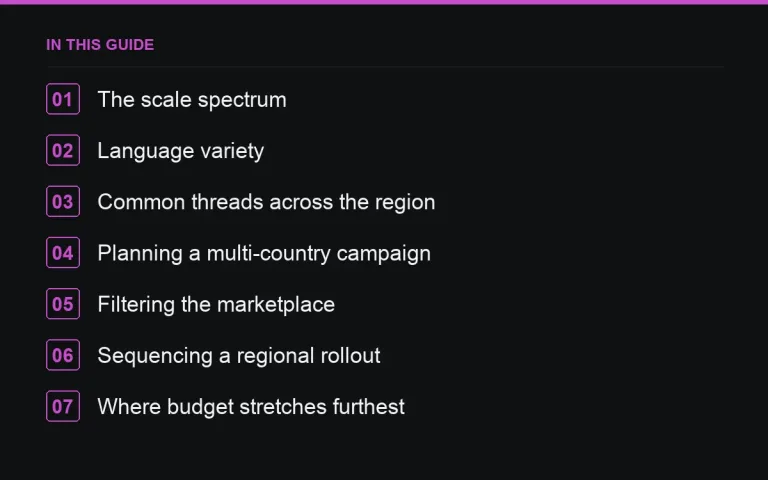
The scale spectrum
Poland and Romania sit at the larger end, with substantial national media, active niche blogging scenes and enough publisher volume to run large, well-segmented campaigns. Countries like Bulgaria, Latvia, Lithuania and Estonia have smaller total publisher pools, which means less room to be highly selective by niche, but also less competition for editorial attention and generally lower placement costs. Ukraine sits somewhat apart given its distinct current media dynamics, covered in more depth in our dedicated Ukrainian guide.
Language variety
Despite geographic proximity, Eastern European languages are far from mutually intelligible — Slavic languages like Polish, Bulgarian and Ukrainian share some structural similarities but are not interchangeable for content purposes, and Baltic languages (Latvian, Lithuanian) are a separate family entirely. Hungarian and Romanian sit further outside the Slavic language group again. Each market needs native-quality content in its own language; there’s no efficient shortcut based on regional similarity here.
Common threads across the region
- Generally lower pricing than Western Europe for comparable authority metrics, making the region efficient for scaling a broader European campaign.
- EU membership (for most countries in the region) standardises invoicing, VAT and payment expectations.
- Strong reader interest in personal finance, real estate and technology content across most markets.
- Some publishers run lean, part-time editorial operations, so response times can be slower than in larger Western markets.
Planning a multi-country campaign
Decide early whether you’re running one campaign per country with tailored content, or a smaller set of themes adapted across several markets — the second approach is more efficient for smaller budgets but still needs native-language execution per country, not machine translation. Prioritise by where your actual audience and business relevance sit rather than defaulting to the biggest markets by publisher count.
Filtering the marketplace
Filter by country individually — Poland, Romania, Bulgaria, Latvia and others — rather than relying on a single “Eastern Europe” label, since language and audience differ meaningfully underneath that grouping. Use https://successtoroad.com/compare/ to weigh pricing across several countries on one shortlist, and https://successtoroad.com/niche/finance/ or https://successtoroad.com/niche/real-estate/ given how consistently those categories perform region-wide.
Sequencing a regional rollout
A practical approach starts with Poland or Romania for scale, then adds smaller markets like Bulgaria, Latvia or Lithuania once the campaign’s content production process is proven, rather than trying to launch across the whole region simultaneously with an unproven workflow.
Where budget stretches furthest
Smaller Baltic and Balkan markets generally offer the most favourable ratio of authority to price in the region, precisely because they see less competition for editorial attention from international advertisers than larger markets like Poland do.
Coordinating internal resourcing across many languages
Running a region this linguistically varied usually requires either a network of native freelance writers per language or a specialised agency covering the region, since maintaining in-house native expertise across seven or eight distinct Eastern European languages is impractical for most marketing teams. Plan resourcing for this reality early rather than assuming one bilingual team member can cover the whole region.
Where possible, working with the same trusted writer or reviewer for each language over time, rather than sourcing fresh talent per campaign, keeps quality and tone consistent as the region-wide campaign scales.
A note on realistic timelines
Given the number of languages involved, allow more lead time for a full regional campaign than you might for a single-language market, particularly in the early stages while native writer relationships for each language are still being established.
Working with EU-wide trade and policy coverage
For the EU member states within this region, a layer of pan-European trade and policy media exists alongside purely national press, covering topics like EU funding, cross-border trade and regulatory harmonisation. This is worth including in a shortlist for B2B content that speaks to genuinely EU-wide themes rather than a single country’s market alone.
Working with Hungary and the Czech Republic within the region
Hungary and the Czech Republic both have well-developed national media and business press, sitting somewhat apart linguistically from the Slavic-language cluster discussed elsewhere in this region. Both are worth including in a broader Eastern European shortlist given their genuine publisher depth, though each needs its own dedicated native-language content track.
Given how much this region rewards a steady, well-resourced native-language approach over a rushed, high-volume one, building out reliable writer and reviewer relationships per language early is one of the better investments a multi-country Eastern European campaign can make.
Where to go next
Read our dedicated guides on https://successtoroad.com/blog/guest-posting-bulgarian-sites/, https://successtoroad.com/blog/guest-posting-latvian-sites/ and https://successtoroad.com/blog/guest-posting-ukrainian-sites/ for placement-level detail in specific markets, and https://successtoroad.com/blog/guest-posting-russian-sites/ for compliance considerations relevant to parts of the region. Our https://successtoroad.com/blog/multilingual-site-link-strategy/ and https://successtoroad.com/blog/international-link-building/ guides cover planning a multi-country region like this from one operational plan.
Frequently asked questions
Can I use one translated piece across several Eastern European countries?
Not effectively. The languages are not mutually intelligible despite geographic proximity, so each market needs its own native-quality content rather than one translated piece reused region-wide.
Which countries have the largest publisher pools?
Poland and Romania generally offer the most volume and segmentation options. Smaller markets like Bulgaria, Latvia, Lithuania and Estonia have fewer sites but often lower costs and less competition for attention.
Is pricing generally lower than Western Europe?
Yes, for comparable authority metrics, pricing across most of Eastern Europe tends to run lower than Western European markets, making it efficient for scaling a broader campaign.
What content categories perform well across the whole region?
Personal finance, real estate and technology content see strong, consistent reader interest across most Eastern European markets.
Put it into practice
Filter 54,483 websites by DR, traffic, niche and price, and order with escrow — you pay only after the link is live.
Browse the marketplace