Domain Rating Explained: What Ahrefs’ DR Score Actually Measures
A close look at Ahrefs' Domain Rating score and how to read it without over-trusting it.

Domain Rating, or DR, is a 0-100 score published by Ahrefs that estimates the relative strength of a website’s backlink profile compared to every other domain in Ahrefs’ index. It is one of the most commonly quoted numbers in link building, and one of the most commonly misread. This post explains what actually goes into it and how to use it without treating it as gospel.
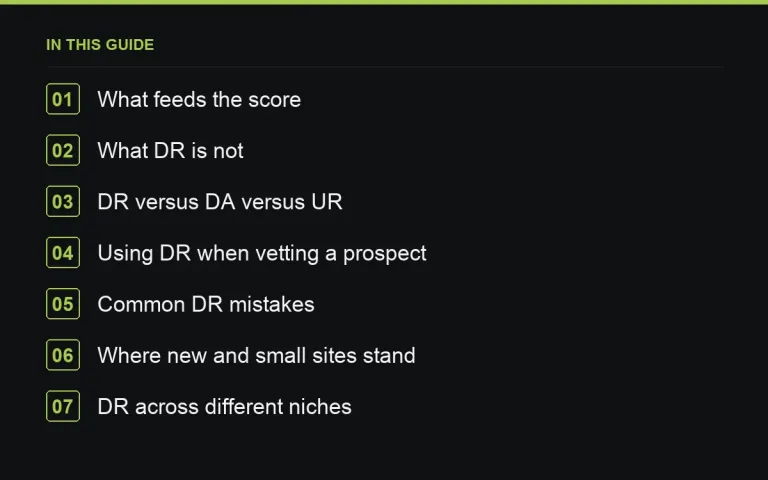
What feeds the score
DR is calculated from the number and strength of referring domains pointing at a site, not the raw number of backlinks. A domain with 50 links from 50 different strong domains will typically outscore one with 500 links from five weak domains. The score is logarithmic, which is why the jump from DR 20 to DR 30 is much easier to achieve than the jump from DR 80 to DR 90 — each additional point at the top of the scale requires disproportionately more link equity.
Why DR moves the way it does
- Losing a handful of strong referring domains can drop DR noticeably.
- Gaining many weak, unrelated referring domains barely moves it.
- Internal links do not count — DR is purely an external, off-site signal.
- It recalculates on Ahrefs’ own schedule, so it is a snapshot, not a live counter — see https://successtoroad.com/blog/how-often-metrics-update/.
What DR is not
DR is not a Google ranking factor. Google has repeatedly said it does not use third-party metrics like DR internally. It is also not a measure of traffic, content quality, or trustworthiness — a site can have a respectable DR built almost entirely from directory links, forum profiles, or a private blog network, and still be a poor place to get a link from. This is why reading the actual referring domains matters more than the headline number; see https://successtoroad.com/blog/how-to-read-a-link-profile/.
DR versus DA versus UR
DR is Ahrefs’ domain-level score. Moz’s Domain Authority (https://successtoroad.com/blog/domain-authority-explained/) does a similar job with a different index and formula, so the two numbers are not interchangeable. Ahrefs also publishes URL Rating (UR), the same idea applied to a single page rather than the whole domain — useful when the exact page hosting your link matters more than the domain as a whole, covered in https://successtoroad.com/blog/url-rating-vs-domain-rating/.
Using DR when vetting a prospect
| Signal | What it tells you alongside DR |
|---|---|
| Referring domains count | Whether the DR is backed by breadth or a handful of large links |
| Traffic estimate | Whether there is a real audience, not just link equity |
| Spam score | Whether the links feeding DR look manipulated (https://successtoroad.com/blog/spam-score-explained/) |
| Niche relevance | Whether the authority is relevant to your buyer’s industry |
A sensible workflow: filter a prospect list by a DR floor first, then apply the other checks before you commit budget. https://successtoroad.com/blog/bulk-domain-check-for-prospect-lists/ covers doing this at scale, and https://successtoroad.com/blog/scoring-model-for-publisher-selection/ shows how to combine DR with the other signals into one weighted score instead of eyeballing each site individually.
Common DR mistakes
The most frequent mistake is chasing round numbers — insisting on “DR 50+” as a blanket rule regardless of niche. A DR 35 site in a narrow, technical niche with genuine readers is usually worth more than a DR 55 general-interest site padded with low-quality links. The second mistake is ignoring trend: a site whose DR has been sliding for months, likely from a disavow or lost links elsewhere, is a different risk profile than one climbing steadily. Track both the number and its direction.
Where new and small sites stand
Brand-new domains almost always start at or near DR 0, regardless of how good their content is, simply because they have not accumulated referring domains yet. Do not use DR alone to dismiss a new site outright — see https://successtoroad.com/blog/metrics-for-new-domains/ for what to check instead. And remember DR is one input among many; https://successtoroad.com/blog/site-age-and-history-checks/ and https://successtoroad.com/blog/outbound-link-ratio/ both catch things DR cannot.
DR across different niches
What counts as a strong DR varies enormously by niche. Highly competitive commercial niches such as finance, insurance, or software attract far more link-building activity, so the sites that rank well there tend to sit at higher DR levels than an equally competent site in a smaller, quieter niche. Comparing a DR 45 personal-finance blog against a DR 45 site in a niche hobby space is not really an apples-to-apples comparison, since the finance site had to compete much harder to reach that number. When you set a DR floor for a campaign, benchmark it against other sites actually operating in the same space, not a generic industry rule of thumb.
DR and the buyer’s actual goal
It helps to ask what a specific link is actually for before fixating on DR. A link meant to build long-term domain-wide authority benefits from a genuinely strong DR host. A link meant mainly to drive direct referral clicks from a relevant, engaged audience can succeed on a much lower-DR site if the audience fit is right. Treating DR as the single objective, rather than a proxy for one possible goal among several, is how buyers end up overpaying for placements that do not actually serve their campaign’s real purpose. A portfolio approach, mixing a few higher-DR anchor placements with a broader base of relevant, moderate-DR sites, tends to serve most link-building goals better than chasing one number across every purchase.
Where to go next
For the full picture of how DR sits alongside every other metric, read https://successtoroad.com/blog/seo-metrics-explained/. To filter live prospects by DR right now, use https://successtoroad.com/marketplace/, or compare a shortlist side by side with https://successtoroad.com/blog/comparing-two-sites-with-compare-tool/.
Frequently asked questions
Is DR the same across all tools?
No, DR is specific to Ahrefs. Moz has its own Domain Authority and Majestic has Trust Flow and Citation Flow, each built from a different link index and formula, so the numbers are not directly comparable.
Can a site have high DR but low traffic?
Yes, this is common. DR only reflects the backlink graph, not visitors. Always pair it with a traffic estimate, see {{post:organic-traffic-estimates-why-tools-disagree}}, before judging a site's overall value.
Does buying a link from a high-DR site guarantee a ranking boost?
No. DR is a proxy for link equity, not a guarantee. Relevance, placement, and the quality of the linking page all matter as much or more than the domain-level score.
How often does DR change?
Ahrefs recalculates it on its own crawl and processing schedule, not instantly. See {{post:how-often-metrics-update}} for typical timelines and what causes bigger jumps.
What DR should I target for a new campaign?
There is no universal floor. Set thresholds relative to your niche and budget, described in {{post:metric-thresholds-by-budget}}, rather than copying a number from an unrelated industry.
Put it into practice
Filter 54,483 websites by DR, traffic, niche and price, and order with escrow — you pay only after the link is live.
Browse the marketplace