Backlink Audits for E-commerce Sites
E-commerce backlink profiles carry their own quirks — product churn, affiliate links, and seasonal spikes chief among them.
E-commerce sites face a few backlink audit challenges that content sites mostly don’t: products get discontinued and pages disappear, affiliate relationships create link patterns that need separate evaluation, and seasonal campaigns produce velocity spikes that are entirely normal rather than suspicious.
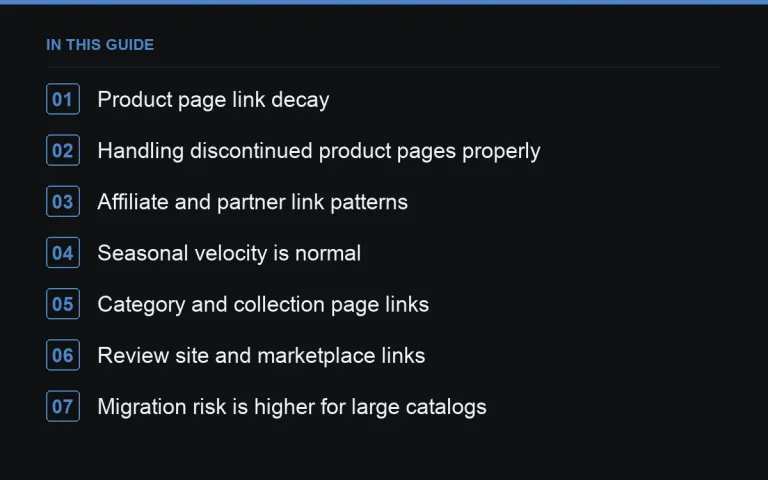
Product page link decay
Unlike an evergreen article, product pages routinely get removed when items are discontinued, which means backlinks pointing to them can break through no fault of the linking site or any manipulation — simply normal inventory turnover. Before assuming a lost link needs outreach per https://successtoroad.com/blog/lost-links-and-reclaiming-them/, check whether the underlying product page still exists or was legitimately retired.
Handling discontinued product pages properly
| Situation | Best practice |
|---|---|
| Product discontinued, similar replacement exists | Redirect to the closest equivalent, preserving link value |
| Product discontinued, no close replacement | Redirect to the relevant category page rather than 404 or homepage |
| Seasonal product, returns yearly | Keep the page live year-round rather than removing and recreating it |
Affiliate and partner link patterns
E-commerce sites often run affiliate programs that generate a distinct backlink pattern — many domains linking with similar commercial anchor text pointing at product or category pages. This can resemble a manipulation pattern superficially, so document which links come from your own legitimate affiliate program during any audit to avoid misclassifying them, and cross-check against https://successtoroad.com/blog/auditing-anchor-distribution/ to keep the pattern from looking too concentrated.
Seasonal velocity is normal
A spike in referring domains around major shopping periods, tied to press coverage, gift guides, or seasonal campaigns, is expected and shouldn’t be treated with the same suspicion as an unexplained spike at a random time of year — see https://successtoroad.com/blog/auditing-link-velocity/ for the general principle, applied here to a predictable seasonal cause.
Category and collection page links
Category pages tend to be more stable link targets than individual product pages and are often worth prioritizing for internal linking and outreach both, since they survive inventory changes. Reviewing this alongside https://successtoroad.com/blog/auditing-internal-links-alongside-backlinks/ helps direct external link value toward pages that will actually still exist next year.
Review site and marketplace links
E-commerce sites frequently accumulate links from review aggregators, comparison sites, and marketplace listings. Evaluate these the same way as any other link — real traffic and relevance matter more than the fact that the link came from a “shopping” context specifically.
Migration risk is higher for large catalogs
A large product catalog migrating platforms creates significant redirect mapping work, and getting it wrong breaks far more links proportionally than a small content site would. Treat any platform migration with the full rigor of https://successtoroad.com/blog/auditing-after-a-site-migration/, budgeting extra time for catalog-scale redirect verification.
Reviews, unboxing content, and earned links
Product review sites, unboxing content, and comparison articles are a common organic link source for e-commerce brands, and they deserve the same quality evaluation as any other link rather than an automatic pass just because they’re clearly related to your industry. A review site with genuine, ongoing content and real traffic is a strong link; a thin comparison page that exists purely to funnel affiliate clicks with no real audience is not, regardless of how relevant it looks on the surface.
Handling international and multi-currency storefronts
If your store operates across multiple country or language versions, backlinks can end up pointing at the wrong regional version of a page, diluting relevance or sending users to a currency and language mismatch. Check during an audit whether external links are landing on the intended regional storefront, and correct with proper hreflang or redirect handling where they aren’t.
Coordinating audits with merchandising cycles
Align your audit schedule loosely with major merchandising events — big seasonal catalog changes, major sales, new collection launches — since these are exactly the moments most likely to introduce broken links or redirect issues at scale. A brief check immediately after any major catalog change catches problems while they’re still fresh and easy to trace back to a specific cause.
Marketplace integrations and third-party feeds
Many e-commerce sites syndicate products to third-party marketplaces or comparison feeds, which can generate their own set of backlinks back to the original product or category pages. Treat these the same as any other link source in an audit, checking whether the feed is pointing at current, live URLs rather than an outdated version of your catalog structure from before a past update.
A final consideration for growing catalogs
As a catalog grows, the sheer number of individual product URLs makes a fully manual link check impractical, so lean more heavily on automated redirect and status checks at scale rather than manual spot checks once the site passes a certain size. Reserve manual review for your highest-traffic category and collection pages, where the effort is clearly justified.
Where to go next
Building links intentionally toward stable category and collection pages, sourced through https://successtoroad.com/niche/e-commerce/ listings on https://successtoroad.com/marketplace/, tends to hold up better over time than links aimed at individual products likely to be discontinued.
Frequently asked questions
Is it normal for e-commerce sites to lose links from discontinued products?
Yes, this is a routine and largely unavoidable consequence of inventory turnover rather than a sign of a problem. The fix is proper redirects to relevant replacement or category pages, not treating every instance as a link to reclaim through outreach.
Are affiliate program links a backlink risk?
They can create a distinctive pattern of similar commercial anchors across many domains, which is worth documenting clearly as legitimate affiliate activity so it isn't misread as manipulation during a routine audit.
Should seasonal traffic spikes worry me during a velocity check?
No, seasonal link spikes tied to shopping periods or recurring campaigns are expected and normal. The concern is specifically unexplained spikes with no clear seasonal or campaign-related cause.
What page types should get priority for new backlinks?
Category and collection pages tend to be more durable link targets than individual product pages, since they survive inventory changes and continue accumulating value over a longer period.
Put it into practice
Filter 54,483 websites by DR, traffic, niche and price, and order with escrow — you pay only after the link is live.
Browse the marketplace