Author Bio Link vs In-Content Link: Where Should Your Anchor Sit
In-content links carry contextual relevance search engines reward; bio links are safer, easier to secure, and still worth having.
When a guest post goes live, your link can sit in one of two places: within the body of the article itself, surrounded by relevant text, or in the author bio at the end, alongside a short description of who you are. Both are common, and many posts include both, but they are not equivalent in value or risk.
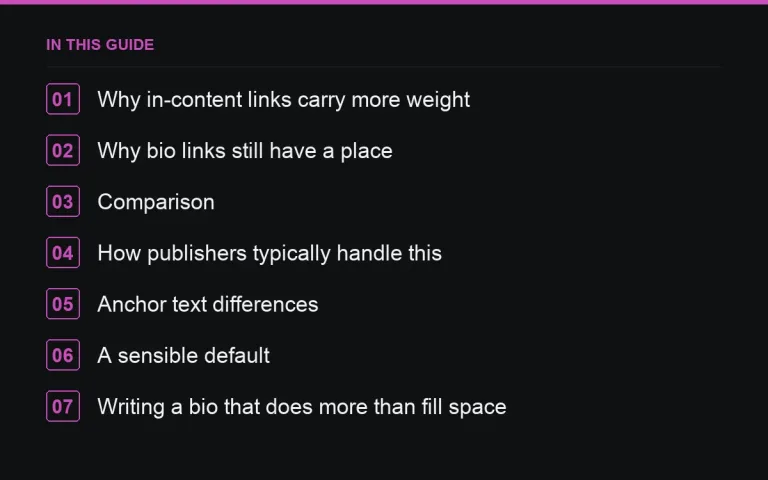
Why in-content links carry more weight
A link placed within the body of an article, in a sentence relevant to your business, gives a search engine much richer context about what you do and why the link is there. The surrounding paragraph acts as a kind of explanation the algorithm can read, reinforcing topical relevance far more than a generic bio sentence can.
Why bio links still have a place
A bio link is lower-friction to negotiate, since many publishers who are hesitant about in-content links, wanting to keep the body purely editorial, are comfortable including a standard author bio with a link back to your site or profile. It is also a very natural, expected pattern for guest contributor content, which makes it a safer, less scrutinised placement.
Comparison
| Factor | In-content link | Author bio link |
|---|---|---|
| Contextual relevance | High | Low to moderate |
| Ease of negotiation | Sometimes resisted by publishers | Usually straightforward |
| Typical anchor flexibility | High | Often limited to brand or generic phrasing |
| Risk if overused | Low, if genuinely relevant | Low, but limited ranking upside |
How publishers typically handle this
Some publishers include one in-content link as part of the standard guest post package, with the bio link included automatically alongside it. Others reserve in-content links for an additional fee, treating the bio link as the default free inclusion. Always clarify this before commissioning a piece, since assuming one when the publisher intends the other leads to a frustrating renegotiation after the content is written.
Anchor text differences
Bio links are usually anchored to your brand name or a generic phrase like “author bio” conventions dictate, while in-content links can carry more specific, topically relevant anchor text tied to the surrounding sentence. If a particular campaign needs precise anchor text for a target keyword, prioritise negotiating for an in-content placement rather than relying on the bio link to do that work.
A sensible default
Aim for both when possible: an in-content link for topical relevance and anchor flexibility, plus a bio link for brand consistency and a secondary, low-risk mention. Many listings on https://successtoroad.com/marketplace/ specify which is included by default, so check before ordering rather than assuming.
Writing a bio that does more than fill space
A generic, one-line author bio wastes an easy opportunity to reinforce who you are beyond just the link itself. https://successtoroad.com/blog/guest-post-author-bio/ covers how to write one that reads naturally and still gives readers a reason to click through, rather than defaulting to a bare company name and title.
How many links a single guest post can reasonably carry
Whether you are negotiating for an in-content link, a bio link, or both, there is a practical limit to how many a publisher will accept in one piece. https://successtoroad.com/blog/how-many-links-per-guest-post/ covers what is typically reasonable to ask for without the request itself becoming a reason for the publisher to say no.
Requesting both placements in one order
Many publishers are willing to include both an in-content link and a bio link within the same guest post order without charging separately for each, especially if you ask upfront rather than after the piece is already drafted. Framing the request as part of your initial brief, rather than a late addition, makes it far more likely to be accepted without friction.
Over a series of guest posts, review the balance between bio links and in-content links across your whole portfolio, not just within a single placement, since a healthy overall mix matters more than getting the ideal split on any one specific post.
What a strong bio actually accomplishes
Beyond the link itself, a well-written bio can drive genuine click-through from engaged readers who want to learn more about the author, which is a real, if secondary, benefit worth optimising for. Treat the bio as a small piece of marketing copy in its own right, not just a mandatory field to fill in before submission.
A modest investment of a few extra minutes per bio, thinking about what would make a reader actually want to click through, compounds nicely across dozens of placements over a year.
Small, consistent improvements to bio copy across your placements add up to a noticeably stronger author presence across the web than treating each one as an afterthought.
Revisit your standard bio text every few months rather than reusing the exact same wording indefinitely, since a stale bio can undersell how your business has grown or changed.
Where to go next
Read https://successtoroad.com/blog/exact-match-vs-branded-anchors/ for how anchor choice interacts with this placement decision, and https://successtoroad.com/blog/homepage-link-vs-deep-link/ for the related question of where the link should point.
Frequently asked questions
Which is better for SEO, a bio link or an in-content link?
In-content links generally carry more contextual relevance and ranking value since they sit within topic-relevant text, while bio links are safer and easier to secure but carry less specific relevance signal.
Do all guest posts include an in-content link by default?
No, some publishers only offer a bio link as standard and treat in-content links as a paid add-on. Always confirm what is included before commissioning the piece.
Can I control the anchor text in a bio link?
Often only loosely, since bio links are typically anchored to a brand name or generic phrase by convention. For precise anchor text control, negotiate an in-content placement instead.
Is it risky to have only bio links across many guest posts?
Not risky in the sense of penalties, but it limits your ranking upside since bio links carry less topical context than in-content placements. A mix of both is generally more effective.
Put it into practice
Filter 54,483 websites by DR, traffic, niche and price, and order with escrow — you pay only after the link is live.
Browse the marketplace