Auditing Anchor Text Distribution the Right Way
A practical method for checking anchor text health without chasing an arbitrary ideal ratio.

Anchor text distribution is one of the clearer signals a search engine can use to spot manipulation, because natural link building produces a messy, varied mix while manipulated link building tends to repeat the same commercial phrase. Auditing it is less about hitting a magic ratio and more about spotting concentration that doesn’t match how people actually write.
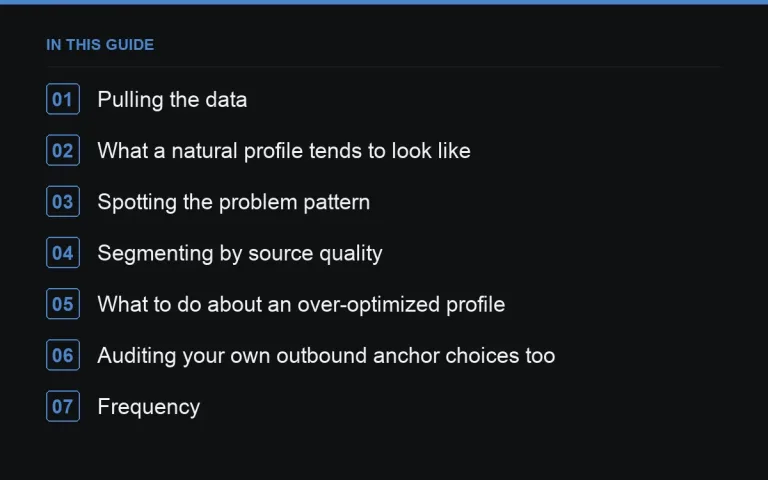
Pulling the data
Export anchor text alongside referring domain from your link data source, following the same base process as https://successtoroad.com/blog/backlink-audit-guide/. Group by anchor text variant, then by category (exact-match commercial, branded, naked URL, generic like “click here,” and partial-match).
What a natural profile tends to look like
- Branded and naked-URL anchors as the largest share, often the majority
- Generic anchors (“this article,” “read more”) making up a meaningful chunk
- Exact-match commercial anchors as a small minority
- Long-tail variation rather than a handful of repeated phrases
There’s no universal safe percentage since it varies by industry and brand name, but a profile where a single commercial phrase dominates outside branded terms is worth investigating further, especially in combination with https://successtoroad.com/blog/link-network-and-pbn-detection/ signals.
Spotting the problem pattern
| Signal | Concern level |
|---|---|
| One exact-match phrase across dozens of unrelated domains | High |
| Exact-match anchors concentrated in one short time window | High — check alongside https://successtoroad.com/blog/auditing-link-velocity/ |
| Slight over-representation of a partial-match phrase | Low, often fine |
| Heavy branded anchor use | Not a concern, this is expected |
Segmenting by source quality
Anchor concentration from high-quality, clearly editorial sources is less concerning than the same concentration from low-quality or networked domains. Cross-reference anchor patterns against the domain scoring from your main audit rather than treating anchor text as a standalone signal.
What to do about an over-optimized profile
You generally can’t edit anchor text on existing external links. Options are limited to: requesting a change from a cooperative site owner (rarely successful at scale), disavowing the worst offenders if they’re also low-quality per https://successtoroad.com/blog/disavow-when-and-when-not/, and — most productively — diluting the pattern by building future links with varied, natural anchor text going forward.
Auditing your own outbound anchor choices too
If you’re placing guest posts or sponsored content, review the anchor text you’re requesting on those placements as part of the same audit. Repeating the same commercial anchor across every placement creates the exact pattern this post is warning about, just from the buying side instead of receiving links passively.
Frequency
Anchor distribution shifts slowly, so it doesn’t need checking as often as link velocity. Reviewing it during each scheduled audit (see https://successtoroad.com/blog/how-often-to-audit-backlinks/) is generally sufficient unless you’re in an active link-building push.
Building a simple tracking sheet
A lightweight way to keep anchor text healthy going forward is a running tracking sheet of every new link you influence — guest posts, sponsored placements, digital PR pitches — recording the anchor text used on each. Reviewing that sheet before requesting the next placement makes it obvious when you’ve leaned on the same phrase too many times in a row, well before it shows up as a concentration problem in your next full audit.
Anchor text and brand growth over time
As a brand becomes better known, branded anchor share tends to rise naturally, since more people simply reference the company by name rather than describing it descriptively. A newer or smaller brand will often see a higher share of generic and descriptive anchors by comparison, and that’s expected too — don’t read too much into an early-stage profile having less branded anchor text than an established competitor’s.
Segmenting anchor data by page rather than site-wide only
A site-wide anchor analysis can hide a problem concentrated on a single important page — perhaps your main product or service page has attracted a heavily concentrated pattern even while the rest of the site looks fine in aggregate. Break the anchor analysis down by target URL for your highest-value pages specifically, not just as one blended site-wide number, so a localized concentration doesn’t get diluted into an average that looks acceptable.
Anchor text in a multi-language or multi-market profile
If your site targets multiple languages or regions, anchor text patterns should be reviewed separately for each, since a healthy blended average can hide a concentrated problem in just one market’s links. A site expanding aggressively into a new region through local guest posting is especially worth watching here, since a smaller, newer link base in that market is more easily dominated by a repeated phrase than the larger, more established base in your home market.
Keeping a running anchor text plan
Rather than deciding anchor text ad hoc for each new placement, keep a short running plan noting which phrases you’ve used recently and which are due for a change. This is a small amount of extra process that consistently prevents the kind of accidental concentration that otherwise creeps in simply because the same convenient phrase keeps getting reused out of habit.
Where to go next
When placing new links through https://successtoroad.com/marketplace/, request natural, varied anchor text rather than the same commercial phrase every time — it keeps future audits cleaner and avoids building the pattern you’re trying to fix.
Frequently asked questions
What percentage of exact-match anchors is safe?
There's no fixed safe number since it depends on brand name length, industry, and overall link volume. The better test is whether the mix looks like something a range of independent writers would naturally produce.
Should I worry about branded anchor text dominating?
No, branded and naked-URL anchors making up the largest share is expected and healthy. It's exact-match commercial phrases dominating outside branded terms that's the actual concern.
Can I fix anchor text on old links?
Rarely. Once a link is published elsewhere you generally can't edit it yourself, though a direct, polite request to a cooperative site owner occasionally works for individual cases.
How does anchor text tie into disavow decisions?
Anchor concentration alone usually isn't enough to disavow; it's one signal among several. Combine it with domain quality and velocity data before deciding a link needs removal or disavow.
Put it into practice
Filter 54,483 websites by DR, traffic, niche and price, and order with escrow — you pay only after the link is live.
Browse the marketplace