Auditing a Site’s Backlink Profile Before You Buy It
Traffic and revenue numbers don't tell you what's in the backlink profile — this checklist covers what to check before you buy.
Site acquisitions live and die on due diligence, and backlink history is one of the areas most often under-checked compared with traffic and revenue verification. A site can show clean analytics and still carry a link profile that puts future rankings at risk, particularly if it’s changed hands before or been through aggressive SEO experiments.
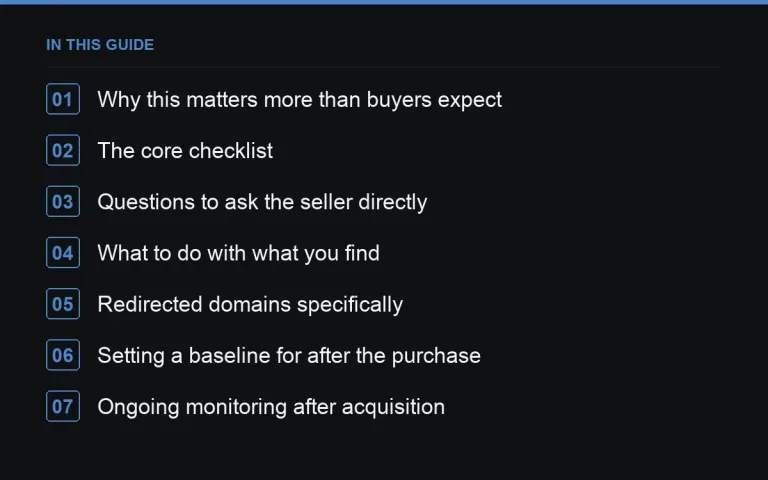
Why this matters more than buyers expect
You’re not just buying current traffic — you’re inheriting every link that’s ever pointed at the domain, including links from schemes or networks the current or previous owner may have used. A manual action risk that hasn’t yet materialized can surface after you’ve already paid for the site.
The core checklist
- Pull the full historical link profile, not just current links — see if there’s evidence of past link buying that’s since expired or been removed
- Check the Manual Actions report if you get pre-purchase access to Search Console, and ask directly whether one has ever existed
- Review anchor text history for signs of past over-optimization, per https://successtoroad.com/blog/auditing-anchor-distribution/
- Check link velocity over the site’s full history for suspicious spikes, per https://successtoroad.com/blog/auditing-link-velocity/
- Look for signs of PBN or network involvement, both incoming and outgoing — see https://successtoroad.com/blog/link-network-and-pbn-detection/
Questions to ask the seller directly
| Question | Why it matters |
|---|---|
| Has this site ever received a manual action? | Confirms whether you need to dig further into penalty history |
| Has link building ever been outsourced to a third party? | Third-party link building is where surprise networks and schemes most often originate |
| Is there a disavow file already in place? | Reveals what the seller already considers risky, and whether it’s being handled |
What to do with what you find
A clean history is a green light. A history with some weak links but no penalty is common and usually not a dealbreaker — most sites accumulate some low-quality links over time. A history with a past manual action, even if since lifted, warrants deeper scrutiny and possibly a lower offer, since recovery isn’t always complete and recurrence risk is higher.
Redirected domains specifically
If the acquisition involves consolidating an old domain via redirect, treat that old domain’s link history as part of the same due diligence — see https://successtoroad.com/blog/redirected-domain-link-audits/ for how to trace what you’d actually be inheriting.
Setting a baseline for after the purchase
Whatever you find, document it as a baseline before you take over, using the same format from https://successtoroad.com/blog/backlink-audit-guide/. This gives you a clear before/after reference and protects you if a dispute arises about the site’s condition at time of sale.
Ongoing monitoring after acquisition
Set up regular audits immediately after taking over rather than waiting — early monitoring catches any issues from the transition period quickly. See https://successtoroad.com/blog/how-often-to-audit-backlinks/ for a reasonable schedule for a newly acquired site.
Working with a broker or intermediary
If the sale is going through a marketplace or broker, ask specifically whether backlink due diligence is part of their standard verification process, since many platforms focus primarily on traffic and revenue authentication and treat link history as the buyer’s own responsibility. Don’t assume it’s been checked on your behalf just because the deal is going through a formal channel — confirm it explicitly and do your own pass regardless.
Budgeting time for this step
A thorough link history review can take anywhere from a few hours for a small, young site to a couple of days for an older domain with a long and eventful history. Build this into your acquisition timeline explicitly rather than treating it as an afterthought squeezed in after the financial due diligence is already done — a serious link problem discovered late can still change your offer or your decision to proceed at all.
Factoring findings into the actual offer
Whatever you find should have a concrete effect on the deal, not just sit in a report. A modest history of low-quality links might justify a small price reduction to cover cleanup effort; a serious, unresolved penalty risk might justify walking away entirely or making the sale contingent on the seller resolving it first. Treat the backlink findings as negotiable deal terms, the same way you would any other diligence finding.
A short delay can be worth the extra certainty
Sellers sometimes push for a fast close, and a rushed backlink review under that pressure is one of the more common ways a real problem gets missed. If the seller resists a reasonable few extra days for this specific check, treat that resistance itself as a data point worth factoring into your overall confidence in the deal, separate from whatever the link data itself eventually shows.
Where to go next
If the acquisition reveals gaps in the link profile you’ll need to fill post-purchase, https://successtoroad.com/marketplace/ offers a filtered way to source clean, relevant replacement links rather than repeating whatever approach the previous owner used.
Frequently asked questions
Can I get Search Console access before buying a site?
Sometimes — serious sellers in a formal due diligence process will often grant temporary access. If they won't, treat that reluctance as a flag worth asking more questions about, though it isn't automatically disqualifying.
What if the site has a disavow file already?
Review it as part of due diligence. It tells you what the previous owner considered risky and can reveal a history of link problems even if there's no active manual action currently in place.
Is a past manual action always a dealbreaker?
Not always, especially if it was lifted long ago and the underlying links were properly cleaned up. But it does warrant deeper scrutiny and possibly a lower valuation to account for recurrence risk.
How far back should I check link history?
As far as your data source allows, ideally covering the site's entire indexed history. Older link building tactics can still carry risk even years later if they were never addressed.
Put it into practice
Filter 54,483 websites by DR, traffic, niche and price, and order with escrow — you pay only after the link is live.
Browse the marketplace