Auditing a Publisher’s Guest Post History Before You Pitch or Buy
A publisher's own guest post archive tells you more about what you're buying than its traffic metrics alone.

Before pitching or paying for a guest post placement, look at what the publisher has already run. A site’s guest post history reveals its actual editorial standards, its link practices, and whether it’s the kind of placement that holds up over time — information that DA and traffic metrics alone won’t tell you.
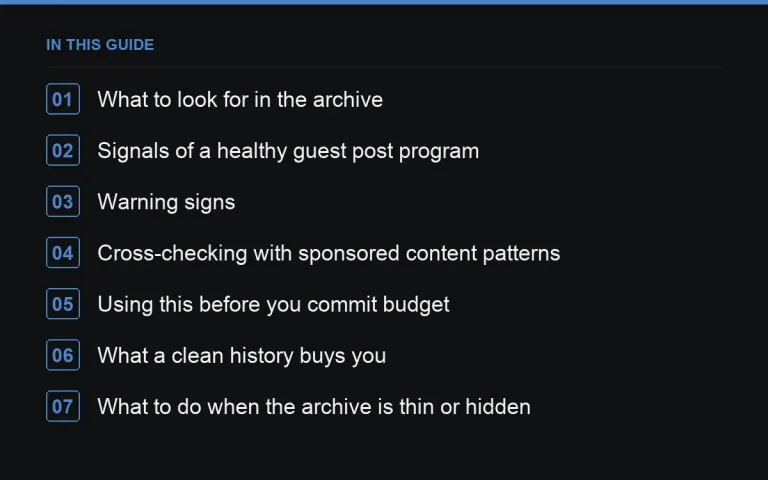
What to look for in the archive
- How many guest posts they publish per month, and whether that volume looks sustainable or like a content mill
- Whether guest content is disclosed (sponsored, contributor, guest author byline) or blended in as if it were staff-written
- The topical range — is it focused and relevant to the site’s stated niche, or does it accept anything from any industry
- Anchor text patterns across past guest posts, which hints at what the publisher will likely allow you to use — see https://successtoroad.com/blog/auditing-anchor-distribution/
Signals of a healthy guest post program
| Signal | Why it’s a good sign |
|---|---|
| Consistent publishing pace over a long period | Suggests a stable, ongoing operation rather than a recent link-selling pivot |
| Varied authors and topics within the niche | Indicates genuine editorial curation rather than accepting everything |
| Old guest posts still live and indexed | Confirms content isn’t pruned or devalued after a short window |
| Reasonable, varied anchor text across past posts | Suggests they don’t allow (or don’t get asked for) heavy exact-match anchors |
Warning signs
- A sudden spike in guest post volume that doesn’t match the site’s historical pattern — may indicate a recent shift toward selling links at scale
- Guest posts covering wildly unrelated topics with no connection to the site’s core subject
- Evidence of past posts being removed or de-indexed after a period, suggesting instability in the arrangement
- Heavy exact-match commercial anchors visible across many past posts, a pattern search engines can also see
Cross-checking with sponsored content patterns
Some publishers blend sponsored and guest content without much distinction. If you’re specifically concerned about disclosure and how it’s handled, review https://successtoroad.com/blog/sponsored-posts-done-wrong/ alongside this check, since the two issues often overlap on lower-quality sites.
Using this before you commit budget
This kind of check fits naturally into the same risk framework used before any placement — see https://successtoroad.com/blog/risk-scoring-a-placement-before-you-buy/ for the fuller pre-purchase checklist, of which guest post history is one important component.
What a clean history buys you
A publisher with a stable, well-curated guest post history is more likely to keep your placement live long-term, apply reasonable anchor text without pushback, and avoid the kind of pattern that draws negative attention during a future audit — yours or a search engine’s.
What to do when the archive is thin or hidden
Some publishers make it hard to browse past guest content, either because it isn’t tagged clearly or because there simply isn’t much history to review — a common situation for newer sites entering the guest post market. In that case, ask the publisher directly for a couple of recent example placements before committing, and treat the lack of an easily browsable history as a mild caution rather than an automatic disqualifier, since plenty of legitimate newer sites just haven’t built up a large archive yet.
Comparing history against current pricing and terms
A publisher whose historical content looks reasonable but whose current terms suggest a sudden shift — a much faster turnaround being offered, noticeably looser topic requirements, or a jump in accepted volume — may be in the middle of changing how they operate. Recent history is more predictive of what you’ll actually get than older history, so weight the last few months more heavily than the full archive when making a final call.
Using this history to shape your own pitch
Beyond risk assessment, a publisher’s guest post history tells you what actually gets accepted there, which is genuinely useful pitching intelligence. If every recent guest post follows a similar structure — a how-to format, a specific length, a certain tone — matching that pattern in your own pitch measurably improves acceptance odds compared with pitching something that doesn’t resemble anything they’ve run before.
Comparing history across a shortlist of candidates
When choosing between several similarly priced options, put their guest post histories side by side rather than evaluating each in isolation. A quick comparison table — publishing frequency, topical consistency, anchor variety, whether older posts stay live — often makes the better choice obvious even when the raw traffic and authority numbers look nearly identical across the shortlist.
A final sanity check before committing
Before finalizing any placement based on this review, do one last direct check: open a handful of the publisher’s most recent posts live, not just from a cached tool listing, to confirm they still exist, still look the way you expect, and still carry working links. Archive-based tools can lag behind a site’s current real state, and a quick manual spot check closes that gap.
Where to go next
Publisher listings on https://successtoroad.com/marketplace/ typically show order history and site metrics together, which makes this kind of check faster than manually crawling a site’s guest post archive from scratch.
Frequently asked questions
How far back should I look at a publisher's guest post history?
A year or two is usually enough to spot a meaningful pattern in volume, topic range, and anchor text. Older history is useful context but less predictive of current practices if the site has changed ownership or policy since.
Is a high volume of guest posts automatically bad?
Not automatically, but it's worth understanding why. A large, well-established publisher with dedicated editorial resources can sustain higher volume responsibly; a small site with a sudden spike is more likely selling links at scale.
What if a publisher doesn't disclose guest content at all?
That's worth factoring into your decision, since non-disclosure can raise both trust and guideline concerns. It doesn't automatically disqualify a site but should prompt more scrutiny of the rest of its practices.
Does old guest content staying indexed matter?
Yes, it's a reasonable signal of stability. If a publisher regularly prunes or de-indexes older guest posts after a period, a fresh placement may not hold its value or visibility for very long either.
Put it into practice
Filter 54,483 websites by DR, traffic, niche and price, and order with escrow — you pay only after the link is live.
Browse the marketplace