Algorithmic Devaluation vs Penalties: What’s the Difference?
Understanding whether a link is being ignored or actively penalized changes what you should do about it.
These two outcomes get conflated constantly, and the confusion leads to wasted disavow effort and misdiagnosed ranking drops. Algorithmic devaluation means a search engine’s systems have decided a link (or category of links) simply doesn’t count — no credit given, no penalty applied. A penalty, usually delivered as a manual action, is an active downgrade applied because a human reviewer or a systemic signal determined guideline violations occurred. One is silence; the other is punishment.
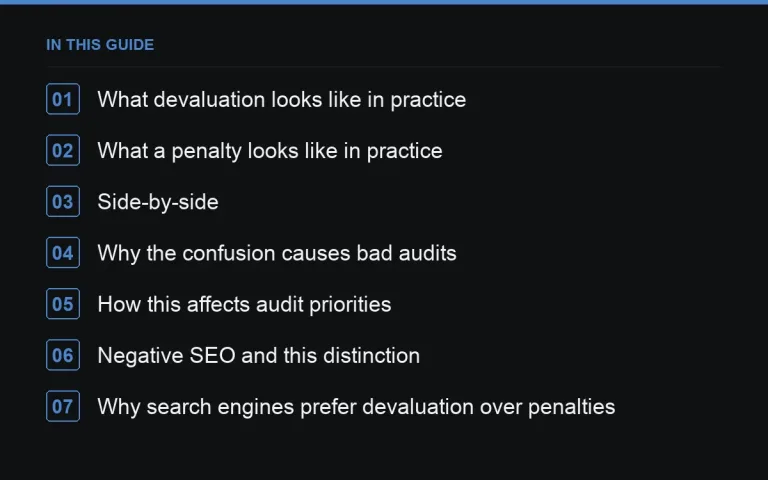
What devaluation looks like in practice
Most low-quality links on the web are devalued rather than penalized. A comment-spam link, a low-quality directory listing, a link from an inactive blog — these are typically just ignored. The site doesn’t get hurt by having them; it simply doesn’t get the ranking benefit either. This is by far the more common outcome for weak links, and it’s why https://successtoroad.com/blog/what-is-a-toxic-link-really/ argues most flagged links need no action.
What a penalty looks like in practice
A penalty shows up as a manual action in Search Console, or occasionally as a systemic algorithmic response to widespread, clear manipulation (link schemes at scale, for instance). Unlike devaluation, a penalty can suppress rankings for content that would otherwise perform fine. See https://successtoroad.com/blog/manual-actions-and-reconsideration/ for how to confirm and respond to an actual manual action.
Side-by-side
| Devaluation | Penalty | |
|---|---|---|
| Visible notice? | No | Usually yes, in Search Console |
| Effect | Link ignored, no credit | Site or section actively suppressed |
| Typical cause | Low-quality or irrelevant single links | Large-scale manipulation pattern |
| Fix | None needed, or build better links | Remove/disavow links, request reconsideration |
Why the confusion causes bad audits
Teams sometimes see a ranking drop, assume the worst, and start disavowing broadly without confirming a penalty exists. That approach removes links that may have been contributing modest, legitimate value while doing nothing to address the actual cause of the drop — which is often a content or algorithm update issue, not links at all.
- Confirm the Manual Actions report before assuming penalty
- Check timing against known broad algorithm updates before blaming links
- Only pursue https://successtoroad.com/blog/disavow-when-and-when-not/ when there’s a confirmed pattern, not a hunch
How this affects audit priorities
When running a routine https://successtoroad.com/blog/backlink-audit-guide/, spend most of your time distinguishing “devalued, ignore” from “network or spam pattern, investigate” (see https://successtoroad.com/blog/link-network-and-pbn-detection/), rather than trying to hunt for a penalty that likely doesn’t exist. Penalties are the exception; devaluation is the default outcome for weak links.
Negative SEO and this distinction
Attackers hoping to cause harm through spammy links are usually betting on triggering a penalty response, but in most cases those links are simply devalued and cause no damage at all. See https://successtoroad.com/blog/negative-seo-link-audits/ for how to tell whether an attack actually needs a response.
Why search engines prefer devaluation over penalties
From a search engine’s perspective, quietly ignoring a manipulative link is often more efficient than issuing a manual action, since it neutralizes the attempted manipulation without requiring human review resources. This is part of why penalties are reserved for larger, clearer patterns of abuse rather than applied to every individual low-quality link — the algorithmic response scales, while manual review doesn’t. Understanding this helps explain why most audits turn up far more “ignore this” findings than “this needs a penalty response” findings.
What this means for link-building strategy going forward
If most weak links simply get ignored rather than actively punished, the practical lesson is that chasing volume for its own sake wastes effort — those extra low-quality links aren’t quietly accumulating risk, but they also aren’t quietly accumulating value. The return on effort is much higher when spent on links likely to be counted at all: real traffic, topical relevance, genuine editorial placement. That’s the same logic behind https://successtoroad.com/blog/risk-scoring-a-placement-before-you-buy/.
A practical rule of thumb for triage
When you’re unsure which bucket a specific finding belongs in, default to treating it as devaluation unless you have concrete evidence otherwise — a confirmed manual action notice, or a pattern so large and so clearly coordinated that it would be surprising for it to go unnoticed. This default keeps audits efficient and prevents the common failure mode of spending disproportionate time chasing penalty-level responses to what is, in the overwhelming majority of cases, just ordinary background noise.
Explaining this distinction to non-specialists
Colleagues outside SEO often use “penalized” loosely to describe any drop in visibility, which muddies internal conversations about what actually happened and what response is appropriate. When discussing a ranking change with a broader team, be precise about which of the two you mean, and point to the Manual Actions report as the concrete evidence either way rather than letting the conversation run on assumption.
A short summary worth keeping in mind
If there’s one habit to take from this distinction, it’s checking the Manual Actions report first, every time, before any conversation about disavowing links or panicking over a traffic dip. It takes a minute and immediately tells you which of these two very different situations you’re actually dealing with, which shapes everything that follows.
Where to go next
Building a resilient profile going forward means favoring quality over volume — browse https://successtoroad.com/marketplace/ for placements with real traffic rather than chasing quantity that mostly gets devalued anyway.
Frequently asked questions
Can devalued links become penalized later?
It's uncommon for an individual devalued link to later trigger a penalty on its own. Penalties tend to result from clear, large-scale manipulation patterns rather than accumulation of ordinary low-quality links over time.
How do I know if my drop is devaluation or a penalty?
Check the Manual Actions report first. If nothing appears there, the drop is far more likely tied to a broader algorithm update, content quality, or technical issue rather than a link penalty.
Does disavowing a devalued link help?
Generally no, since the link isn't contributing anything either way. Disavow is meant for links contributing to an active penalty or manipulation pattern, not for links that are simply ignored.
Are all low-quality links devalued equally?
No — the degree of devaluation likely varies by how clearly manipulative or low-quality the link is, though search engines don't publish the specifics. Treat any single weak link as low-priority either way.
Put it into practice
Filter 54,483 websites by DR, traffic, niche and price, and order with escrow — you pay only after the link is live.
Browse the marketplace