Roundup Posts Done Well: Why Most Fail and How to Fix That
The failure mode of most roundups is predictable, and so is the fix.
The expert roundup got overused to the point that many marketers now associate the format with low-effort content: a generic question, forty short quotes with no editing or synthesis, and a mass email blast to contributors hoping they’ll share it. That version rarely earns links anymore, not because roundups are inherently weak, but because that specific execution gives readers and other writers no reason to cite it over any of the dozens of similar roundups already published. A better version still works, covered in https://successtoroad.com/blog/expert-interviews-for-content-marketing/ as the related single-expert format.
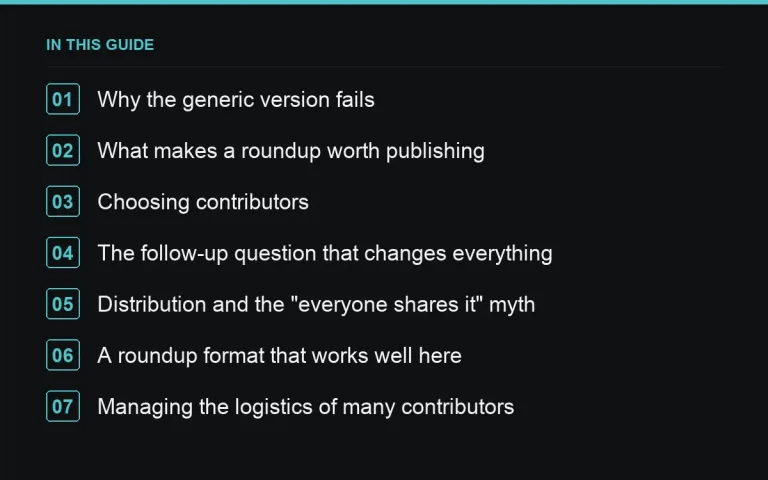
Why the generic version fails
- A broad, generic question produces broad, generic answers that don’t tell a reader anything a single good article couldn’t.
- Unedited quotes strung together with no analysis leave the reader to do all the synthesis work themselves.
- Contributors solicited purely for a link back rarely engage seriously with the question, which shows in the quality of what they submit.
What makes a roundup worth publishing
Ask a specific, narrow question that produces genuinely different answers from different contributors, rather than a broad question everyone answers the same way. Then do the work a good editor does with any content: group similar answers, highlight genuine disagreement between contributors, and add a short synthesis that tells the reader what the range of answers actually means, rather than just listing them in submission order.
Choosing contributors
Fewer, more relevant contributors beat a long list of loosely related names. Ten people with direct, specific experience on the exact question produce a stronger piece than fifty people with a general interest in the topic. Vet contributors for relevance before reaching out rather than accepting anyone who responds to a public call for submissions.
The follow-up question that changes everything
After collecting initial answers, send a short follow-up to a few contributors whose answers raise an interesting tension — “several people disagreed with you on X, want to respond?” This single step turns a static list of quotes into something closer to an actual discussion, and it’s usually the difference between a roundup that gets cited as a genuine resource and one that reads like a link-building exercise.
Distribution and the “everyone shares it” myth
Don’t assume every contributor will share the piece — in practice, only a minority reliably do, and that’s fine as long as the content stands on its own merit for readers who find it through search or other channels. Send each contributor their specific quote highlighted and a ready-to-share blurb, the same approach covered in https://successtoroad.com/blog/expert-interviews-for-content-marketing/, but plan your broader distribution — https://successtoroad.com/blog/content-distribution-channels/ — as if contributor sharing is a bonus, not the primary channel.
A roundup format that works well here
A roundup of publisher or editor perspectives — “what makes you accept or reject a guest post pitch” — produces genuinely varied, specific answers because editorial judgment differs a lot from site to site, and the resulting piece is directly useful to anyone doing outreach through https://successtoroad.com/services/writing/ or sourcing sites via https://successtoroad.com/marketplace/, including narrower niches like https://successtoroad.com/niche/business/ or https://successtoroad.com/niche/technology/.
Managing the logistics of many contributors
A roundup with fifteen or twenty contributors needs a clear deadline, a simple submission format and a realistic follow-up schedule for the people who don’t respond on time, since a meaningful share never will regardless of reminders. Build slack into the timeline rather than promising contributors a publish date you can’t hit if a few responses come in late, and decide in advance how long you’ll wait before publishing with the contributors you do have rather than letting the piece stall indefinitely waiting for full participation.
Crediting contributors properly
Link to each contributor’s own site or profile alongside their quote, not just their name — this is both a courtesy that makes participation worthwhile for them and a natural reason for them to check the piece and consider sharing it. Make sure the credit is accurate and current, since a broken or outdated link to a contributor’s site undermines the professionalism of the whole piece.
Deciding whether a roundup is the right format at all
Before committing to the coordination overhead of a roundup, consider whether a single in-depth expert interview or a piece of original research would answer the same underlying question more efficiently. Roundups earn their keep when a question genuinely benefits from multiple, differing perspectives; if one expert could answer it thoroughly on their own, the simpler single-interview format is usually the better use of everyone’s time.
Timing a roundup around a relevant moment
A roundup published to coincide with a relevant industry moment — a widely discussed shift in practice, a season when the underlying question is naturally on people’s minds — tends to get more initial traction than the same piece published with no particular timing rationale. This doesn’t make it a purely timely piece in the sense described in https://successtoroad.com/blog/evergreen-vs-timely-content/, but a thoughtful publish date can meaningfully boost the first wave of attention it receives.
Where to go next
Read https://successtoroad.com/blog/expert-interviews-for-content-marketing/ for the single-expert version of this format, and https://successtoroad.com/blog/content-distribution-channels/ for getting a finished roundup in front of people beyond the contributors. For the wider strategy, see https://successtoroad.com/blog/content-marketing-for-links/.
Frequently asked questions
How many contributors should a roundup include?
Ten to twenty relevant contributors usually produces a stronger piece than fifty loosely related ones. Prioritize relevance and answer quality over headcount.
Should we edit contributor quotes?
Light editing for clarity and length is standard and expected, but send meaningfully edited quotes back for approval. Never alter the substance of what someone said without their sign-off.
What's a good question to build a roundup around?
A specific, practitioner-level question likely to produce genuinely different answers — for example, a decision point people handle differently based on experience, rather than a broad opinion question everyone answers similarly.
Do roundups still earn links in a crowded content landscape?
Yes, but only the well-executed version — narrow question, vetted contributors, real editorial synthesis. The generic, mass-outreach version has become common enough that it rarely stands out or gets cited.
Put it into practice
Filter 54,483 websites by DR, traffic, niche and price, and order with escrow — you pay only after the link is live.
Browse the marketplace