Pillar Pages and Topic Clusters: A Structure That Earns Links
Why a single broad page rarely earns links alone, and how a cluster of supporting pages changes that.
A pillar page is a comprehensive page on a broad topic, supported by a cluster of narrower posts that each go deep on one sub-topic and link back to the pillar. The model was built for SEO, but it has a useful side effect for link building: clusters give outreach targets a specific, narrow page to link to, while the pillar collects the accumulated authority. Done well, this is one of the more durable content structures available, discussed at a strategy level in https://successtoroad.com/blog/content-marketing-for-links/.
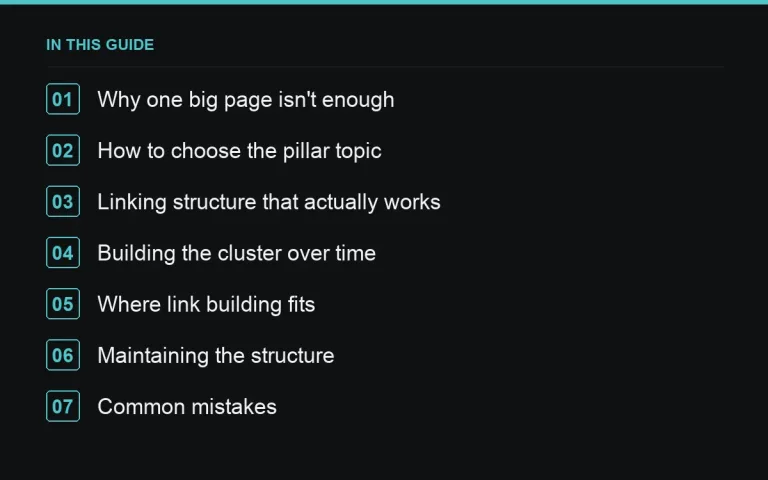
Why one big page isn’t enough
A 4,000-word guide that tries to cover everything about a topic ends up shallow on each sub-point, because depth and breadth trade off against each other inside a single page. Readers researching one specific question — say, “how to write outreach subject lines” inside a broader link-building topic — don’t want to scroll through an entire pillar to find three paragraphs. A cluster page dedicated to that one question can go deeper, rank for a narrower keyword and be the specific thing a blogger cites when writing about that sub-topic.
How to choose the pillar topic
The pillar should be broad enough to need five to ten sub-pages but narrow enough that one page can meaningfully introduce all of them. “Link building” is too broad for a single pillar; “link building for small businesses” or “content marketing for links” is workable. Map the sub-topics first — the questions someone researching the pillar topic would ask in sequence — then decide which deserve their own page versus a paragraph inside the pillar.
Linking structure that actually works
- Every cluster page links up to the pillar, usually in the opening paragraph and again near the close.
- The pillar links down to every cluster page from the relevant section, not just a footer list.
- Cluster pages link sideways to each other where the topics genuinely overlap — don’t force it where they don’t.
This differs from a generic “related posts” widget because the links are chosen for topical relevance, not recency or popularity. A reader following pillar-to-cluster-to-cluster links should feel like they’re moving through a deliberate structure, not a random suggestion engine.
Building the cluster over time
You don’t need all the cluster pages before publishing the pillar, but publish the pillar once there are at least three or four solid supporting pages — a pillar linking to nothing looks unfinished and gives outreach targets nowhere specific to send readers. Use https://successtoroad.com/blog/content-calendars-for-link-goals/ to sequence which cluster pages go out first: start with the sub-topics most likely to be searched or cited independently.
Where link building fits
Clusters are easier to pitch for links than pillars because they’re specific. A journalist writing about “how small businesses should handle guest post outreach” will link to your cluster page on that exact topic far more readily than to a broad pillar that only mentions it in passing. Once a few cluster pages have earned links and the pillar has internal authority flowing to it, the pillar itself becomes a target for broader, higher-value links — round-up mentions, “best guides on X” lists, and the kind of general citation that a narrow cluster page can’t attract. If you’re supplementing this organic growth with sourced placements, https://successtoroad.com/services/writing/ and the wider https://successtoroad.com/marketplace/ are where to find sites in your topic’s niche, such as https://successtoroad.com/niche/marketing/ or https://successtoroad.com/niche/business/.
Maintaining the structure
Clusters rot at different rates. A pillar on a stable topic might need only annual updates, while a cluster page tied to a specific tool or tactic can go stale within months. Treat the whole cluster as one unit during https://successtoroad.com/blog/content-audits-for-link-opportunities/ — check that every cluster page still links to the current version of the pillar, and that no cluster page has been quietly outranked by a competitor’s fresher version. https://successtoroad.com/blog/content-refresh-cycles/ covers the cadence in more detail.
Common mistakes
The most common failure is duplicating content between the pillar and its cluster pages instead of dividing it — search engines and readers both penalize this, readers by bouncing, search engines by diluting which page ranks. The second is building the cluster and never linking it into the site’s main navigation or other high-authority pages, leaving it an island that neither earns nor passes much authority. A pillar page also needs its own promotion; it won’t earn links purely by existing, as covered in https://successtoroad.com/blog/content-distribution-channels/.
Naming and URL structure
Keep the pillar and its cluster pages under a consistent, predictable URL pattern where possible — a shared folder or a consistent naming convention makes the relationship legible to readers glancing at a URL and to your own team maintaining the structure months later. This isn’t strictly required for the linking mechanics to work, but it pays off when someone unfamiliar with the site needs to understand which pages belong to which cluster, especially as the number of pillars grows past two or three.
Measuring a cluster as a unit, not just individual pages
When reviewing performance, look at the cluster’s combined referring domains and rankings rather than judging each page in total isolation. A cluster page with few direct links but strong internal traffic passed down from a well-linked pillar is still doing its job; conversely, a pillar with strong external links but cluster pages nobody visits internally suggests the internal linking itself needs attention, not necessarily new content. This combined view, tracked the way https://successtoroad.com/blog/measuring-content-earned-links/ describes, gives a more accurate picture of whether the structure is working than checking pages one at a time.
Where to go next
Pair this structure with https://successtoroad.com/blog/long-form-guides-that-earn-links/ for how to write the pillar itself, and https://successtoroad.com/blog/glossaries-as-link-assets/ for a cluster format that ages unusually well. For the outreach side once your cluster exists, see https://successtoroad.com/blog/content-marketing-for-links/.
Frequently asked questions
How many cluster pages does a pillar need?
There's no fixed number, but five to ten is a common range for a well-scoped pillar. Fewer than three and the structure looks thin; more than fifteen usually means the pillar topic was too broad to begin with.
Should the pillar page rank for the main keyword, or the cluster pages?
The pillar should target the broad keyword and the cluster pages the specific, longer-tail ones. If a cluster page starts outranking the pillar for the main term, that's a sign the pillar needs strengthening, not that the cluster should be cut.
Can a cluster page exist without a pillar?
Yes, and many good pages do. But if you're planning multiple related pages on one broad topic anyway, structuring them as a cluster from the start saves you from retrofitting internal links later.
Do pillar pages need to be updated more often than cluster pages?
Usually yes, since they touch more sub-topics and are more likely to reference something that's changed. Review the pillar whenever any of its cluster pages get a significant update.
Put it into practice
Filter 54,483 websites by DR, traffic, niche and price, and order with escrow — you pay only after the link is live.
Browse the marketplace