Long-Form Guides That Earn Links (Not Just Traffic)
Length alone doesn't earn links — completeness, structure and a reason to cite do.
A long guide and a link-earning guide aren’t the same thing. Plenty of 3,000-word posts get read once and forgotten because they cover the same ground as everything else ranking for the keyword, just at greater length. A guide earns links when it’s the page someone can point to and say “this covers it properly,” which means it needs to be more complete, better organized or more current than the alternatives — not just longer.
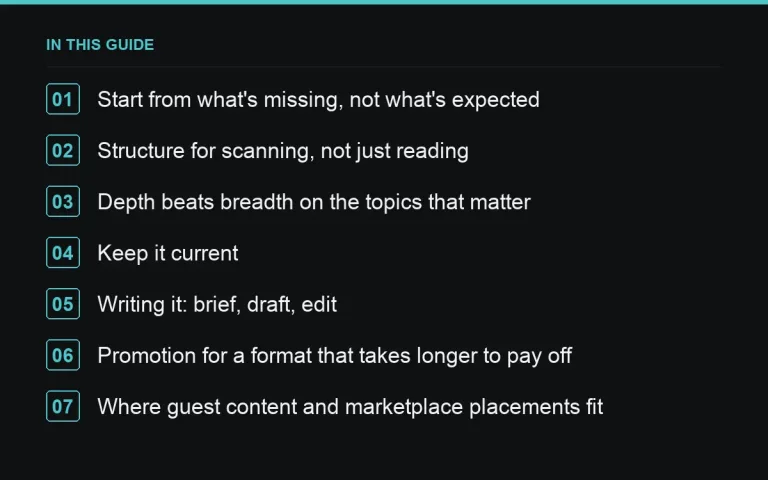
Start from what’s missing, not what’s expected
Before writing, read the five guides currently ranking for your target topic and note what each one skips, gets wrong or covers only briefly. That gap is your angle. If every existing guide on a topic ignores a specific audience, a specific edge case or a specific recent change, covering it properly is often enough to become the reference other writers cite for that angle, even without matching the others on overall length.
Structure for scanning, not just reading
- Use descriptive H2s that work as a table of contents on their own — someone should be able to judge whether the guide covers what they need just by scanning headings.
- Break long sections into H3 sub-sections once they cover more than one distinct idea.
- Use tables and lists wherever you’re comparing options or listing steps — a table someone can screenshot or reference is more citable than the same information in prose.
This structure also makes the guide easier to link into partially — a blogger linking to “the section on outreach templates” needs a heading to anchor to, not a wall of text they’d have to describe manually.
Depth beats breadth on the topics that matter
A guide that tries to cover every possible sub-topic at equal depth ends up shallow everywhere. Identify the two or three sections that matter most for your target reader and go deeper there than any competing guide does, even if it means covering peripheral topics more briefly or linking out to a dedicated page instead. This is where the pillar-and-cluster structure in https://successtoroad.com/blog/pillar-pages-and-topic-clusters/ helps — move a tangent into its own cluster page rather than cramming it into the guide.
Keep it current
Long guides are exactly the content type most likely to go stale, because they cover the most ground and therefore have the most individual facts that can become outdated. A guide that still references a discontinued tool or an old pricing model loses credibility fast, and links to it start looking like they were pointing at something wrong. Build the update into your calendar from the start — https://successtoroad.com/blog/content-refresh-cycles/ covers a workable cadence, and https://successtoroad.com/blog/content-audits-for-link-opportunities/ is how you catch decay before a competitor’s fresher guide replaces yours in the citations.
Writing it: brief, draft, edit
A long-form guide needs a tighter brief than a shorter post, because the writer needs to know the angle, the gap you identified, and which sections deserve the most depth before they start — see https://successtoroad.com/blog/content-briefs-for-writers/. Whether you write it in-house or commission it, the editing pass matters more here than on shorter content, since it’s where inconsistent depth and repeated points usually get caught; https://successtoroad.com/blog/editing-for-authority/ covers what to look for.
Promotion for a format that takes longer to pay off
Long guides tend to earn links slowly through organic search and reference over time rather than through a single promotional push, but that doesn’t mean skip promotion entirely. Pitch it to a handful of relevant writers as the “complete” resource on the topic, and consider it for https://successtoroad.com/blog/roundup-posts-done-well/ others might be compiling. https://successtoroad.com/blog/content-distribution-channels/ has the fuller list of channels worth trying.
Where guest content and marketplace placements fit
A strong long-form guide is also a good candidate to place directly on relevant third-party sites through https://successtoroad.com/services/writing/ or a marketplace search filtered to your niche — https://successtoroad.com/niche/marketing/, https://successtoroad.com/niche/business/ or wherever your audience actually reads. Placing a shorter, original version there with a link back to your full guide gets you both the placement’s own authority and a route back to the definitive version, browsable through https://successtoroad.com/marketplace/.
Handling the introduction and conclusion carefully
The opening paragraph is doing more work in a link-earning guide than in a typical blog post — it needs to answer the core question fast enough that a skimming reader or writer can immediately judge relevance, while still setting up why this particular guide is worth reading in full. Avoid a slow, scene-setting introduction that delays the actual substance; get to the point in the first two or three sentences, then use the rest of the introduction to preview what the guide covers. The closing section deserves similar care — a strong “where to go next” close, pointing to related pages and a next step, gives the reader (and potentially the linking writer) a clear sense that the guide is part of a larger, well-maintained body of work rather than a one-off post.
Common length traps to avoid
Two opposite failure modes are common. The first is padding: adding a section on a barely-related tangent, or restating the same point in slightly different words across several paragraphs, purely to reach a length target. The second is false brevity: cutting a genuinely important sub-topic down to a single sentence because the guide is already running long, which leaves a visible gap a competitor’s guide can exploit. Both are avoidable by planning the guide’s outline against the actual sub-topics it needs to cover before writing a single paragraph, rather than discovering the right length by writing until it feels done.
Where to go next
Pair a long guide with a glossary of its key terms — https://successtoroad.com/blog/glossaries-as-link-assets/ — and with a template or checklist version of its main process, in https://successtoroad.com/blog/templates-and-checklists-for-links/. For the strategy this sits inside, see https://successtoroad.com/blog/content-marketing-for-links/.
Frequently asked questions
How long does a long-form guide actually need to be?
Long enough to cover the topic properly and no longer. There's no fixed target — a genuinely complete guide might be 1,500 words on a narrow topic or 6,000 on a broad one. Padding to hit a length target usually hurts more than it helps.
Should we update an old guide or write a new one?
Update the old one if it already has links and rankings — a refresh keeps that equity. Write a new one only if the old angle is fundamentally wrong or the topic has changed so much that a rewrite is really a different guide.
How many sections should a long guide have?
Enough to cover the distinct sub-topics a reader needs, typically five to eight H2 sections. More than that usually means some sections should be split into their own cluster pages instead.
Do long guides need original data to earn links?
It helps but isn't required. Thoroughness, clear structure and covering a genuine gap in existing guides can earn links on their own — original data is one route to link-worthiness, not the only one.
Put it into practice
Filter 54,483 websites by DR, traffic, niche and price, and order with escrow — you pay only after the link is live.
Browse the marketplace