Interactive Tools and Calculators That Earn Links
A tool that gives a personal answer earns links differently than content that gives a general one.
An article tells everyone the same thing. A calculator or interactive tool tells each visitor something specific to them, and that personal output is what makes people share it and link to it — “I ran our numbers through this and here’s what it said” is a more natural thing to write than “I read an article about this.” That’s the core reason interactive tools punch above their weight as link-earning assets, discussed at a strategy level in https://successtoroad.com/blog/content-marketing-for-links/.
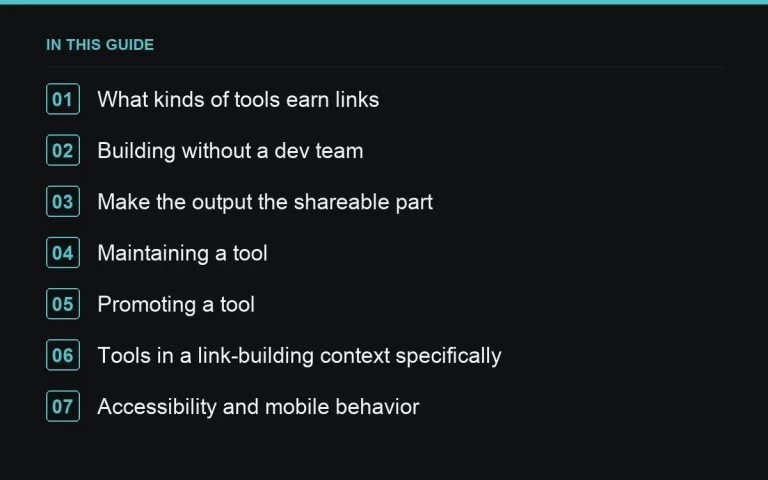
What kinds of tools earn links
- Calculators — turning a formula readers would otherwise do manually into an instant, personalized result. A price estimator, a break-even calculator, a return-on-spend calculator.
- Checkers and auditors — tools that assess something about the user’s own site or content and return a score or a list of issues, similar in spirit to https://successtoroad.com/blog/backlink-audit/ but self-serve.
- Comparison tools — letting a reader input two or more options and see them side by side, an interactive version of the static comparison covered in https://successtoroad.com/blog/link-building-tools-compared/.
- Quizzes and generators — lighter-weight, more shareable, though generally less durable as a link source than a genuinely useful calculator.
Building without a dev team
A tool doesn’t need to be technically sophisticated to earn links — a well-designed spreadsheet-style calculator embedded on a page, built with basic front-end scripting, can do the job. The bar is whether it gives a useful, personalized output faster than the reader could get one manually, not whether it looks like a polished SaaS product. Complexity can actually work against you here: a tool that asks for fifteen inputs before returning a result has a much higher drop-off rate than one that asks for three.
Make the output the shareable part
Design the results screen to be the thing people screenshot or link to directly — a clear headline number, a short explanation of what it means, and ideally a unique URL for that specific result set so someone can link to their exact output rather than just the tool’s homepage. This is the detail that separates a tool that gets linked to from one that just gets used once and closed.
Maintaining a tool
Unlike a static article, a tool can break — a formula can go out of date, an underlying data source can stop updating, a third-party script it depends on can be deprecated. Treat tools as a maintenance commitment, not a one-time build, and check them on the same cadence as your other content during https://successtoroad.com/blog/content-audits-for-link-opportunities/. A broken calculator that still has links pointing to it is worse than no calculator at all, since it actively damages trust with anyone who follows the link.
Promoting a tool
Tools are well suited to being pitched directly to writers covering the exact problem the tool solves — “here’s a free calculator for X” is a concrete, low-effort thing for a blogger to link to inside an existing article, unlike a full guide that would require them to restructure their piece. https://successtoroad.com/blog/content-distribution-channels/ covers this kind of targeted outreach in more depth, and https://successtoroad.com/blog/content-promotion-on-a-budget/ is worth reading if you’re doing this without a dedicated PR effort.
Tools in a link-building context specifically
A domain-comparison or campaign-budget calculator built around guest posting and backlink metrics is a natural fit for this kind of asset — it gives marketers a personalized answer about their own link-building spend or targets, and it’s the kind of thing other SEO blogs link to when discussing budgeting or ROI. Point the tool’s results toward relevant next steps, such as https://successtoroad.com/niche/marketing/ listings or the general https://successtoroad.com/marketplace/, so a visitor who gets a useful answer has an obvious place to act on it.
Accessibility and mobile behavior
A meaningful share of anyone finding a tool through a shared link will open it on a phone, so test the input flow and results screen on a small screen before launch, not just on the desktop browser used to build it. Number inputs, sliders and dropdown fields all behave differently across devices, and a tool that’s awkward to use on mobile will quietly lose a large fraction of its potential audience before they ever see the output worth sharing.
Setting expectations about precision
A calculator’s output can look more authoritative than the underlying assumptions justify, especially if it returns a single precise number rather than a range. Where the underlying formula involves real uncertainty — an estimate rather than a fixed calculation — say so plainly near the result, and consider presenting a range instead of false precision. This matters for the same reason avoiding fabricated statistics matters elsewhere in this series: an overconfident tool output that turns out to be unreliable damages trust in everything else you publish.
Where to go next
Read https://successtoroad.com/blog/templates-and-checklists-for-links/ for a lower-effort alternative that still earns links through utility, and https://successtoroad.com/blog/visual-content-and-charts-for-links/ for presenting a tool’s output well. For the broader strategy, see https://successtoroad.com/blog/content-marketing-for-links/.
Frequently asked questions
Do interactive tools need custom development?
Not necessarily — many effective tools are built with basic scripting or embeddable widgets rather than a full custom application. The bar is a fast, personalized output, not technical sophistication.
How do we know if a tool idea is worth building?
Check whether people are already doing the underlying calculation manually or asking about it in forums and communities. If there's evidence of the need but no existing free tool, that's a strong signal.
What's the biggest maintenance risk with tools?
Silent breakage — a formula, data source or script dependency failing without anyone noticing, while links still point to it. Schedule a periodic functional check, not just a content review.
Are quizzes worth building for link building specifically?
They're generally weaker for links than calculators or checkers, since the output is entertainment rather than a genuinely useful personalized answer. They can still work for social sharing and brand awareness, just less reliably for earned links.
Put it into practice
Filter 54,483 websites by DR, traffic, niche and price, and order with escrow — you pay only after the link is live.
Browse the marketplace