Guest Content vs Owned Content: Choosing Where to Publish
Owned content earns links passively over time. Guest content places links immediately, on someone else's authority.
Owned content — published on your own site — and guest content — published on someone else’s — solve different problems, and treating them as interchangeable leads to poor decisions about which to invest in for a given goal. Owned content builds your own site’s long-term authority and can earn links from many different sources over time; guest content places a specific link, on a specific site, immediately, but leaves the resulting authority concentrated somewhere you don’t control.
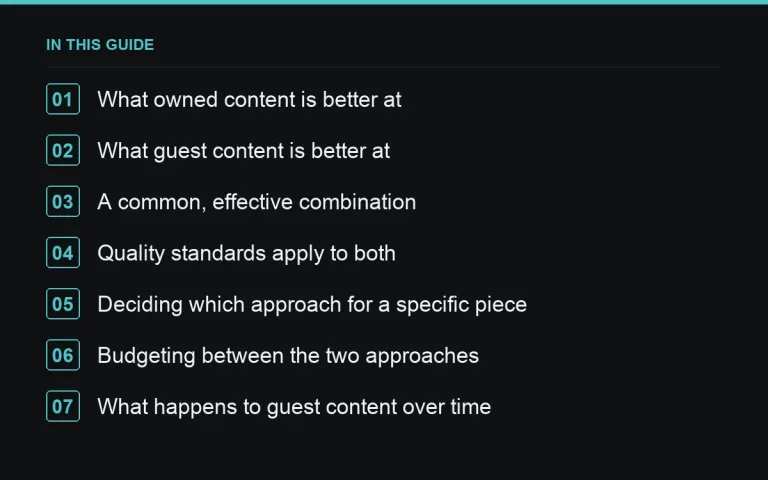
What owned content is better at
Original research, glossaries, pillar pages and other reference formats — covered throughout https://successtoroad.com/blog/content-marketing-for-links/ — belong on your own site because their long-term value comes from accumulating links and search visibility over years. Publishing this kind of asset as a one-off guest post elsewhere wastes its compounding potential, since the passive, ongoing link accumulation that makes these formats valuable can only happen on a page you control and keep updated.
What guest content is better at
Guest content is well suited to placing a specific, immediate link on a specific, relevant site — useful when you need a link from a particular publication for its authority or its audience, rather than waiting for that site to discover and cite your owned content organically. It’s also a good way to reach an audience that wouldn’t otherwise find your site at all, since the content lives where that audience already reads. https://successtoroad.com/services/writing/ exists specifically to source and manage this kind of placement, and https://successtoroad.com/marketplace/ is where you find sites in relevant niches, such as https://successtoroad.com/niche/business/ or https://successtoroad.com/niche/marketing/.
A common, effective combination
Many programs run both deliberately: a comprehensive owned-content asset that earns links passively over time, plus a shorter guest-content version placed on a handful of relevant sites, each linking back to the full owned version. This gets you the immediate, guaranteed placement from the guest post and the compounding, long-term value of the owned asset, rather than choosing one at the expense of the other. This is a form of the repurposing discussed in https://successtoroad.com/blog/repurposing-content-for-links/.
Quality standards apply to both
A guest post doesn’t get a lower editorial bar just because it’s not living on your own site — the standards from https://successtoroad.com/blog/editing-for-authority/, including no fabricated statistics or invented quotes, apply exactly the same way. A weak guest post reflects on your brand on someone else’s site just as much as weak owned content would on your own, and it can damage your relationship with that publisher for future placements.
Deciding which approach for a specific piece
- Is the goal long-term compounding authority, or an immediate link on a specific site? Owned favors the former, guest content the latter.
- Does the content depend on proprietary data or ongoing maintenance? That favors keeping it owned.
- Is there a specific relevant publisher you want a relationship with? A tailored guest post, sourced through https://successtoroad.com/services/writing/, is often the more direct route.
Budgeting between the two approaches
A useful planning exercise is to estimate, for a given quarter, roughly how much time and budget goes toward owned content development versus guest placement sourcing, and check whether that split matches your actual goals. A program aiming primarily for long-term organic authority should weight toward owned content; one needing to hit near-term link targets for a specific campaign will lean more heavily on guest placements through https://successtoroad.com/services/writing/ in the interim, while the owned assets mature.
What happens to guest content over time
Unlike owned content, you generally can’t refresh a guest post once it’s published on someone else’s site — if it goes stale, your options are limited to reaching out to the host site about an update, which isn’t always practical. This is one more reason to keep your most durable, evergreen assets as owned content, reserving guest placements for pieces that don’t depend on staying current for years, or for shorter pieces that simply link back to an owned asset you do keep updated.
A simple decision aid
| Goal | Better fit |
|---|---|
| Long-term, compounding site authority | Owned content |
| Immediate link from a specific relevant site | Guest content |
| Reaching an audience that doesn’t know you yet | Guest content |
| An asset that depends on ongoing maintenance or proprietary data | Owned content |
Revisiting the split as the program matures
Early on, a new site often leans more heavily on guest content simply because it hasn’t yet built enough owned authority to earn links organically. As the owned content library and its accumulated authority grow, the balance can shift, with owned assets carrying more of the load and guest placements becoming a more targeted, occasional tool rather than the primary link-building mechanism.
A final word on patience
Neither approach is a shortcut, despite how guest content is sometimes marketed as the faster option. A guest placement still requires research, a strong pitch, a well-written draft and a real editorial relationship to land well, and owned content still requires the same investment before it starts earning anything on its own. Choosing between them is about matching the right tool to the right goal, not about finding the one that avoids the underlying work entirely.
Where to go next
Read https://successtoroad.com/blog/finding-guest-post-opportunities/ for identifying the right sites for guest placements, and https://successtoroad.com/blog/content-distribution-channels/ for how owned content reaches an audience without a placement. For the wider strategy, see https://successtoroad.com/blog/content-marketing-for-links/.
Frequently asked questions
Should original research ever be published as a guest post instead of owned content?
A summarized version can work well as a guest post linking back to the full research on your own site, but the complete original research should live on your own site to capture its long-term compounding link value.
Does guest content count as content marketing?
Yes — it's a distribution and placement channel for content marketing, distinct from owned publishing but still part of the same broader strategy of producing content that earns trust and links.
Is it worth paying for guest post placements if we already publish strong owned content?
Often yes, as a complement rather than a replacement — placements guarantee a specific link on a chosen site quickly, while owned content compounds more slowly and unpredictably on its own.
How do we keep quality consistent across owned and guest content?
Apply the same editorial standards and brief structure to both, and route guest content through the same review process as anything published on your own site before it goes out.
Put it into practice
Filter 54,483 websites by DR, traffic, niche and price, and order with escrow — you pay only after the link is live.
Browse the marketplace