Expert Interviews: A Reliable Format for Links and Authority
An interview earns two kinds of links at once: from readers citing the expert's view, and from the expert sharing it themselves.
Expert interviews are one of the few content formats with a built-in distribution channel: the person you interview usually has their own audience, and a reasonable share of interviewees will share the piece once it’s published, simply because it features them. That’s on top of the normal citation value of specific, attributed expertise, which writers find easier to reference than an unattributed general claim.
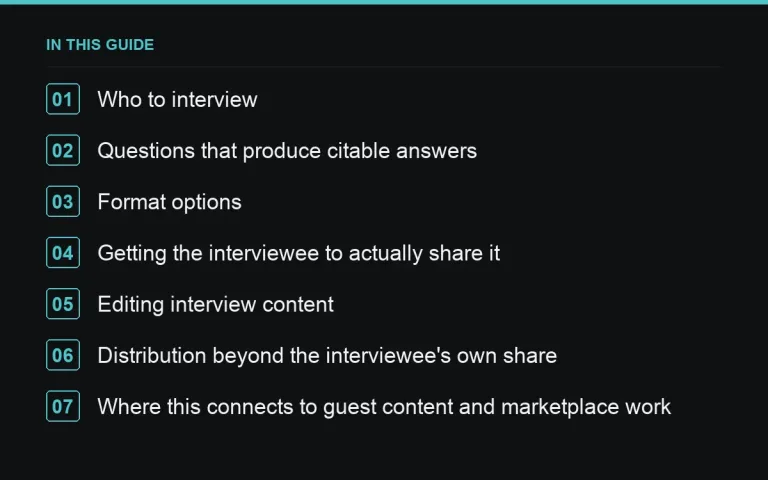
Who to interview
Look for people with specific, demonstrable experience in a narrow slice of your topic rather than the most generically famous name you can reach — a narrower expert is both easier to book and often gives more useful, specific answers than someone spread across many topics. Practitioners who’ve actually done the work, not only commentators, tend to give answers with the kind of concrete detail that makes a quote worth citing elsewhere.
Questions that produce citable answers
- Ask for specifics, not generalities — “walk me through how you decided X” produces a better quote than “what’s your opinion on X.”
- Include at least one question likely to produce a contrarian or unexpected answer — agreement with conventional wisdom rarely gets quoted elsewhere.
- Ask what they’d do differently, which tends to surface more honest, specific detail than a purely positive framing.
Format options
A single in-depth interview works well as a standalone piece, especially paired with a long-form guide on the same topic — see https://successtoroad.com/blog/long-form-guides-that-earn-links/. A series of shorter interviews with several experts on the same narrow question is a different, often stronger format for link building, since it produces multiple attributable quotes and multiple people with a reason to share the piece; this overlaps with the roundup format covered in https://successtoroad.com/blog/roundup-posts-done-well/, though a true roundup usually asks one question of many people rather than many questions of one.
Getting the interviewee to actually share it
Make sharing easy: send a short, ready-to-use blurb and a link as soon as the piece is live, rather than assuming they’ll write their own. Give them enough advance notice to plan a share rather than sending the link the moment it publishes. None of this guarantees a share, but removing friction meaningfully raises the odds compared to a bare “it’s live” email.
Editing interview content
Lightly edit for clarity and length, but don’t alter the substance of what someone said, and always send edited quotes back for approval before publishing if you’ve done more than trim filler words. This matters both ethically and practically — a misquoted expert is unlikely to share the piece and may ask for a correction that undermines the content’s credibility. https://successtoroad.com/blog/editing-for-authority/ covers this kind of careful editing pass in more depth.
Distribution beyond the interviewee’s own share
An interview series is also a natural fit for outreach to writers covering the same topic, since a piece with several named, quotable experts gives them multiple specific things to cite rather than one general claim. https://successtoroad.com/blog/content-distribution-channels/ and https://successtoroad.com/blog/content-promotion-on-a-budget/ cover the practical side of reaching that wider audience.
Where this connects to guest content and marketplace work
Interviewing people who run publisher sites or work in guest posting — editors, niche site owners, outreach specialists — produces content that’s directly relevant to a backlink marketplace audience and gives you a natural reason to link into https://successtoroad.com/services/writing/, relevant niches such as https://successtoroad.com/niche/marketing/, and the broader https://successtoroad.com/marketplace/ where readers can act on the advice being discussed.
Recording and note-taking practicalities
Record every interview if the interviewee agrees, even when you’re taking notes live — memory is unreliable for exact phrasing, and having a recording to check back against protects both accuracy and the interviewee’s trust in how they’ll be represented. Transcribe promptly rather than letting recordings pile up, since context and nuance fade quickly, and a delayed write-up is more likely to lose the specific detail that made an answer worth quoting in the first place.
What to do when an answer doesn’t fit the piece
Not every answer earns a place in the final piece, and that’s fine — cutting a weaker answer to keep the published version focused is normal editorial judgment, not a disservice to the interviewee. If you’re leaving out a substantial portion of what someone said, a brief, honest note thanking them for the fuller conversation goes a long way toward keeping the relationship positive for future interviews, even when their exact words don’t make the final cut.
Following up after publication
Once the interview is live, a brief follow-up thanking the expert and asking if they have any reaction to how it performed keeps the relationship warm for a future interview, whether that’s a follow-up conversation on the same topic or an entirely new one. Experts who feel well treated the first time are noticeably easier to book again, which matters if interviews are a recurring format in your content plan rather than a one-off experiment.
Where to go next
Read https://successtoroad.com/blog/roundup-posts-done-well/ for the related multi-expert format, and https://successtoroad.com/blog/case-studies-that-earn-links/ for another specificity-driven content type. For the wider strategy, see https://successtoroad.com/blog/content-marketing-for-links/.
Frequently asked questions
How long should an expert interview piece be?
Long enough to include the full substance of the answers without padding around them, typically 900 to 1,200 words including framing and introduction. Trim filler rather than adding commentary just to hit a length target.
Should we pay experts for interviews?
Most industry interviews are unpaid in exchange for exposure and a link back to the expert's own site, though norms vary by field. Be upfront about what you're offering before the interview so expectations are clear.
What if the expert gives generic, unquotable answers?
Follow up with a more specific question rather than publishing a flat answer as-is. Asking for a concrete example or a specific decision usually produces something more useful than accepting the first general response.
Can we combine an interview with original research?
Yes — asking an expert to react to or interpret your own research findings is a strong combination, giving the piece both original data and an attributed expert perspective in one asset.
Put it into practice
Filter 54,483 websites by DR, traffic, niche and price, and order with escrow — you pay only after the link is live.
Browse the marketplace