Editing for Authority: The Pass That Makes Content Citable
Grammar checking catches typos. Editing for authority catches the things that make a piece worth citing.
A grammar and style pass makes content readable. A different, more demanding pass is needed to make it authoritative — one that checks whether every claim is actually defensible, whether the piece says something a reader couldn’t already get from the five other articles ranking for the same topic, and whether it reads like it was written by someone who genuinely knows the subject. This second pass is where a lot of otherwise decent drafts either become citable or quietly stay forgettable.
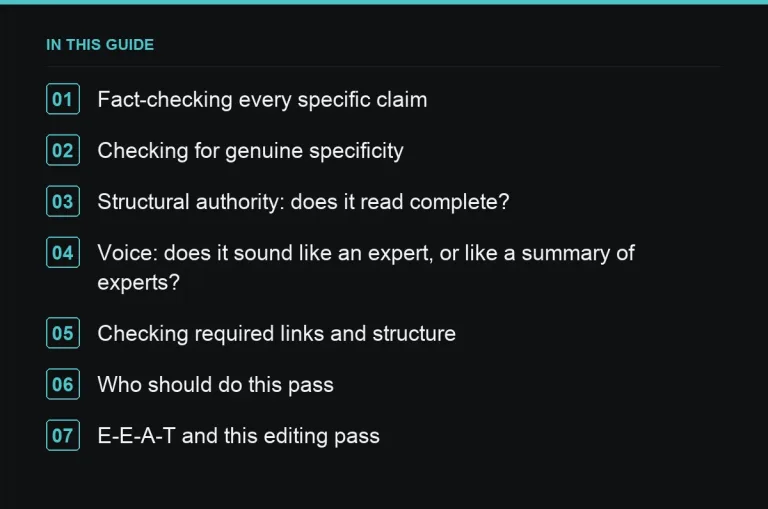
Fact-checking every specific claim
Every number, tool name, statistic and specific claim in a draft needs to be traceable to something real — either your own data, a defensible general statement, or an explicitly sourced piece of public information. This is the single most important check, since a fabricated statistic that slips through and later gets challenged or disproven damages the credibility of everything else you’ve published, not just the one piece. If a writer’s draft includes a specific number with no clear source, that’s a stop-and-verify moment, not a minor style note.
Checking for genuine specificity
- Flag vague, generic statements that could appear in any article on the topic — “content is important for SEO” adds nothing a reader doesn’t already know.
- Push for concrete examples wherever a claim is abstract, since specificity is what makes a piece feel like it was written by someone who’s actually done the work.
- Cut sections that restate the introduction in different words instead of adding new information — a common padding pattern in drafts written to hit a word count.
Structural authority: does it read complete?
A reader — and a writer considering whether to cite the piece — judges completeness partly by structure. Check that headings map to a logical progression, that nothing important is buried in a paragraph when it deserves its own section, and that the piece doesn’t leave an obvious sub-question unanswered. This overlaps with the structural guidance in https://successtoroad.com/blog/long-form-guides-that-earn-links/ and the cluster-page division covered in https://successtoroad.com/blog/pillar-pages-and-topic-clusters/.
Voice: does it sound like an expert, or like a summary of experts?
Content that hedges every sentence with “some experts believe” or “it is often said that” reads as secondhand, even when the underlying information is accurate. A strong edit pushes toward direct, specific statements the piece is willing to stand behind, reserving hedged language for genuinely uncertain or contested points rather than using it as a reflexive habit throughout.
Checking required links and structure
Confirm the piece includes its required internal links in natural, relevant places rather than dropped in as an afterthought at the end, and that at least one marketplace reference — https://successtoroad.com/services/writing/, https://successtoroad.com/marketplace/, or a relevant niche or language filter — appears where it genuinely helps the reader rather than feeling inserted. A link that reads as forced undermines the same authority the rest of the edit is trying to build.
Who should do this pass
Ideally someone other than the original writer, since it’s hard to spot your own vague statements and unverified claims after spending hours immersed in a draft. This is true whether the writer is in-house or freelance — see https://successtoroad.com/blog/hiring-writers-vs-in-house/ — and it’s worth building into the workflow as a non-negotiable step rather than something that happens only when time allows.
E-E-A-T and this editing pass
Much of what this pass checks for overlaps directly with the experience, expertise, authoritativeness and trust signals search engines and readers both respond to — see https://successtoroad.com/blog/e-e-a-t-signals-in-content/ for how those concepts map onto specific, checkable editorial decisions rather than staying abstract.
Building an editing checklist your team actually uses
A checklist that lives only in someone’s head gets applied inconsistently as the team grows or as deadlines get tight. Write down the specific things this pass checks for — unverified claims, vague statements, missing required links, forced marketplace mentions — as a short, concrete list attached to your editorial workflow, so the standard doesn’t quietly erode when the person who originally cared most about it is busy or out.
When to push a piece back versus fix it yourself
An editor fixing every issue silently, rather than sending feedback back to the writer, might feel faster in the moment but doesn’t help the writer improve, and it puts unsustainable ongoing load on the editor as volume grows. Reserve direct fixes for small, mechanical issues, and send substantive problems — an unverified claim, a section that doesn’t add anything new — back to the writer with specific feedback, which builds a stronger long-term working relationship and better second drafts over time.
A five-minute version for smaller teams
Not every team has the bandwidth for a full, separate editing-for-authority pass on every piece. A scaled-down version — checking just the most consequential specific claims and scanning for one or two vague, generic statements to cut — still catches a meaningful share of the issues a full pass would find, and is far better than skipping this kind of check entirely because the ideal process feels too heavy to sustain.
Where to go next
Read https://successtoroad.com/blog/e-e-a-t-signals-in-content/ for the broader framework this pass supports, and https://successtoroad.com/blog/content-that-fails-to-earn-links/ for what happens when this step gets skipped. For the wider strategy, see https://successtoroad.com/blog/content-marketing-for-links/.
Frequently asked questions
How long should an editing-for-authority pass take?
It varies with length and complexity, but budget real time for it separately from a copyedit — checking every specific claim and pushing for genuine specificity takes longer than checking grammar and typically can't be rushed.
Can this pass be done by the same person who wrote the brief?
It can, but a second, independent reader often catches more, since the brief writer may share the same blind spots as whoever executed it. Where possible, use a different person for this check.
What's the most common issue this pass catches?
Vague, generic statements that could apply to any article on the topic, along with unverified specific claims. Both are easy to miss during a normal read-through focused on flow and grammar.
Does this replace a standard copyedit?
No, it's a separate, additional pass focused on substance and credibility rather than grammar and style. Most workflows need both, usually in that order — substance first, then polish.
Put it into practice
Filter 54,483 websites by DR, traffic, niche and price, and order with escrow — you pay only after the link is live.
Browse the marketplace