Content Refresh Cycles: How Often to Update Your Best Pages
A page that earned links two years ago can be quietly losing them right now if nobody's checked on it.
Content doesn’t fail all at once. A page that earned solid links in its first year can keep ranking for a while even as it goes stale, right up until a fresher competitor’s version overtakes it in both search results and in what writers choose to cite. By the time that shows up clearly in your analytics, you’ve usually lost months of potential links you didn’t have to lose. A refresh cycle exists to catch this before it happens rather than after.
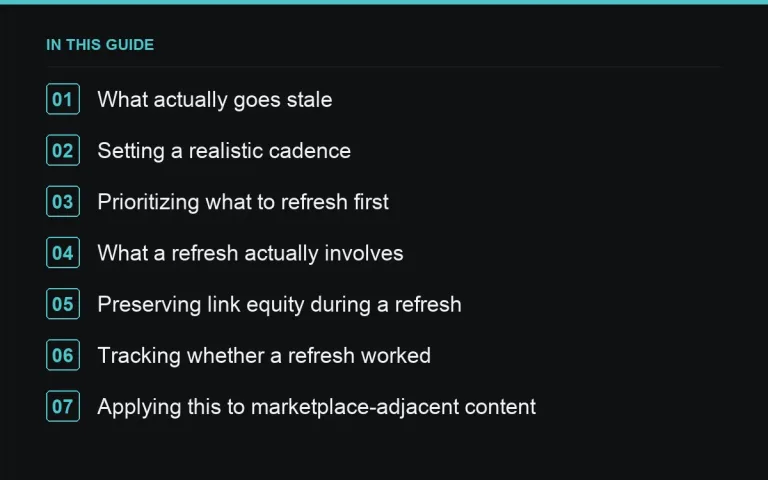
What actually goes stale
- Facts, prices, tool names and screenshots that reference something that’s since changed.
- Links to other pages on your own site that have been moved, merged or removed.
- Competitive gaps — a newer competitor guide now covers something yours doesn’t.
- Outdated framing — advice that was standard practice when written but has since shifted.
Setting a realistic cadence
Not every page needs the same schedule. A glossary entry might only need a quick accuracy check once a year, as covered in https://successtoroad.com/blog/glossaries-as-link-assets/, while a long-form guide on a fast-moving topic might need attention every three to six months. Tie the cadence to how quickly the underlying topic actually changes, not to a single blanket policy — a fixed “update everything every twelve months” rule wastes effort on stable pages and under-serves fast-changing ones.
Prioritizing what to refresh first
Start with pages that already have meaningful links and rankings — these have the most to lose from decay and the most to gain from staying current, since a refresh here protects existing link equity rather than trying to build new equity from scratch. https://successtoroad.com/blog/content-audits-for-link-opportunities/ is the broader process for identifying these pages; a refresh cycle is what you do with what the audit finds.
What a refresh actually involves
A meaningful refresh is more than changing the published date. Re-verify every factual claim, check every internal and external reference still resolves correctly, re-read the piece against what’s currently ranking to see what competitors now cover that you don’t, and update the examples if they’ve dated. If the core structure of the piece is sound, this can often be done without a full rewrite — but if the topic itself has shifted substantially, a refresh that only patches surface details will leave the piece looking dated compared to newer competitors anyway.
Preserving link equity during a refresh
Keep the same URL whenever possible — moving a page to a new address during a refresh forfeits links pointing at the old one unless you set up a careful redirect, which is its own risk. If sections are being restructured, keep the anchors that existing inbound links point to intact, or redirect them precisely rather than letting them 404. https://successtoroad.com/blog/link-reclamation-404s/ is worth reading if you’ve already lost links this way and need to recover them.
Tracking whether a refresh worked
Compare referring domains and rankings for the page in the months following a refresh against the months before it. A refresh that only changes minor details rarely moves the needle much; one that adds genuinely new information or closes a real competitive gap should show some measurable improvement within a reasonable window, tracked the same way as new content in https://successtoroad.com/blog/measuring-content-earned-links/.
Applying this to marketplace-adjacent content
Pages referencing marketplace features, pricing patterns or niche availability age faster than general advice content, since those details change as the marketplace itself evolves — check that any page linking to https://successtoroad.com/marketplace/, https://successtoroad.com/services/writing/ or specific niches like https://successtoroad.com/niche/finance/ still describes those accurately before republishing.
Assigning ownership of the refresh process
Refresh work tends to fall through the cracks when it isn’t clearly owned by someone, since it competes for attention against the more visible, more celebrated work of publishing new content. Assign a specific person or role responsibility for the refresh calendar, with the same accountability as new-content deadlines, rather than treating it as something anyone can pick up when they have spare time. Programs that treat refresh work as a first-class, scheduled responsibility consistently protect more of their existing link equity than those that treat it as an occasional cleanup task.
Communicating changes to readers and linking sites
For a significant refresh — one that changes the core recommendation or reverses previous advice — a brief note at the top of the page acknowledging what changed and why is good practice, both for returning readers and for anyone who linked to the earlier version and might want to know the guidance has shifted. This kind of transparency protects trust in a way that silently rewriting a page never quite does, and it fits naturally alongside the honesty standards discussed in https://successtoroad.com/blog/e-e-a-t-signals-in-content/.
Where to go next
Read https://successtoroad.com/blog/content-audits-for-link-opportunities/ for the identification process this cycle depends on, and https://successtoroad.com/blog/evergreen-vs-timely-content/ for how content type should shape your refresh cadence. For the wider strategy, see https://successtoroad.com/blog/content-marketing-for-links/.
Frequently asked questions
How do we know a page needs refreshing rather than replacing?
If the core structure and angle are still sound and only details have dated, refresh it. If the topic or the reader's underlying question has fundamentally shifted, a full rewrite under the same URL is usually better than patching.
Does updating the published date help on its own?
Not meaningfully, and doing it without real content changes can come across as misleading to readers who notice the date doesn't match the substance. The value comes from the actual updates, not the date itself.
How often should a fast-moving topic's guide be refreshed?
Every three to six months is reasonable for genuinely fast-moving topics. Slower-moving reference content can go a year or more between checks.
What's the biggest risk when refreshing a page with existing links?
Losing the URL or breaking the specific anchors that inbound links point to. Keep the address stable and redirect carefully if restructuring is unavoidable.
Put it into practice
Filter 54,483 websites by DR, traffic, niche and price, and order with escrow — you pay only after the link is live.
Browse the marketplace