Content Licensing and Syndication Partnerships
Syndicating your content to a larger publisher can extend your reach, but the attribution link and canonical setup need to be agreed before publication, not after.

Content syndication — letting another publisher republish your article, in full or adapted, on their own site — and content licensing — granting broader rights to reuse your material, sometimes for a fee — are both partnership formats that hinge on getting attribution and technical link setup right. Get it wrong and you can end up competing with your own syndicated copy in search results, or losing credit entirely.
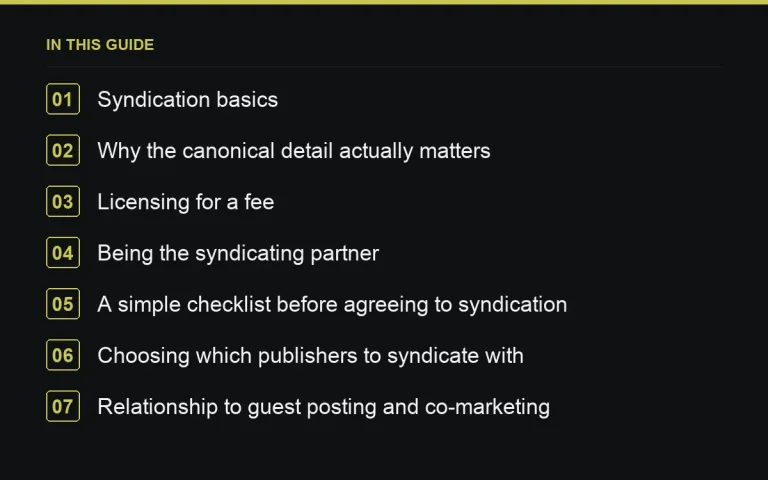
Syndication basics
- Syndication should always include a clear attribution link back to the original piece on your site, typically at the top or bottom of the republished article.
- Wherever possible, ask the syndicating publisher to add a canonical tag pointing back to your original URL — this tells search engines which version is the authoritative source, protecting your original from being outranked by the syndicated copy on a larger site.
- If a canonical tag isn’t possible, a clear, prominent “originally published at [link]” note is the next best thing, both for SEO and for basic attribution fairness.
Why the canonical detail actually matters
A larger publisher syndicating your content on a stronger domain can, without a canonical tag pointing back to you, end up outranking your own original article for the same content. This isn’t a hypothetical edge case — it happens regularly when the syndicating site has significantly more authority. Negotiate the canonical tag as a condition of the syndication agreement, not an afterthought raised after the piece is already live.
Licensing for a fee
Some publishers pay to license content outright, sometimes with fewer attribution requirements than free syndication (since they’re paying for usage rights). If you license content this way, still negotiate for an author or company mention where possible — an unattributed licensed piece gives you the licensing fee but nothing on the SEO or brand side.
Being the syndicating partner
If you’re the one republishing someone else’s content — a common approach for a marketplace or media site wanting to fill out coverage of a topic — apply the canonical tag pointing to the original source as standard practice, and give clear, prominent attribution. This is both the right approach for search engines and a reasonable way to keep good relationships with content partners for future syndication opportunities.
A simple checklist before agreeing to syndication
- Confirm who requests the canonical tag and how — many CMSs make this a simple field, but not all publishers know to set it.
- Agree on a delay, if any, between original publication and syndicated republishing (some publishers require a period of exclusivity first).
- Decide whether the syndicated version can be edited (headline changes are common; substantive content changes should require your approval).
Choosing which publishers to syndicate with
Not every syndication opportunity is worth pursuing, even with a properly set canonical tag. A publisher whose audience genuinely overlaps with your target readers, and whose own site maintains reasonable editorial standards, extends your reach in a way that’s worth the coordination effort. A publisher that exists mainly to aggregate other people’s content at volume, with little original editorial judgement of its own, adds little beyond a technical link and can occasionally dilute your brand’s association with quality content if your piece sits alongside low-effort material. Review a prospective syndication partner’s existing content — via a directory such as https://successtoroad.com/marketplace/ filtered to a relevant https://successtoroad.com/niche/marketing/ or sector-specific category — the same way you’d evaluate any other publisher relationship.
Where a publisher approaches you first, rather than the other way around, that’s often a positive signal about your original content’s quality and reach — treat these inbound requests as a chance to build an ongoing syndication relationship rather than a one-off transaction, provided the technical attribution terms are handled properly each time.
Relationship to guest posting and co-marketing
Syndication differs from guest posting in that the content already exists and is simply being republished, rather than written fresh for the new publisher. It’s a lower-effort way to extend reach compared to https://successtoroad.com/blog/co-marketing-campaigns/, but the SEO risk from a missing canonical tag makes it worth more technical diligence than a typical guest post relationship.
Setting a clear internal policy
Once you start syndicating regularly, write down your standard terms — attribution format, canonical requirement, editing rules, exclusivity window — so every new syndication conversation starts from the same baseline instead of being renegotiated from scratch each time. This also protects you against inconsistent agreements across multiple publishers, where one is held to a canonical requirement and another isn’t purely because the two conversations were handled differently.
Handling translated or adapted syndication
Syndication sometimes involves adaptation rather than a straight republish — a translation into another language, a regional adaptation of examples and references, or a condensed version for a different format. These changes make a strict canonical tag less appropriate, since the content is no longer identical, but attribution and a clear link back to the original source remain just as important. Agree explicitly on how adapted versions will credit the original piece, since this is easy to overlook when the conversation is framed mainly around translation logistics rather than SEO or attribution.
Where to go next
For content partnerships that involve fresh writing rather than republishing existing material, see https://successtoroad.com/blog/guest-exchange-non-competing-brands/ and https://successtoroad.com/blog/co-marketing-campaigns/. If your syndication partner is also a white-label reseller of your content specifically, read https://successtoroad.com/blog/white-label-partnership-links/.
Frequently asked questions
What happens if a syndicated copy outranks our original article?
This usually happens when no canonical tag was set and the syndicating site has stronger authority. Ask the publisher to add a canonical tag pointing to your original as soon as this is noticed.
Is a link-only attribution enough, or do we need a canonical tag too?
A visible attribution link protects readers' understanding of the source, but only a canonical tag protects your search rankings from the syndicated copy competing with the original.
Can we syndicate the same article to multiple publishers?
Yes, but each syndication should ideally include its own canonical tag back to your original, and be aware that syndicating too widely can dilute the perceived uniqueness of your original content over time.
Should paid content licensing still include attribution?
It's worth negotiating for even when payment is involved — attribution protects your brand and search visibility in ways a licensing fee alone doesn't replace.
Put it into practice
Filter 54,483 websites by DR, traffic, niche and price, and order with escrow — you pay only after the link is live.
Browse the marketplace