Content for YMYL Topics: What Changes When It’s Money or Life
Health, finance and legal content is held to a stricter bar because getting it wrong actually hurts someone.
Your Money or Your Life topics — health, finance, legal, safety — carry consequences that a piece about content marketing formats simply doesn’t. Bad advice about outreach templates wastes someone’s afternoon; bad advice about a medication interaction or a financial decision can cause real harm. That difference should shape every part of the content process, from who writes it to how aggressively you pursue links for it.
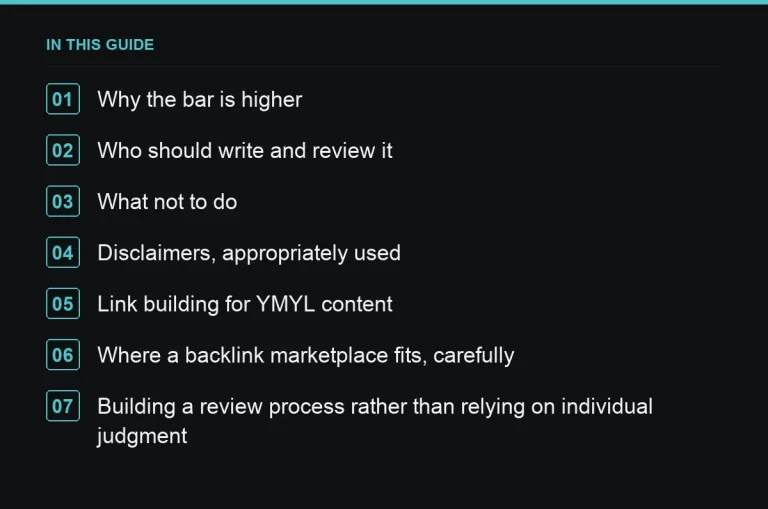
Why the bar is higher
Readers researching YMYL topics are often making a decision with real stakes, and they — along with anyone evaluating whether to cite or link to the content — reasonably expect a higher standard of accuracy, sourcing and demonstrated expertise than they would for lower-stakes topics. This isn’t unique to any one platform’s guidelines; it reflects a genuine difference in what responsible content on these topics requires.
Who should write and review it
- Someone with genuine, verifiable relevant expertise should write or closely review the content — a generalist writer working from a brief and general research is a weaker fit here than for most other topics.
- A qualified reviewer’s name and credentials, where applicable, should be visible on the piece, tying into the author-page practices in https://successtoroad.com/blog/author-pages-for-content-marketing/.
- Claims that touch on medical, legal or financial specifics need a clear, checkable source, not a general statement standing in for one.
What not to do
Never fill a gap in genuine expertise with confident-sounding generic content — if you don’t have someone qualified to write or review a specific YMYL topic, that’s a signal to either invest in getting that expertise involved or to not publish the piece at all, rather than publishing something that reads authoritative without the substance behind it. This is a stricter version of the general fabrication rule that applies across all content, but the stakes make it much less forgivable here.
Disclaimers, appropriately used
A disclaimer noting that content is general information and not a substitute for professional advice is appropriate and expected for YMYL content, but it’s not a substitute for actually getting the substance right — a disclaimer doesn’t excuse inaccurate or irresponsible advice, it just clarifies the intended scope of what’s being offered.
Link building for YMYL content
The same principles from https://successtoroad.com/blog/content-marketing-for-links/ apply, but the bar for what counts as link-worthy is higher — a thin guide won’t earn credible links on a YMYL topic the way it might on a lower-stakes one, because publishers and readers alike are more scrutinous. Original research or a genuinely expert-reviewed guide, as in https://successtoroad.com/blog/original-research-for-links/ and https://successtoroad.com/blog/expert-interviews-for-content-marketing/, tend to be stronger formats here than a general listicle.
Where a backlink marketplace fits, carefully
If you’re sourcing placements for YMYL content through a marketplace, prioritize sites with genuine topical relevance and editorial standards in the specific niche — https://successtoroad.com/niche/health/ or https://successtoroad.com/niche/finance/ on https://successtoroad.com/marketplace/, for instance — over sites picked purely for metrics, since a placement on an irrelevant or low-quality site does less for a YMYL topic’s credibility than it might elsewhere. https://successtoroad.com/services/writing/ can help source genuinely relevant placements, but the content itself still needs the expert involvement described above regardless of where it’s placed.
Building a review process rather than relying on individual judgment
For any regular volume of YMYL content, a formal review step — a named qualified reviewer, a sign-off requirement before publication, a record of who reviewed what — protects consistency in a way that trusting individual writers to self-police can’t. This matters more here than for general content because the cost of a single slip is higher, and a documented process also gives you something concrete to point to if a reader or a regulator ever questions how a piece was vetted.
What to do when you can’t get qualified review
If a topic genuinely requires expertise you don’t have access to, the honest options are to find and compensate a qualified reviewer, to narrow the piece to the parts you can responsibly cover without specialist input, or to not publish it at all. Publishing anyway with a disclaimer as the only safeguard is a common shortcut, but it doesn’t substitute for the actual review process YMYL content needs.
A note on tone for YMYL content specifically
Confident, direct writing is generally good practice, but YMYL topics call for a slightly different balance — appropriate confidence on well-established points, paired with genuine, clearly marked caveats on anything uncertain or situation-dependent. Readers making a real decision benefit more from an honest “this depends on your specific situation, consult a professional” than from false certainty dressed up as authoritative advice.
Reviewing YMYL content on a shorter cycle
Guidance in health, finance and legal topics can shift faster than in general marketing content, sometimes due to regulatory changes or updated professional consensus. Review YMYL pages on a shorter refresh cycle than you might use elsewhere, per https://successtoroad.com/blog/content-refresh-cycles/, and be willing to pull or heavily revise a piece quickly if the underlying guidance it relied on has genuinely changed.
Where to go next
Read https://successtoroad.com/blog/e-e-a-t-signals-in-content/ for the broader trust framework this sits inside, and https://successtoroad.com/blog/author-pages-for-content-marketing/ for making reviewer credentials visible. For the wider strategy, see https://successtoroad.com/blog/content-marketing-for-links/.
Frequently asked questions
What topics count as YMYL beyond health and finance?
Legal advice, safety information, major life decisions like immigration or parenting, and anything else where inaccurate advice could cause real financial or physical harm. The exact boundary is judgment-based rather than a fixed list.
Can a generalist writer produce YMYL content with enough research?
Research alone usually isn't enough — genuine review by someone with relevant qualifications is the safer standard, especially for anything touching specific medical, legal or financial guidance rather than general background information.
Do disclaimers protect us from publishing inaccurate YMYL content?
No — a disclaimer clarifies scope but doesn't excuse getting the substance wrong. Accuracy and appropriate expert involvement are the actual safeguards; the disclaimer is a supplement, not a substitute.
Is it harder to earn links for YMYL content?
Often yes, since publishers and readers apply more scrutiny. Genuinely well-researched, expert-reviewed content still earns links, but thin or generic content is less likely to succeed here than in lower-stakes topics.
Put it into practice
Filter 54,483 websites by DR, traffic, niche and price, and order with escrow — you pay only after the link is live.
Browse the marketplace