Content Distribution Channels That Actually Lead to Links
Publishing content is the easy half; getting it seen by people who could link to it is the part that earns the links.
A great piece of content with no distribution plan will eventually earn some links through organic search discovery, but slowly, and often only after a competitor’s less thorough version has already claimed the citations you were hoping for. Distribution is what compresses that timeline — getting the piece in front of the specific people likely to link to it, rather than waiting for them to stumble onto it.
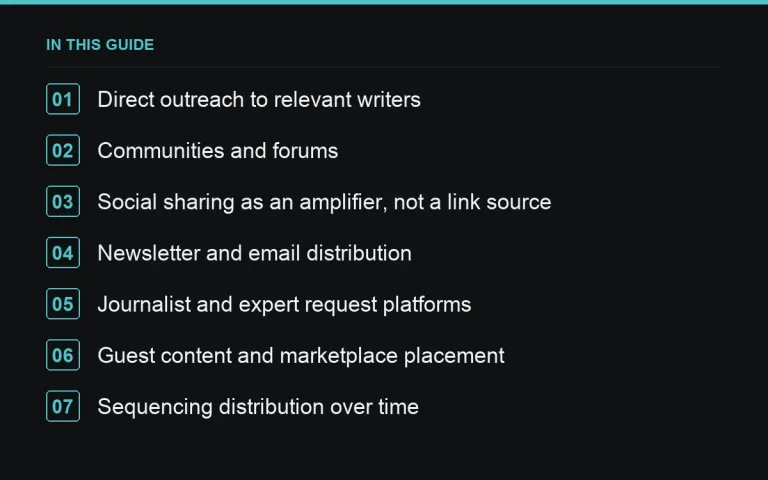
Direct outreach to relevant writers
The highest-conversion channel is usually a short, personal email to a handful of writers already covering the topic, pointing them to the specific piece and the specific reason it’s relevant to something they’ve written or might write. This works best with format that give writers something concrete to cite — original research, a chart, a tool — rather than a general article restating known advice. It’s a small-scale, high-relevance version of the same instinct behind https://successtoroad.com/blog/finding-guest-post-opportunities/: find the people already writing about your topic before you try to reach a broader audience.
Communities and forums
Niche communities, forums and topic-specific groups are where practitioners actually ask for resources, and sharing genuinely useful content there — when it fits the conversation, not as a drive-by drop — can surface both direct traffic and secondary citations from people who saw it there and later referenced it elsewhere. https://successtoroad.com/blog/community-and-forum-links/ covers the etiquette that keeps this from reading as spam.
Social sharing as an amplifier, not a link source
Social platforms themselves rarely pass a direct SEO-relevant link, but they widen the pool of people who see a piece, some of whom write on other sites and may cite it later. Treat social distribution as a discovery layer rather than the goal itself — https://successtoroad.com/blog/social-media-and-links/ covers this relationship in more depth.
Newsletter and email distribution
If you or partners maintain an email newsletter with a relevant audience, it’s one of the most reliable channels for driving the first wave of engaged readers to a new piece, some of whom are themselves publishers or writers. Coordinating a piece’s launch with a newsletter mention can meaningfully change its early trajectory.
Journalist and expert request platforms
For content built around expertise — interviews, original data, commentary — https://successtoroad.com/blog/journalist-request-platforms/ are worth monitoring, since they surface reporters actively looking for a source or a citation on a specific topic right now, which is a much narrower and higher-intent audience than a general pitch.
Guest content and marketplace placement
Distribution doesn’t have to mean waiting for someone else to link to your content — publishing directly on relevant third-party sites through https://successtoroad.com/services/writing/ is a distribution channel in its own right, putting a version of your ideas (with a link back to the full piece) in front of an audience that’s already reading that site. Browsing https://successtoroad.com/marketplace/ by niche, such as https://successtoroad.com/niche/marketing/ or https://successtoroad.com/niche/business/, is how you find sites where that audience overlap is strongest.
Sequencing distribution over time
Most content gets one initial distribution push and then goes quiet, but the strongest evergreen pieces benefit from a second and third round of distribution months later, especially after a refresh — see https://successtoroad.com/blog/content-refresh-cycles/ — or when a related news event makes the topic newly relevant. Plan for this rather than treating distribution as a one-time launch task.
Tracking which channel actually delivered a link
When a new referring domain appears, it’s worth a quick check on how that site likely found the content — a specific outreach email, a community post, an organic search, a shared newsletter mention — since this kind of attribution, even if imperfect, tells you which channels are actually converting into links versus which are mainly generating traffic. Over several pieces, a clearer picture emerges of which channels are worth the ongoing time investment for your specific niche and audience, which then feeds back into how you allocate distribution effort for future content.
Building channel relationships over time
The channels that matter most tend to be relationships rather than one-off tactics — a specific journalist who’s cited your research twice before, a community where your posts are consistently well received, a newsletter editor who’s shared your content in the past. Treat these relationships as assets worth nurturing deliberately rather than starting from zero with every new piece, since a warm contact responds very differently to a pitch than a cold one does.
A simple distribution checklist for every new piece
- A short list of specific writers or publications to pitch directly, chosen for genuine relevance.
- At least one relevant community or forum where sharing would be appropriate and welcome.
- A newsletter mention if you or a partner has one with an overlapping audience.
- A check of journalist request platforms for any open, relevant queries.
Running through this list as a standard step before considering a piece “published” prevents the common failure of treating distribution as optional or something to get to later, which in practice often means it never happens at all.
Where to go next
Read https://successtoroad.com/blog/content-promotion-on-a-budget/ if resources are limited, and https://successtoroad.com/blog/repurposing-content-for-links/ for getting more distribution mileage out of content you’ve already published. For the wider strategy, see https://successtoroad.com/blog/content-marketing-for-links/.
Frequently asked questions
Which distribution channel has the best return for the least effort?
Direct outreach to a short list of highly relevant writers tends to have the best conversion rate per hour spent, though it doesn't scale as easily as broader channels like social or newsletters.
How soon after publishing should distribution start?
Immediately — the first days after publishing are usually when a piece is freshest and most relevant to pitch. Waiting weeks to start outreach loses momentum and makes the piece feel dated to anyone you approach.
Do we need a big following for social distribution to matter?
A large following helps but isn't required — a small, relevant audience that includes even a few writers or publishers can be enough to start a citation chain, especially combined with direct outreach.
Is paid promotion worth it for link-earning content?
Occasionally, for reaching a specific relevant audience, but paid promotion drives traffic, not links directly. It can support link earning indirectly by putting the content in front of people who then choose to cite it.
Put it into practice
Filter 54,483 websites by DR, traffic, niche and price, and order with escrow — you pay only after the link is live.
Browse the marketplace