Co-Marketing Campaigns: Building Links Through Joint Content
A joint webinar, guide or report with a partner can earn links on both sides if the split of work and credit is fair from the start.
Co-marketing is two companies producing something together — a guide, a webinar, a benchmark report, a tool — and each promoting it to their own audience. Done well, it produces one of the few link formats where both sides want the link to exist, because it points to content they helped create. Done badly, it becomes a single logo swap on a landing page nobody updates again.
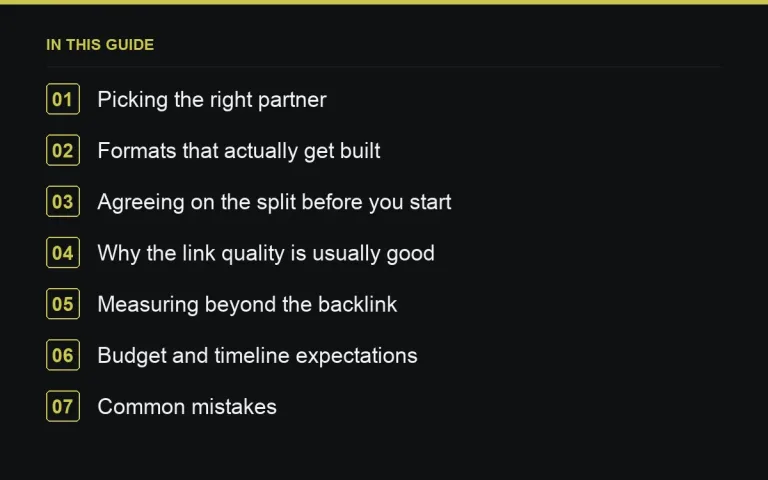
Picking the right partner
The best co-marketing partners serve the same audience but do not compete for the same purchase. A project management tool and a time-tracking tool share a buyer; an SEO tool and a link marketplace share a buyer. Avoid two companies that are actually substitutes for each other — the incentive to promote the joint asset honestly breaks down when one party benefits more from the other looking weaker.
Look for partners who already publish content regularly. A company with no blog and no email list cannot distribute their side of the campaign, and you will end up doing all the promotion while still splitting the credit.
Formats that actually get built
| Format | Effort | Typical link value |
|---|---|---|
| Co-authored guide or report | Medium | High — becomes a linkable reference page |
| Joint webinar with landing page | Low–Medium | Medium — landing page often gets deindexed after the event |
| Shared benchmark or checklist tool | High | High — ongoing utility keeps the page linked |
| Cross-posted interview or Q&A | Low | Low–Medium — depends on how evergreen the topic is |
A co-authored guide or a shared tool tends to outperform a webinar landing page for links, simply because the page keeps being useful after the event date passes. If you do run a webinar, plan for the landing page to convert into an on-demand resource page afterwards rather than letting it die.
Agreeing on the split before you start
Three things need to be settled in writing before either side starts producing content:
- Who hosts the primary asset (usually whoever has the stronger domain, since that page will attract more of the resulting links).
- What each party’s promotion commitment looks like — an email to the full list, a dedicated blog post, or just a social mention. Vague commitments are the most common reason co-marketing campaigns under-deliver.
- Whether links between the two co-marketing pages will be reciprocal and what anchor text each side will use. See https://successtoroad.com/blog/negotiating-partnership-link-terms/ for how to phrase this without it feeling transactional.
Why the link quality is usually good
Because the content genuinely required two companies’ input, the resulting page has a reason to exist beyond SEO. That is the same underlying logic covered in https://successtoroad.com/blog/partnership-link-building-guide/: links attached to real deliverables survive scrutiny that links attached to nothing but a directory entry do not. Compare this to a straightforward https://successtoroad.com/blog/guest-exchange-non-competing-brands/ arrangement, which produces a link with less shared investment and therefore less durability.
Measuring beyond the backlink
Track three things after launch: the referring traffic each side sends, the number of new leads or sign-ups attributable to the campaign, and whether the resulting page keeps earning links from third parties over time (a strong sign the content itself has become a citable resource, not just a partnership artefact). A campaign that produces one link and no downstream citations was probably too thin to have been worth co-producing.
Budget and timeline expectations
A co-authored guide with a genuinely committed partner typically takes six to ten weeks from first outline to publication, once you account for review cycles on both sides — longer if either company has a formal legal or brand-approval step. Build that timeline into any launch plan that depends on the asset, rather than assuming content production speed on your own. A joint webinar moves faster, often three to four weeks from confirmed topic to live event, since there’s no lengthy drafting process, but the promotion window either side needs to fill a calendar slot properly is easy to underestimate.
Budget-wise, most of the cost in a co-marketing campaign is time, not cash, unless you’re also paying for design, video production, or paid promotion to extend reach. Agree upfront whether either party is funding anything beyond their own team’s time, since assuming a 50/50 split on ad spend without discussing it is a common source of friction midway through a campaign.
Common mistakes
- Publishing two near-identical versions of the same content on each site instead of one canonical asset both sides link to — this splits authority instead of concentrating it.
- Treating the partner’s audience as a new list to sell to rather than an audience to genuinely help; this shows in the content and reduces both sides’ willingness to repeat the exercise.
- Skipping a clear owner for updates — joint content that goes stale faster than either party’s solo content, because neither side feels fully responsible for it.
Where to go next
If you are choosing between a co-marketing campaign and a simpler exchange, read https://successtoroad.com/blog/guest-exchange-non-competing-brands/ for the lighter-weight version, and https://successtoroad.com/blog/joint-research-partnerships/ if the asset you want to build is closer to original data than a guide. You can also find category-relevant publishers to promote the finished asset through in https://successtoroad.com/niche/marketing/ or browse https://successtoroad.com/marketplace/ for placements that complement the campaign.
Frequently asked questions
How long should a co-marketing campaign run before we judge whether it worked?
Give it at least a full quarter after launch. Initial traffic and links arrive in the first few weeks, but the more valuable signal — whether other sites cite the asset independently — takes longer to show up.
Should co-marketing links always be reciprocal?
Not necessarily in a strict one-for-one sense, but both sides should get a link back to their own site from the joint asset's landing page at minimum. Reciprocity beyond that should reflect actual contribution, not be forced evenly.
What if our partner stops updating their side of the page?
Build the update responsibility into the original agreement, including a review date. If a partner page goes stale, ask if you can host an updated version and link to it, rather than leaving an outdated joint asset live.
Is a webinar landing page worth the effort if it gets taken down after the event?
Only if you convert it into an on-demand resource afterwards. A landing page that disappears once the event has passed rarely earns a lasting link, so plan the afterlife of the page before the campaign starts.
Put it into practice
Filter 54,483 websites by DR, traffic, niche and price, and order with escrow — you pay only after the link is live.
Browse the marketplace