Agency-to-Agency Referrals and the Links That Come With Them
Agencies that refer overflow work to each other build a durable network of mutual mentions — and marketplace referral programmes formalise the same idea.
Agencies routinely refer work they can’t take on — wrong specialism, wrong budget, at capacity — to other agencies they trust. This informal referral network, if made a little more visible, produces a reliable source of links: a “recommended partners” page, a mutual mention in a case study, or a formal referral-partner listing. It’s one of the more naturally occurring partnership link formats because the underlying incentive (getting good referrals in return) has nothing to do with SEO at all.
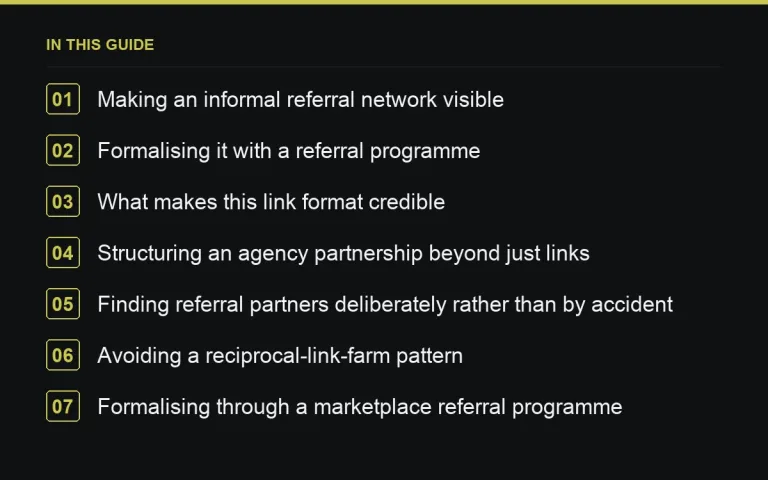
Making an informal referral network visible
- Maintain a simple “partners we recommend” or “specialists we work with” page listing agencies you genuinely refer work to, with a link to each.
- Ask referral partners to do the same — a reciprocal listing is a natural, low-effort ask given the relationship already exists.
- Keep the list current; an outdated referral page recommending an agency that’s since closed or changed focus undermines the credibility of the whole page.
Formalising it with a referral programme
Some agencies and platforms run a structured referral programme — a defined commission or reciprocal-work arrangement for sending qualified leads, sometimes with a public directory of participating referral partners. Marketplaces in adjacent services, including link-building and content marketplaces, often run exactly this kind of programme, giving agencies a clear structure and a public listing rather than relying on informal goodwill alone.
What makes this link format credible
Because referrals reflect genuine professional trust — an agency won’t refer a client to a partner they think will do bad work, since their own reputation is on the line — a referral listing carries more weight than a generic directory submission. This is the same underlying logic as the supplier and vendor relationships in https://successtoroad.com/blog/supplier-vendor-links/: the link exists because of a real, ongoing incentive that has nothing to do with search rankings.
Structuring an agency partnership beyond just links
- Define clearly what triggers a referral (client budget, project type, capacity, specialism mismatch) so both sides know when to send work the other way.
- Agree whether referral relationships involve any commission or fee-sharing arrangement, and put that in writing to avoid disputes later.
- Consider a joint case study or co-marketing piece (https://successtoroad.com/blog/co-marketing-campaigns/) if the referral relationship has produced a strong shared client outcome, subject to that client’s approval.
Finding referral partners deliberately rather than by accident
Most agency referral networks form organically, through personal relationships built over years at events or via mutual clients — which is exactly why they often stay small and undocumented. Building this deliberately means identifying two or three specialisms adjacent to your own that you regularly turn away or refer informally already, and formalising those relationships with an actual conversation rather than assuming the informal referral will keep happening on its own. Look at agencies serving the same client profile from a different angle — an SEO agency and a paid media agency, a web development shop and a copywriting studio — as natural starting points, and consider browsing relevant https://successtoroad.com/niche/marketing/ publisher and service listings on https://successtoroad.com/marketplace/ as one way to identify agencies active in adjacent specialisms worth a direct introduction.
Once a referral relationship is established, revisit it periodically rather than assuming it stays healthy indefinitely — agencies change focus, take on new specialisms, or get acquired, and a referral list that isn’t checked for a year or two often contains partners who no longer fit the criteria that made the relationship useful in the first place.
Avoiding a reciprocal-link-farm pattern
A small, tight-knit group of agencies that all list each other identically, with matching commercial anchor text, can start to look like the reciprocal-linking pattern flagged in https://successtoroad.com/blog/manipulative-partnership-links/, even when every referral is completely genuine. Keep referral pages varied in wording, and resist the temptation to add an agency to your recommended list purely because they added you to theirs — the list should reflect actual referral activity, not a link trade.
Formalising through a marketplace referral programme
If building bilateral relationships one at a time feels slow, a structured referral programme run by a relevant marketplace is a faster route to a similar outcome — a defined process, clear terms, and a public listing without needing to negotiate each relationship from first principles. This is a reasonable complement to, not a replacement for, the organic referral network you build through direct professional relationships over time.
Handling a referral relationship that turns commercially significant
Occasionally a referral relationship grows into something substantial enough — a steady, meaningful stream of client work in one direction — that it’s worth formalising with a clearer written agreement covering commission, exclusivity, and expectations, rather than continuing on the original informal basis indefinitely. Recognise when a relationship has crossed that threshold and raise the conversation proactively, rather than waiting for a dispute over an unclear expectation to force the issue.
Where to go next
Read https://successtoroad.com/blog/supplier-vendor-links/ for the closely related vendor-relationship version of this format, and https://successtoroad.com/blog/partnership-outreach-email-structure/ for approaching a new potential referral partner cold. If you’re building a referral network as part of a broader partnerships push, https://successtoroad.com/blog/partnership-link-building-guide/ covers where this fits among the other formats.
Frequently asked questions
Should agency referral listings include a commission arrangement?
It's common but not required — some agencies simply refer work informally out of professional courtesy, while others formalise it with a fee-sharing or commission structure. Decide and document it clearly either way.
How is this different from a reciprocal guest-post exchange?
The underlying relationship is different: referral partnerships exist because agencies genuinely send each other client work, whereas a guest exchange is purely a content and link arrangement. The referral relationship's substance is what keeps it from looking manipulative.
Can we join a marketplace's formal referral programme instead of building our own network?
Yes, and it's often a faster way to get a structured listing and clear terms than building bilateral relationships with individual agencies one at a time, especially if you're new to a market.
What if a referral partner starts sending us low-quality leads?
Address it directly and adjust the referral criteria agreed at the outset. A referral relationship that stops being mutually beneficial should be renegotiated or wound down rather than continued out of habit.
Put it into practice
Filter 54,483 websites by DR, traffic, niche and price, and order with escrow — you pay only after the link is live.
Browse the marketplace